
Science
Yale School of the Environment Celebrates 125 Years of Impact

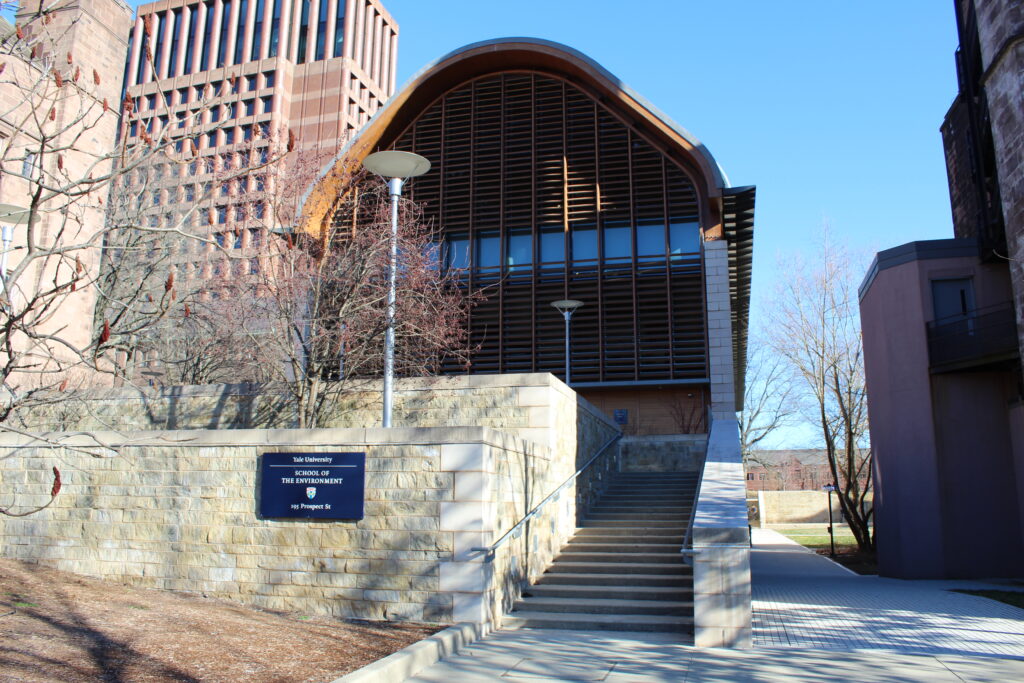
The Yale School of the Environment (YSE) is commemorating its 125th anniversary this year, marking a significant milestone in its commitment to environmental education and stewardship. Established in 1900, the institution has evolved from its origins as the Yale Forest School into a leading hub for environmental studies, producing over 5,800 graduates dedicated to conservation and sustainability.
Kroon Hall, the school’s contemporary home, exemplifies Yale’s dedication to sustainability, constructed from Quercus rubra red oaks harvested from the Yale Forests. The design utilizes natural materials and demonstrates energy efficiency, consuming 50 percent less energy than buildings of comparable size. This facility not only serves as a learning space but also embodies the school’s mission to nurture future environmental leaders.
Indy Burke, the Dean of the Yale School of the Environment, reflected on the anniversary’s significance in a recent email, noting, “Commemorating our 125th Anniversary has been a source of inspiration and hope for all of us who care deeply about the environment and our school community.” She highlighted the global impact of alumni, who occupy leadership roles in environmental policy across 80 countries.
The anniversary celebrations included a reunion weekend from October 24 to 26, drawing alumni back to campus. Terry Baker, president of the Alumni Association Board and a member of the class of 2007, described the event as “inspiring.” He remarked on the strong connections fostered among alumni and current students, emphasizing a collective commitment to a healthier planet.
The history of the school traces back to its founding on September 29, 1900, thanks to a donation from James Pinchot. His son, Gifford Pinchot, who was the first president of the school and a prominent figure in U.S. forestry, led the initial class consisting of just seven students. The school relocated to Sage Hall in 1923 following a substantial donation from William H. Sage, class of 1865.
By the time of its third decennial reunion in 1930, the school had expanded significantly, boasting a library of 30,000 forestry-related volumes and 1,300 acres of research forest land. The institution’s name transitioned to the Yale School of Forestry and Environmental Studies in 1972 to reflect its broader educational mission that now encompasses various environmental disciplines.
Alumni such as Bryan Garcia, class of 2000, illustrate the school’s impact on its graduates. After serving in the Peace Corps, Garcia became president and CEO of the Connecticut Green Bank, an organization dedicated to advancing the green economy. He described his time at YSE as transformative, stating, “I entered as an environmental education interested student, and I left as a multi-disciplinary thinker.” He acknowledged the diverse perspectives among his classmates, which enriched his educational experience.
Similarly, Charissa Leising, a graduate from 2013, transitioned from a focus on conservation biology to industrial ecologies, working with major companies such as Apple and Albertson’s on sustainability initiatives. “You have some of the most diverse and creative, innovative thinkers,” Leising noted, emphasizing the value of lifelong connections formed during her studies.
As YSE moves into its next 125 years, the commitment to addressing pressing environmental issues remains at the forefront. The school’s alumni continue to play pivotal roles in tackling challenges like climate change, deforestation, and biodiversity loss, reinforcing the institution’s legacy in fostering environmental leadership. The celebration of this milestone reflects not only on past achievements but also on the urgent work that lies ahead in ensuring a sustainable future for generations to come.

Cosmic Mystery Deepens: Where Are the Universe’s Defects?

Lady Bulldogs Shine in Postseason Awards Following Final Four Run

CALV Hosts Essential Class for Local Real Estate Professionals

Urgent Alert: “Spaving” Surges as Shoppers Overspend Online

Jefferies Initiates Coverage on Insmed with “Buy” Rating

Three Dog Night to Perform with Ambrosia at Mayo Civic Center

Urgent Announcement: Charles M. Payment Passes Away at 78

Houston Education Foundation Donates $4,592 for Student Programs

Beeks Financial Cloud Shares Drop 7% Amid Increased Trading Volume

Foreign Inflows into Japan Stocks Surge to ¥1.34 Trillion

University of Hawaiʻi Joins $25.6M AI Project to Monitor Disasters

Sydney Sweeney Embraces Body Positivity Amid Hollywood Challenges

Hudson Williams Gains Popularity as Breakout Star on Heated Rivalry

Urgent Farewell: Joleen Chaney Leaves Legacy at KFOR

Boeing’s Merger with McDonnell Douglas: A Strategic Move Explained

$1.25M Grant Advances Hawaiʻi’s Real-Time Hazard Monitoring

Derrick Dove and ABAC Band Set for Free Americana Concert

BOYNEXTDOOR’s Jaehyun Faces Backlash Amid BTS-TWICE Controversy
-
Business9 months ago
Foreign Inflows into Japan Stocks Surge to ¥1.34 Trillion
-
Science8 months ago
University of Hawaiʻi Joins $25.6M AI Project to Monitor Disasters
-
 Entertainment9 months ago
Sydney Sweeney Embraces Body Positivity Amid Hollywood Challenges
-
 Entertainment7 months ago
Hudson Williams Gains Popularity as Breakout Star on Heated Rivalry
-
 Top Stories8 months ago
Urgent Farewell: Joleen Chaney Leaves Legacy at KFOR
-
 World9 months ago
Boeing’s Merger with McDonnell Douglas: A Strategic Move Explained
-
 Science7 months ago
$1.25M Grant Advances Hawaiʻi’s Real-Time Hazard Monitoring
-
 Entertainment8 months ago
Derrick Dove and ABAC Band Set for Free Americana Concert
-
 Top Stories9 months ago
BOYNEXTDOOR’s Jaehyun Faces Backlash Amid BTS-TWICE Controversy
-

 Health6 months ago
Bodybuilder Eugene Teo Transitions to Mindful Movement for Health
-

 World6 months ago
San Francisco Airport to Host 16 Nonstop Airlines to Europe in 2026
-

 Top Stories7 months ago
National Coast Guard Museum Set to Open in 2027 After Funding Secured