
Science
U.S. Army Collaborates with University to Innovate Soldier Gear

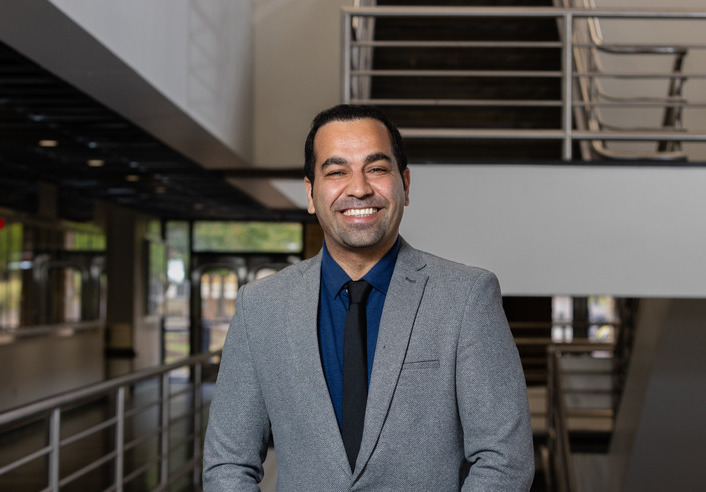
A research team at the University of Tulsa is embarking on an innovative project in partnership with the U.S. Army to develop advanced battery-powered solutions for military gear and uniforms. The initiative aims to create equipment that is not only safer and lighter but also more durable for soldiers in the field.
The project is led by Ahmad Amiri, Ph.D., an assistant professor of chemical and mechanical engineering. He is joined by co-principal investigators Andreas Polycarpou, Ph.D., the dean of the College of Engineering and Computer Science, and Jacob Meyer, Ph.D., the vice president of technology at ATSP Innovations. “Our joint team brings together expertise in materials science, battery technology, and advanced polymer manufacturing to make this next generation of energy storage possible,” Amiri stated.
The research grant results from years of foundational research and a strong track record of innovation in advanced battery materials among the team members. Each has extensive experience with structural and low-temperature batteries, having previously worked on projects with reputable organizations such as NASA, the U.S. National Science Foundation, and the Department of Defense.
“We proposed a concept that not only advances battery safety and performance but also recaptures how energy can be integrated into wearable systems,” Amiri explained. The grant was awarded based on the team’s technical innovation, feasibility, and interdisciplinary expertise.
Aligning with National Defense Goals
The funding from the Army aligns with the Pentagon’s priorities in advanced materials and microelectronics. The technology developed through this initiative has potential applications across various sectors, including defense, aerospace, consumer electronics, and medical wearables. Following the prototype phase, the team plans to collaborate with Army research centers and industry partners to scale up production.
Amiri expressed the significance of this achievement, highlighting the support from the Russell School of Chemical Engineering at the University of Tulsa, which has provided an ideal environment for his research efforts. He also acknowledged the dedication of his doctoral students—Akif Rahman, Hossein Shahali, and Shahnewaz Khan—as well as ATSP Innovations for its role in bridging academic research with practical industrial applications.
“Professionally, this project validates our team’s vision and the university’s growing role in advancing next-generation energy technologies,” Amiri noted. “Personally, it reinforces our passion for solving practical, high-impact problems that can directly benefit people, from improving soldiers’ safety and endurance to enabling more sustainable energy systems.”
Encouragement for Future Innovators
In reflecting on the journey ahead, Amiri offered advice to those inspired by his research. He emphasized the importance of perseverance in the face of challenges: “Stay focused on your goal and keep pushing forward, even when the path feels uncertain. Research can be challenging and unpredictable, but every obstacle teaches you something valuable. Keep powering your ‘battery’ with persistence and passion, and never give up.”
This collaboration between the University of Tulsa and the U.S. Army not only marks a step forward in military technology but also exemplifies the potential for academic institutions to drive innovation that has far-reaching impacts on society.

Cosmic Mystery Deepens: Where Are the Universe’s Defects?

Lady Bulldogs Shine in Postseason Awards Following Final Four Run

CALV Hosts Essential Class for Local Real Estate Professionals

Urgent Alert: “Spaving” Surges as Shoppers Overspend Online

Jefferies Initiates Coverage on Insmed with “Buy” Rating

Three Dog Night to Perform with Ambrosia at Mayo Civic Center

Urgent Announcement: Charles M. Payment Passes Away at 78

Houston Education Foundation Donates $4,592 for Student Programs

Beeks Financial Cloud Shares Drop 7% Amid Increased Trading Volume

Foreign Inflows into Japan Stocks Surge to ¥1.34 Trillion

University of Hawaiʻi Joins $25.6M AI Project to Monitor Disasters

Sydney Sweeney Embraces Body Positivity Amid Hollywood Challenges

Hudson Williams Gains Popularity as Breakout Star on Heated Rivalry

Urgent Farewell: Joleen Chaney Leaves Legacy at KFOR

Boeing’s Merger with McDonnell Douglas: A Strategic Move Explained

$1.25M Grant Advances Hawaiʻi’s Real-Time Hazard Monitoring

Derrick Dove and ABAC Band Set for Free Americana Concert

BOYNEXTDOOR’s Jaehyun Faces Backlash Amid BTS-TWICE Controversy
-
Business9 months ago
Foreign Inflows into Japan Stocks Surge to ¥1.34 Trillion
-
Science8 months ago
University of Hawaiʻi Joins $25.6M AI Project to Monitor Disasters
-
 Entertainment9 months ago
Sydney Sweeney Embraces Body Positivity Amid Hollywood Challenges
-
 Entertainment7 months ago
Hudson Williams Gains Popularity as Breakout Star on Heated Rivalry
-
 Top Stories8 months ago
Urgent Farewell: Joleen Chaney Leaves Legacy at KFOR
-
 World9 months ago
Boeing’s Merger with McDonnell Douglas: A Strategic Move Explained
-
 Science7 months ago
$1.25M Grant Advances Hawaiʻi’s Real-Time Hazard Monitoring
-
 Entertainment8 months ago
Derrick Dove and ABAC Band Set for Free Americana Concert
-
 Top Stories9 months ago
BOYNEXTDOOR’s Jaehyun Faces Backlash Amid BTS-TWICE Controversy
-

 Health6 months ago
Bodybuilder Eugene Teo Transitions to Mindful Movement for Health
-

 World6 months ago
San Francisco Airport to Host 16 Nonstop Airlines to Europe in 2026
-

 Top Stories7 months ago
National Coast Guard Museum Set to Open in 2027 After Funding Secured