
Science
Researchers Create Eco-Friendly Heat-Dissipating Material Using Egg Whites

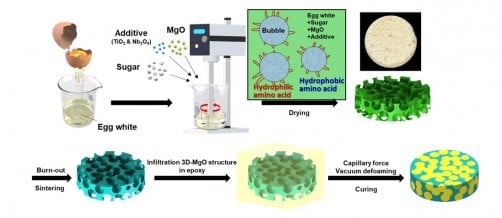
A research team led by Dr. Hyun-Ae Cha from the Korea Institute of Materials Science (KIMS) has developed a groundbreaking heat-dissipating composite material that combines eco-friendliness with cost-effective processing. Using an innovative protein foaming technique inspired by egg whites, the team created a three-dimensional magnesium oxide (MgO) structure that significantly enhances thermal conductivity, achieving levels up to 2.6 times higher than traditional materials.
As electronic devices continue to evolve, their heat generation increases, necessitating advanced thermal management solutions. This challenge is particularly critical for electric vehicles (EVs), where inadequate cooling can lead to performance issues, fires, or explosions. At the heart of effective thermal management systems is the Thermal Interface Material (TIM), which is essential for efficient heat dissipation. Conventional TIMs often rely on randomly dispersed thermally conductive fillers within a polymer matrix, but this method typically results in broken thermal pathways and limited performance.
To overcome these limitations, the team employed a protein foaming method to create a tightly interconnected particle structure. By utilizing the property of egg-white proteins that expand when heated, they successfully formed a three-dimensional network that allows for continuous thermal pathways. This innovative process resulted in a composite material with an impressive thermal conductivity of 17.19 W/m·K, demonstrating exceptional heat dissipation capabilities.
Another notable advantage of this new material is that it utilizes magnesium oxide, a lightweight and low-cost resource. The resulting composite outperformed widely used materials such as aluminum oxide (Al2O3) and nitride-based heat dissipation substances. Furthermore, by integrating the composite with epoxy resin, a polymer commonly used for thermal fillers, the team created a practical solution suitable for real-world applications.
This technology holds the potential to significantly improve the performance and stability of various devices that generate substantial heat, including electronic equipment, semiconductor packages, EV batteries, 5G communication devices, and high-performance servers. The domestic market for thermal interface materials in South Korea is estimated to exceed KRW 200 billion annually, yet it currently relies heavily on imports. The commercialization of this new technology is expected to enhance South Korea’s technological self-reliance in thermal management materials.
In her statement, Dr. Hyun-Ae Cha emphasized the environmental and economic benefits of this research: “Through the protein foaming-based process, we can produce high-thermal-conductivity materials in an eco-friendly and cost-effective way.” She highlighted that this study exemplifies the feasibility of developing lightweight, high-performance heat-dissipating materials.
The findings of this research were published on May 28, 2023, in the esteemed journal Advanced Science, where they were selected as the cover article for Volume 12, Issue 33. This research was funded by the Nano Materials Technology Development Program of the National Research Foundation of Korea (NRF).
KIMS, the institution behind this innovation, is a non-profit government-funded research institute under the Ministry of Science and ICT of the Republic of Korea. It specializes in materials technology and has played a crucial role in advancing the Korean industry through extensive research and development initiatives.

Cosmic Mystery Deepens: Where Are the Universe’s Defects?

Lady Bulldogs Shine in Postseason Awards Following Final Four Run

CALV Hosts Essential Class for Local Real Estate Professionals

Urgent Alert: “Spaving” Surges as Shoppers Overspend Online

Jefferies Initiates Coverage on Insmed with “Buy” Rating

Three Dog Night to Perform with Ambrosia at Mayo Civic Center

Urgent Announcement: Charles M. Payment Passes Away at 78

Houston Education Foundation Donates $4,592 for Student Programs

Beeks Financial Cloud Shares Drop 7% Amid Increased Trading Volume

Foreign Inflows into Japan Stocks Surge to ¥1.34 Trillion

University of Hawaiʻi Joins $25.6M AI Project to Monitor Disasters

Sydney Sweeney Embraces Body Positivity Amid Hollywood Challenges

Hudson Williams Gains Popularity as Breakout Star on Heated Rivalry

Urgent Farewell: Joleen Chaney Leaves Legacy at KFOR

Boeing’s Merger with McDonnell Douglas: A Strategic Move Explained

$1.25M Grant Advances Hawaiʻi’s Real-Time Hazard Monitoring

Derrick Dove and ABAC Band Set for Free Americana Concert

BOYNEXTDOOR’s Jaehyun Faces Backlash Amid BTS-TWICE Controversy
-
Business9 months ago
Foreign Inflows into Japan Stocks Surge to ¥1.34 Trillion
-
Science8 months ago
University of Hawaiʻi Joins $25.6M AI Project to Monitor Disasters
-
 Entertainment9 months ago
Sydney Sweeney Embraces Body Positivity Amid Hollywood Challenges
-
 Entertainment7 months ago
Hudson Williams Gains Popularity as Breakout Star on Heated Rivalry
-
 Top Stories8 months ago
Urgent Farewell: Joleen Chaney Leaves Legacy at KFOR
-
 World9 months ago
Boeing’s Merger with McDonnell Douglas: A Strategic Move Explained
-
 Science7 months ago
$1.25M Grant Advances Hawaiʻi’s Real-Time Hazard Monitoring
-
 Entertainment8 months ago
Derrick Dove and ABAC Band Set for Free Americana Concert
-
 Top Stories9 months ago
BOYNEXTDOOR’s Jaehyun Faces Backlash Amid BTS-TWICE Controversy
-

 Health6 months ago
Bodybuilder Eugene Teo Transitions to Mindful Movement for Health
-

 World6 months ago
San Francisco Airport to Host 16 Nonstop Airlines to Europe in 2026
-

 Top Stories7 months ago
National Coast Guard Museum Set to Open in 2027 After Funding Secured