
Science
Scientists Uncover Ancient Human Populations and Cosmic Wonders

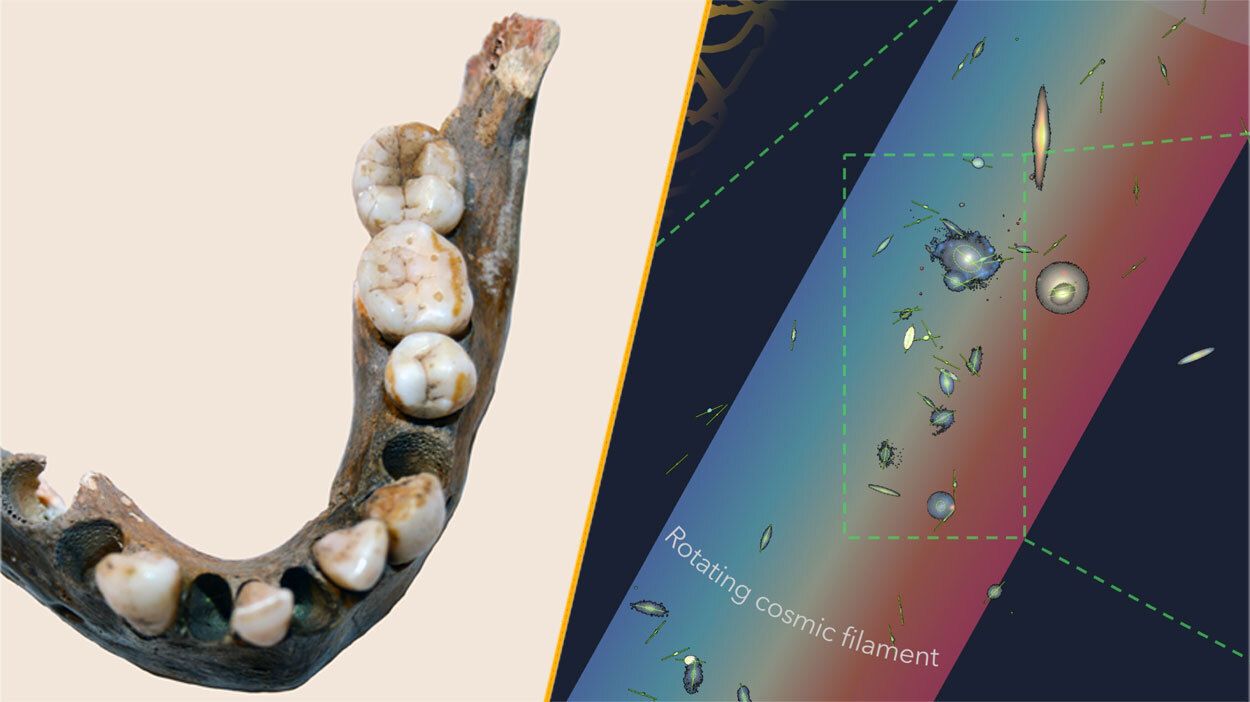
This week, significant advancements in science revealed astonishing findings about human history and cosmic phenomena. A team of researchers identified a human population in southern Africa that remained genetically isolated for an impressive 100,000 years. Meanwhile, astronomers discovered the largest spinning structure in the universe, located 140 million light-years away.
The groundbreaking study of ancient humans focused on skeletal remains found south of the Limpopo River, which flows from South Africa into Mozambique. Researchers examined skeletons dating back up to 10,000 years and concluded that these individuals displayed a markedly different genetic profile compared to modern humans. The findings suggest they represent an “extreme end of human genetic variation,” highlighting the diverse nature of human ancestry.
In a striking contrast, archaeologists in China made a puzzling discovery of a mass grave consisting of skulls at a site near a 4,000-year-old city. Intriguingly, nearly all the skulls belonged to males, deviating from the typical sacrificial patterns seen in nearby settlements. Additionally, a 2,700-year-old tomb in Greece raised eyebrows as it contained a female skeleton adorned with an upside-down crown, challenging previously held beliefs about burial customs.
Shifting focus to environmental concerns, a new analysis revealed unintended consequences from China’s long-standing Great Green Wall initiative aimed at combating desertification. While the massive tree-planting project initially succeeded, it inadvertently altered rainfall and evaporation patterns, resulting in reduced water levels in some of the country’s most densely populated areas.
In related climate news, researchers suggested that the world record for the highest temperature, recorded in Death Valley in 1913, might have stemmed from human error. Furthermore, the potential collapse of a vital Atlantic current could lead to prolonged drought conditions across Europe.
Exploring the cosmos, interstellar comet 3I/ATLAS has captivated scientists since its arrival in July. Recent observations using the Joan Oró Telescope at the Montsec Observatory in Spain revealed intriguing behavior as the comet heated up and brightened while approaching the sun. This phenomenon suggests that ice is sublimating from its surface, making it akin to other celestial objects in our solar system.
In a noteworthy technological advancement, engineers from the Massachusetts Institute of Technology (MIT) developed a novel method to extract drinking water from the air. This technique utilizes ultrasound to efficiently remove moisture, making it significantly more effective than traditional evaporation methods. The device, which requires a power source, could potentially be paired with solar cells to operate in arid regions.
As the week progresses, researchers continue to uncover remarkable insights into both our planet’s history and the vastness of space. The discoveries not only enhance our understanding of human evolution but also prompt discussions on environmental sustainability and technological innovation.

Cosmic Mystery Deepens: Where Are the Universe’s Defects?

Lady Bulldogs Shine in Postseason Awards Following Final Four Run

CALV Hosts Essential Class for Local Real Estate Professionals

Urgent Alert: “Spaving” Surges as Shoppers Overspend Online

Jefferies Initiates Coverage on Insmed with “Buy” Rating

Three Dog Night to Perform with Ambrosia at Mayo Civic Center

Urgent Announcement: Charles M. Payment Passes Away at 78

Houston Education Foundation Donates $4,592 for Student Programs

Beeks Financial Cloud Shares Drop 7% Amid Increased Trading Volume

Foreign Inflows into Japan Stocks Surge to ¥1.34 Trillion

University of Hawaiʻi Joins $25.6M AI Project to Monitor Disasters

Sydney Sweeney Embraces Body Positivity Amid Hollywood Challenges

Hudson Williams Gains Popularity as Breakout Star on Heated Rivalry

Urgent Farewell: Joleen Chaney Leaves Legacy at KFOR

Boeing’s Merger with McDonnell Douglas: A Strategic Move Explained

$1.25M Grant Advances Hawaiʻi’s Real-Time Hazard Monitoring

Derrick Dove and ABAC Band Set for Free Americana Concert

BOYNEXTDOOR’s Jaehyun Faces Backlash Amid BTS-TWICE Controversy
-
Business9 months ago
Foreign Inflows into Japan Stocks Surge to ¥1.34 Trillion
-
Science9 months ago
University of Hawaiʻi Joins $25.6M AI Project to Monitor Disasters
-
 Entertainment9 months ago
Sydney Sweeney Embraces Body Positivity Amid Hollywood Challenges
-
 Entertainment7 months ago
Hudson Williams Gains Popularity as Breakout Star on Heated Rivalry
-
 Top Stories8 months ago
Urgent Farewell: Joleen Chaney Leaves Legacy at KFOR
-
 World9 months ago
Boeing’s Merger with McDonnell Douglas: A Strategic Move Explained
-
 Science7 months ago
$1.25M Grant Advances Hawaiʻi’s Real-Time Hazard Monitoring
-
 Entertainment8 months ago
Derrick Dove and ABAC Band Set for Free Americana Concert
-
 Top Stories9 months ago
BOYNEXTDOOR’s Jaehyun Faces Backlash Amid BTS-TWICE Controversy
-

 Health6 months ago
Bodybuilder Eugene Teo Transitions to Mindful Movement for Health
-

 World6 months ago
San Francisco Airport to Host 16 Nonstop Airlines to Europe in 2026
-

 Top Stories7 months ago
National Coast Guard Museum Set to Open in 2027 After Funding Secured