
Science
Fermi Telescope Data Offers New Insight into Dark Matter

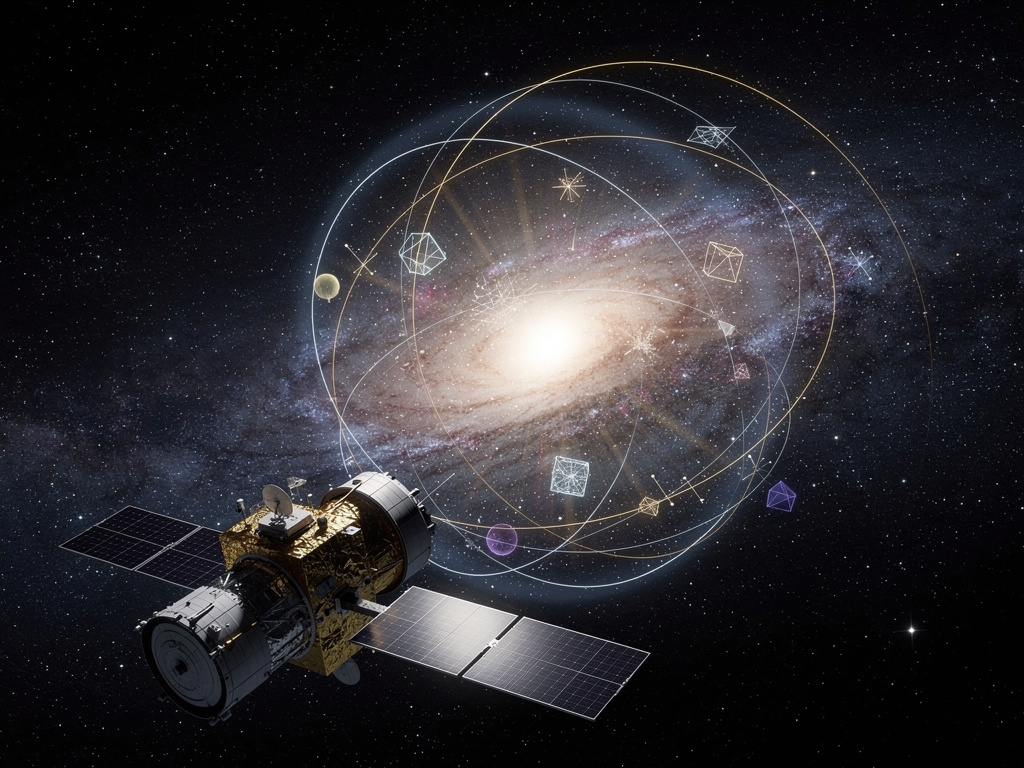
A recent analysis of data from NASA’s Fermi Gamma-ray Space Telescope has revealed what scientists believe to be a significant clue regarding dark matter. This analysis, led by astrophysicist Tomonori Totani from the University of Tokyo, indicates a halo of high-energy gamma rays emerging from the center of the Milky Way. This discovery aligns closely with theoretical predictions of dark matter particle interactions, suggesting it may represent a breakthrough in understanding the universe’s elusive composition, where dark matter is estimated to account for approximately 85% of all matter.
The research team examined over 15 years of observations from the Fermi telescope, identifying a spherical glow of gamma rays with energy peaks around 20 gigaelectronvolts (GeV). This energy profile corresponds with theoretical models of weakly interacting massive particles (WIMPs), which have long been considered prime candidates for dark matter. These particles, upon colliding and annihilating, are expected to generate detectable gamma rays, making this finding a promising lead in the ongoing quest to identify dark matter.
Implications for Cosmology and Particle Physics
The implications of this discovery extend beyond merely confirming dark matter’s existence. It challenges alternative theories such as modified Newtonian dynamics, which attempt to explain gravitational anomalies without invoking unseen matter. Should this signal be validated, it could reinforce the standard cosmological model known as Lambda-CDM, which includes dark matter and dark energy as fundamental components of the universe.
Industry experts in particle physics and astrophysics are abuzz with excitement, as findings like Totani’s could influence ongoing experiments at facilities such as CERN’s Large Hadron Collider. These experiments may gain new directions in the search for WIMPs, potentially leading to significant advancements in our understanding of fundamental forces and particles.
The Fermi telescope, operational since 2008, has been pivotal in mapping high-energy phenomena across the universe. Totani’s research concentrated on the galactic center, an area where dark matter is theorized to concentrate due to gravitational forces. The detected gamma-ray halo, which extends approximately 5,000 light-years from the center, exhibits a symmetry and energy spectrum that defies explanations from known astrophysical sources, such as pulsars or cosmic rays. This correlation with annihilation models offers what Totani describes as one of the most compelling leads in the pursuit of dark matter.
While some skeptics caution against premature conclusions, proposing alternative explanations such as emissions from millisecond pulsars, the halo’s unique characteristics suggest a strong link to dark matter. Previous detections, such as the 2012 gamma-ray excess, have prompted similar debates, with some attributing findings to dark matter while others dismissed them as pulsar activity. Totani’s analysis utilizes advanced statistical methods to refine these conclusions, potentially isolating the signal from background noise.
Future Exploration and Collaborative Efforts
Collaboration with other observatories could provide additional validation for these findings. The forthcoming Cherenkov Telescope Array is expected to deliver higher-resolution gamma-ray imaging, while underground detectors like LUX-ZEPLIN continue to search for WIMP-nucleon interactions. The convergence of ground-based and space-based efforts underscores a multidisciplinary approach, merging astronomy with particle physics to unravel this cosmic mystery.
The history of dark matter research stretches back to the 1930s when astronomer Fritz Zwicky first observed that galaxies in the Coma Cluster were moving at speeds that could not be explained by visible mass alone. This notion of “missing mass” has evolved into modern dark matter theory, supported by data from cosmic microwave background observations from satellites like Planck. The recent findings from the Fermi telescope may represent a pivotal moment in this long-standing investigation.
Public and scientific reactions reflect a blend of excitement and speculation. Social media discussions highlight the gamma-ray halo’s alignment with WIMP models, with some commentators referring to it as humanity’s first “sighting” of dark matter. This engagement illustrates a growing interest in the implications of such findings for our understanding of the universe, from galaxy formation to the nature of reality itself.
As validation processes unfold, including peer review and independent analyses, these findings will undergo rigorous scrutiny. If upheld, they could reshape funding priorities for future telescopes, emphasizing the need for enhanced gamma-ray observatories to delve deeper into galactic mysteries.
The implications of confirming WIMPs extend beyond astrophysics. It may refine models of the early universe, shedding light on structure formation following the Big Bang, and could intersect with studies of dark energy, as both components significantly influence the cosmos’s energy budget. Advancements in dark matter research can also spur innovations in detection technologies, benefiting fields such as medical imaging and cybersecurity.
The pursuit of understanding dark matter encapsulates humanity’s innate curiosity. Tomonori Totani and his team embody the meticulous analysis that drives progress in this field. As discussions continue and new technologies emerge, the quest for dark matter remains a thrilling frontier in modern science. Whether the gamma-ray halo proves to be dark matter’s signature or a sophisticated mimic, it advances our collective understanding of the universe, one gamma ray at a time.

Cosmic Mystery Deepens: Where Are the Universe’s Defects?

Lady Bulldogs Shine in Postseason Awards Following Final Four Run

CALV Hosts Essential Class for Local Real Estate Professionals

Urgent Alert: “Spaving” Surges as Shoppers Overspend Online

Jefferies Initiates Coverage on Insmed with “Buy” Rating

Three Dog Night to Perform with Ambrosia at Mayo Civic Center

Urgent Announcement: Charles M. Payment Passes Away at 78

Houston Education Foundation Donates $4,592 for Student Programs

Beeks Financial Cloud Shares Drop 7% Amid Increased Trading Volume

Foreign Inflows into Japan Stocks Surge to ¥1.34 Trillion

University of Hawaiʻi Joins $25.6M AI Project to Monitor Disasters

Sydney Sweeney Embraces Body Positivity Amid Hollywood Challenges

Hudson Williams Gains Popularity as Breakout Star on Heated Rivalry

Urgent Farewell: Joleen Chaney Leaves Legacy at KFOR

Boeing’s Merger with McDonnell Douglas: A Strategic Move Explained

$1.25M Grant Advances Hawaiʻi’s Real-Time Hazard Monitoring

Derrick Dove and ABAC Band Set for Free Americana Concert

BOYNEXTDOOR’s Jaehyun Faces Backlash Amid BTS-TWICE Controversy
-
Business9 months ago
Foreign Inflows into Japan Stocks Surge to ¥1.34 Trillion
-
Science9 months ago
University of Hawaiʻi Joins $25.6M AI Project to Monitor Disasters
-
 Entertainment9 months ago
Sydney Sweeney Embraces Body Positivity Amid Hollywood Challenges
-
 Entertainment7 months ago
Hudson Williams Gains Popularity as Breakout Star on Heated Rivalry
-
 Top Stories8 months ago
Urgent Farewell: Joleen Chaney Leaves Legacy at KFOR
-
 World9 months ago
Boeing’s Merger with McDonnell Douglas: A Strategic Move Explained
-
 Science7 months ago
$1.25M Grant Advances Hawaiʻi’s Real-Time Hazard Monitoring
-
 Entertainment8 months ago
Derrick Dove and ABAC Band Set for Free Americana Concert
-
 Top Stories9 months ago
BOYNEXTDOOR’s Jaehyun Faces Backlash Amid BTS-TWICE Controversy
-

 Health6 months ago
Bodybuilder Eugene Teo Transitions to Mindful Movement for Health
-

 World6 months ago
San Francisco Airport to Host 16 Nonstop Airlines to Europe in 2026
-

 Top Stories7 months ago
National Coast Guard Museum Set to Open in 2027 After Funding Secured