
Science
Astronomers Uncover Cosmic ‘Scar’ from Sun’s Close Encounter

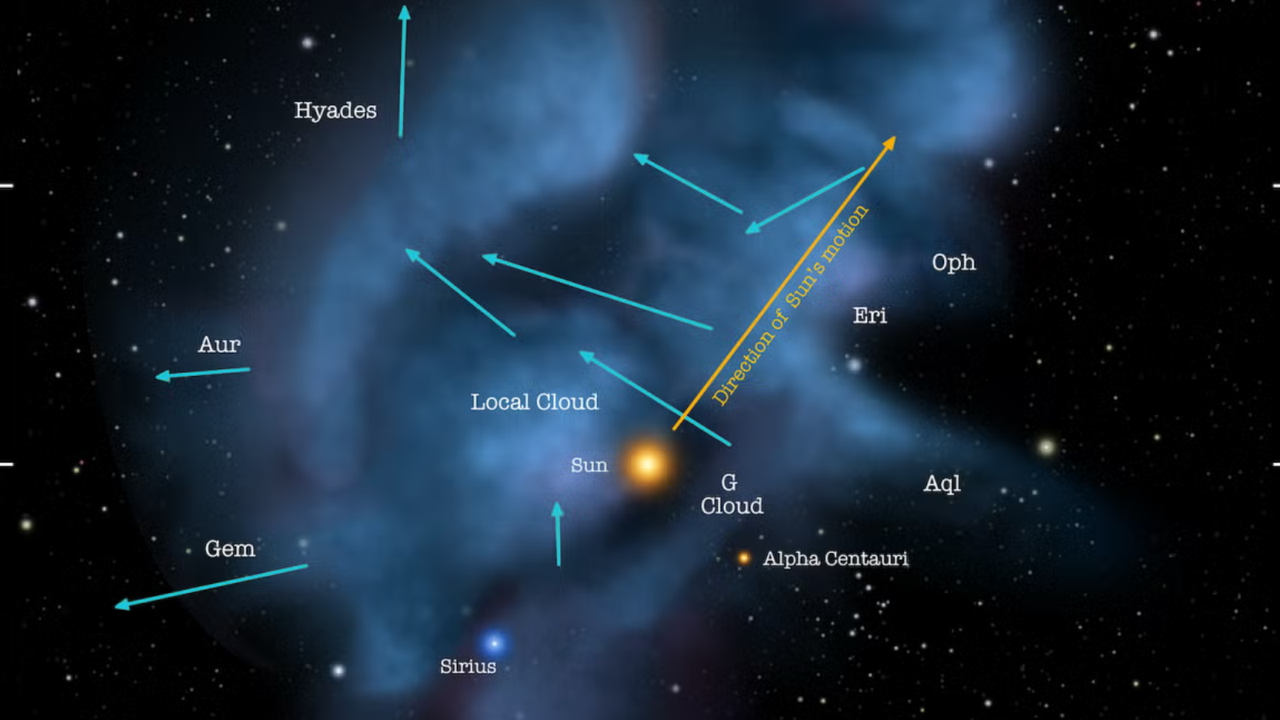
Astronomers have identified a significant cosmic event involving our sun, revealing that it had a near encounter with two massive stars approximately 4.4 million years ago. This interaction left a distinct “scar” in the surrounding interstellar clouds, which are composed of gas and dust just beyond the solar system. The findings not only enhance our understanding of the solar system’s immediate environment but also provide insights into how such cosmic events could have influenced the evolution of life on Earth.
To make this discovery, a team of scientists from the University of Colorado Boulder studied the movements of local interstellar clouds, which extend about 30 light-years. They tracked the sun’s path alongside the two intruder stars, now positioned about 400 light-years from Earth, located in the constellation Canis Major. The challenge arose from the sun’s own velocity, traveling at a remarkable 58,000 miles per hour (approximately 93,000 km/h), creating a complex scenario akin to a “jigsaw puzzle,” according to team leader Michael Shull.
The solar system is situated in a region of the Milky Way known as the “local hot bubble,” which is relatively free of gas and dust. Understanding these regions is crucial for comprehending the potential conditions that allowed life to thrive on Earth. “The fact that the sun is inside this set of clouds that can shield us from ionizing radiation may be an important piece of what makes Earth habitable today,” Shull remarked.
To investigate the effects of the close encounter, the team focused on two notable stars in Canis Major: Epsilon Canis Majoris, or Adhara, and Beta Canis Majoris, or Mirzam. The researchers concluded that these stars likely passed within 30 light-years of the sun, becoming significantly brighter than any stars currently visible from Earth. “Four to six times brighter than Sirius,” Shull explained, emphasizing their luminosity during that period.
Both stars are approximately 13 times more massive than the sun and possess surface temperatures reaching 45,000 degrees Fahrenheit (around 25,000 degrees Celsius). This extreme heat resulted in the emission of intense ultraviolet radiation, which ionized nearby atoms in the interstellar clouds. This ionization process stripped electrons from hydrogen and helium atoms, creating the “scar” detectable by astronomers today.
The research also addresses a long-standing query regarding the unusually high levels of ionization in local interstellar clouds, with findings indicating that about 20% of hydrogen atoms and 40% of helium atoms had been ionized. The team theorizes that the ionization could have been bolstered by at least four additional sources of ultraviolet radiation, including three white dwarf stars and the local hot bubble itself.
These regions of low density in the Milky Way were likely cleared by the supernova explosions of several stars, which contributed to heating the gas and facilitating the emission of ionizing radiation. While the ionization effect is not permanent, it is expected to fade as the hydrogen and helium atoms gradually regain their neutral charge over the course of a few million years.
Looking ahead, both Epsilon and Beta Canis Majoris are nearing the end of their short-lived existence. While the sun is expected to last another 5 billion years before transforming into a white dwarf, these massive stars are on a much quicker timeline. They are predicted to go supernova within the next few million years. Although they pose no direct threat to Earth, such an event would offer a spectacular display from a safe distance. “A supernova blowing up that close will light up the sky,” Shull noted, “but it won’t be lethal.”
The findings of this research were published in late November in The Astrophysical Journal, contributing valuable knowledge to the field of astronomy and deepening our understanding of the forces that shape our cosmic neighborhood.

Cosmic Mystery Deepens: Where Are the Universe’s Defects?

Lady Bulldogs Shine in Postseason Awards Following Final Four Run

CALV Hosts Essential Class for Local Real Estate Professionals

Urgent Alert: “Spaving” Surges as Shoppers Overspend Online

Jefferies Initiates Coverage on Insmed with “Buy” Rating

Three Dog Night to Perform with Ambrosia at Mayo Civic Center

Urgent Announcement: Charles M. Payment Passes Away at 78

Houston Education Foundation Donates $4,592 for Student Programs

Beeks Financial Cloud Shares Drop 7% Amid Increased Trading Volume

Foreign Inflows into Japan Stocks Surge to ¥1.34 Trillion

University of Hawaiʻi Joins $25.6M AI Project to Monitor Disasters

Sydney Sweeney Embraces Body Positivity Amid Hollywood Challenges

Hudson Williams Gains Popularity as Breakout Star on Heated Rivalry

Urgent Farewell: Joleen Chaney Leaves Legacy at KFOR

Boeing’s Merger with McDonnell Douglas: A Strategic Move Explained

$1.25M Grant Advances Hawaiʻi’s Real-Time Hazard Monitoring

Derrick Dove and ABAC Band Set for Free Americana Concert

BOYNEXTDOOR’s Jaehyun Faces Backlash Amid BTS-TWICE Controversy
-
Business9 months ago
Foreign Inflows into Japan Stocks Surge to ¥1.34 Trillion
-
Science9 months ago
University of Hawaiʻi Joins $25.6M AI Project to Monitor Disasters
-
 Entertainment9 months ago
Sydney Sweeney Embraces Body Positivity Amid Hollywood Challenges
-
 Entertainment7 months ago
Hudson Williams Gains Popularity as Breakout Star on Heated Rivalry
-
 Top Stories8 months ago
Urgent Farewell: Joleen Chaney Leaves Legacy at KFOR
-
 World9 months ago
Boeing’s Merger with McDonnell Douglas: A Strategic Move Explained
-
 Science7 months ago
$1.25M Grant Advances Hawaiʻi’s Real-Time Hazard Monitoring
-
 Entertainment8 months ago
Derrick Dove and ABAC Band Set for Free Americana Concert
-
 Top Stories9 months ago
BOYNEXTDOOR’s Jaehyun Faces Backlash Amid BTS-TWICE Controversy
-

 Health6 months ago
Bodybuilder Eugene Teo Transitions to Mindful Movement for Health
-

 World6 months ago
San Francisco Airport to Host 16 Nonstop Airlines to Europe in 2026
-

 Top Stories7 months ago
National Coast Guard Museum Set to Open in 2027 After Funding Secured