
Science
Time on Mars: New Research Reveals How Fast We Age There

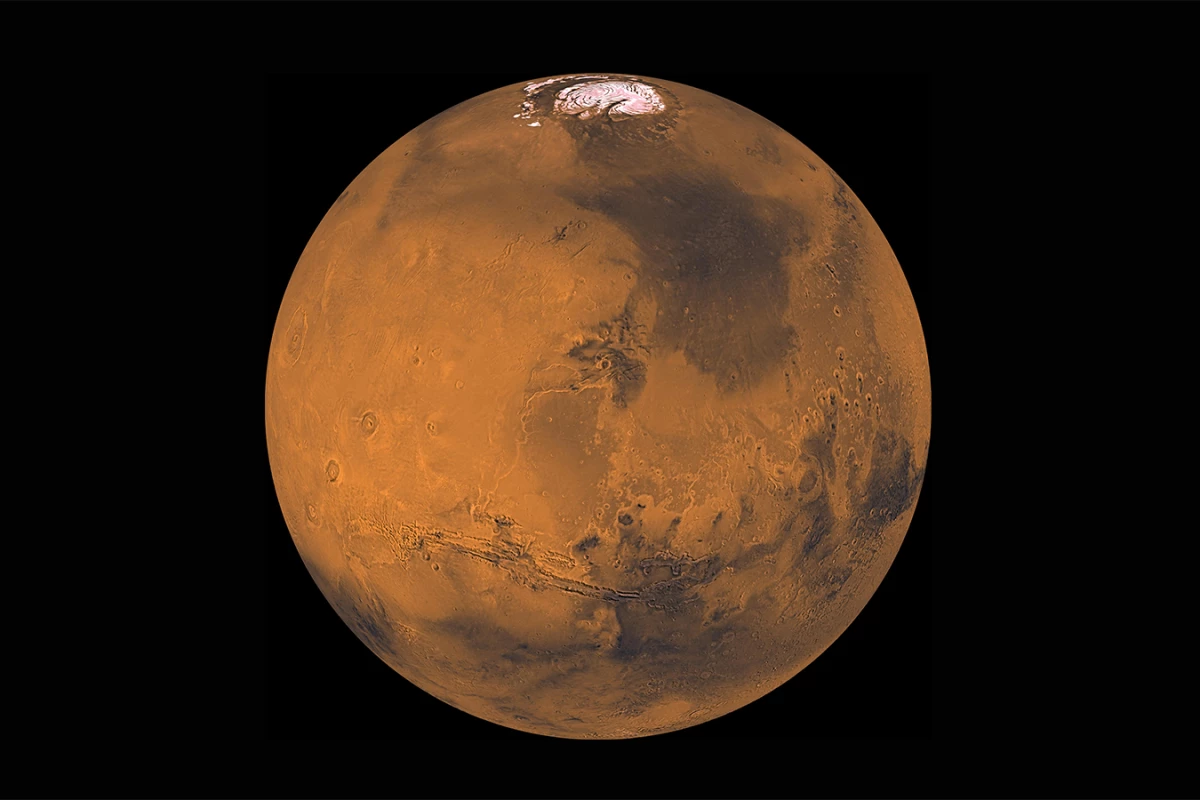
Traveling to Mars will not just be an adventure; it will also affect how time is experienced by astronauts. New research from the National Institute of Standards and Technology (NIST) indicates that time on Mars runs approximately 477 microseconds faster each day compared to Earth. This discrepancy arises from the effects of Einstein’s Theory of Relativity, which alters how we perceive time based on speed and gravitational influences.
Understanding relativity is not straightforward, as it involves complex mathematics. However, the fundamental concept is that time can pass at different rates depending on various factors, including velocity and gravitational pull. For instance, while a GPS satellite orbits Earth at about 17,500 mph (28,000 km/h), it experiences a time dilation effect, gaining about 38 microseconds every day compared to clocks on the ground.
The Challenges of Timekeeping on Mars
The research led by Neil Ashby and Bijunath Patla highlights that calculating time differences on Mars is significantly more complicated than on the Moon. This complexity arises from the gravitational influences of Earth, the Moon, and the Sun, alongside Mars itself. Unlike the Moon, which has a simpler gravitational relationship, Mars’s elliptical orbit around the Sun causes its speed to vary throughout its year, adding another layer of complexity to the calculations.
The findings indicate that time on Mars fluctuates by 266 microseconds over the course of its year. Such variability presents challenges for future missions, especially as plans for human colonization of Mars develop. If not properly accounted for, these time discrepancies could lead to significant errors in navigation and communication systems, potentially stranding astronauts or misdirecting equipment.
The Implications for Space Exploration
As humanity seeks to expand its presence in space, understanding how time operates on other celestial bodies becomes increasingly vital. For Mars, the implications are profound. A miscalculation of just 89 miles (143 km) per day could result from these temporal differences. The research emphasizes the need for a dynamic system to adjust for these variations continuously, ensuring accurate data transmission and reception.
“It’s good to know for the first time what is happening on Mars timewise,” said Ashby. “Nobody knew that before. It improves our knowledge of the theory itself, the theory of how clocks tick and relativity.” The research underscores that while the concepts of time and relativity may seem simple, their practical applications in space travel are anything but straightforward.
Published in The Astronomical Journal, this research represents a significant step in understanding the complexities of timekeeping in our solar system. As missions to Mars become more frequent, addressing these challenges will be crucial for the success of human exploration beyond Earth.

Cosmic Mystery Deepens: Where Are the Universe’s Defects?

Lady Bulldogs Shine in Postseason Awards Following Final Four Run

CALV Hosts Essential Class for Local Real Estate Professionals

Urgent Alert: “Spaving” Surges as Shoppers Overspend Online

Jefferies Initiates Coverage on Insmed with “Buy” Rating

Three Dog Night to Perform with Ambrosia at Mayo Civic Center

Urgent Announcement: Charles M. Payment Passes Away at 78

Houston Education Foundation Donates $4,592 for Student Programs

Beeks Financial Cloud Shares Drop 7% Amid Increased Trading Volume

Foreign Inflows into Japan Stocks Surge to ¥1.34 Trillion

University of Hawaiʻi Joins $25.6M AI Project to Monitor Disasters

Sydney Sweeney Embraces Body Positivity Amid Hollywood Challenges

Hudson Williams Gains Popularity as Breakout Star on Heated Rivalry

Urgent Farewell: Joleen Chaney Leaves Legacy at KFOR

Boeing’s Merger with McDonnell Douglas: A Strategic Move Explained

$1.25M Grant Advances Hawaiʻi’s Real-Time Hazard Monitoring

Derrick Dove and ABAC Band Set for Free Americana Concert

BOYNEXTDOOR’s Jaehyun Faces Backlash Amid BTS-TWICE Controversy
-
Business9 months ago
Foreign Inflows into Japan Stocks Surge to ¥1.34 Trillion
-
Science9 months ago
University of Hawaiʻi Joins $25.6M AI Project to Monitor Disasters
-
 Entertainment9 months ago
Sydney Sweeney Embraces Body Positivity Amid Hollywood Challenges
-
 Entertainment7 months ago
Hudson Williams Gains Popularity as Breakout Star on Heated Rivalry
-
 Top Stories8 months ago
Urgent Farewell: Joleen Chaney Leaves Legacy at KFOR
-
 World9 months ago
Boeing’s Merger with McDonnell Douglas: A Strategic Move Explained
-
 Science7 months ago
$1.25M Grant Advances Hawaiʻi’s Real-Time Hazard Monitoring
-
 Entertainment8 months ago
Derrick Dove and ABAC Band Set for Free Americana Concert
-
 Top Stories9 months ago
BOYNEXTDOOR’s Jaehyun Faces Backlash Amid BTS-TWICE Controversy
-

 Health6 months ago
Bodybuilder Eugene Teo Transitions to Mindful Movement for Health
-

 World6 months ago
San Francisco Airport to Host 16 Nonstop Airlines to Europe in 2026
-

 Top Stories7 months ago
National Coast Guard Museum Set to Open in 2027 After Funding Secured