
Science
New Grading System Enhances Prognosis for Pancreatic Cancer Patients

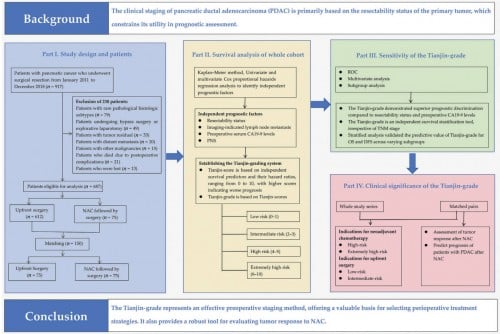
Pancreatic ductal adenocarcinoma (PDAC), one of the most aggressive forms of cancer, poses significant challenges for treatment and prognosis. A new grading system, developed by researchers at the Tianjin Medical University Cancer Institute & Hospital, aims to improve patient outcomes by combining anatomical and biological factors with individual patient conditions. This innovative approach addresses the limitations of traditional staging methods, offering a more comprehensive assessment for those affected by this formidable disease.
The Tianjin Grading System, published in Cancer Biology & Medicine in 2025, enhances risk stratification through the inclusion of key indicators such as lymph node metastasis and levels of the biomarker CA19-9. By utilizing a cohort of 687 PDAC patients who underwent surgical resection, the researchers have created a grading system that classifies patients into four risk categories: low-risk (0-1), intermediate-risk (2-3), high-risk (4-5), and extremely high-risk (6-10). Each category correlates with significantly different survival outcomes.
The traditional TNM classification system, which primarily focuses on anatomical factors, has proven insufficient for accurately predicting patient survival. The Tianjin Grading System takes a more holistic approach, integrating tumor resectability, imaging-detected lymph node metastasis, serum markers like CA19-9, and the Prognostic Nutritional Score (PNS). This multi-dimensional method enhances clinical decision-making and allows for personalized treatment strategies.
According to Dr. Jihui Hao, one of the lead researchers, “The Tianjin Grading System offers a more accurate way of predicting outcomes for PDAC patients by integrating not just anatomical factors but also biological and patient-specific conditions.” This innovative system helps identify which patients are most likely to benefit from aggressive treatments, such as neoadjuvant chemotherapy (NAC), thereby improving the overall efficacy of care.
The study revealed that patients categorized as high-risk and extremely high-risk experienced significant benefits from NAC, emphasizing the importance of tailored treatment plans. The ability to classify patients effectively not only aids in determining the appropriate timing for surgery but also prevents low-risk patients from being subjected to unnecessary treatments.
Accessibility is a key feature of the Tianjin Grading System, as it relies on standard imaging and laboratory tests. This practicality makes it applicable in various clinical settings, even those with limited resources, thus setting a new standard in personalized pancreatic cancer care. The study’s findings underline the necessity for ongoing research into integrating biological markers into preoperative assessments, which can enhance prognosis and inform treatment options.
The development of this grading system was supported by the Tianjin Natural Science Foundation, and its implications extend far beyond the immediate patient population in China. By providing a more nuanced understanding of PDAC, the Tianjin Grading System promises to improve survival rates and quality of care globally.
As research continues to evolve, this system may pave the way for further advancements in the management of pancreatic cancer, ultimately leading to better patient outcomes and more effective therapeutic strategies. The findings highlight the critical need for innovative approaches in the fight against one of the deadliest forms of cancer.
For more detailed information, refer to the published study at DOI: 10.20892/j.issn.2095-3941.2025.0213.

Cosmic Mystery Deepens: Where Are the Universe’s Defects?

Lady Bulldogs Shine in Postseason Awards Following Final Four Run

CALV Hosts Essential Class for Local Real Estate Professionals

Urgent Alert: “Spaving” Surges as Shoppers Overspend Online

Jefferies Initiates Coverage on Insmed with “Buy” Rating

Three Dog Night to Perform with Ambrosia at Mayo Civic Center

Urgent Announcement: Charles M. Payment Passes Away at 78

Houston Education Foundation Donates $4,592 for Student Programs

Beeks Financial Cloud Shares Drop 7% Amid Increased Trading Volume

Foreign Inflows into Japan Stocks Surge to ¥1.34 Trillion

University of Hawaiʻi Joins $25.6M AI Project to Monitor Disasters

Sydney Sweeney Embraces Body Positivity Amid Hollywood Challenges

Hudson Williams Gains Popularity as Breakout Star on Heated Rivalry

Urgent Farewell: Joleen Chaney Leaves Legacy at KFOR

Boeing’s Merger with McDonnell Douglas: A Strategic Move Explained

$1.25M Grant Advances Hawaiʻi’s Real-Time Hazard Monitoring

Derrick Dove and ABAC Band Set for Free Americana Concert

BOYNEXTDOOR’s Jaehyun Faces Backlash Amid BTS-TWICE Controversy
-
Business9 months ago
Foreign Inflows into Japan Stocks Surge to ¥1.34 Trillion
-
Science9 months ago
University of Hawaiʻi Joins $25.6M AI Project to Monitor Disasters
-
 Entertainment9 months ago
Sydney Sweeney Embraces Body Positivity Amid Hollywood Challenges
-
 Entertainment8 months ago
Hudson Williams Gains Popularity as Breakout Star on Heated Rivalry
-
 Top Stories9 months ago
Urgent Farewell: Joleen Chaney Leaves Legacy at KFOR
-
 World9 months ago
Boeing’s Merger with McDonnell Douglas: A Strategic Move Explained
-
 Science8 months ago
$1.25M Grant Advances Hawaiʻi’s Real-Time Hazard Monitoring
-
 Entertainment8 months ago
Derrick Dove and ABAC Band Set for Free Americana Concert
-
 Top Stories9 months ago
BOYNEXTDOOR’s Jaehyun Faces Backlash Amid BTS-TWICE Controversy
-

 Health6 months ago
Bodybuilder Eugene Teo Transitions to Mindful Movement for Health
-

 World7 months ago
San Francisco Airport to Host 16 Nonstop Airlines to Europe in 2026
-

 Top Stories7 months ago
National Coast Guard Museum Set to Open in 2027 After Funding Secured