
Lifestyle
Glasgow’s Lion Chambers Faces Decline Amid Preservation Efforts

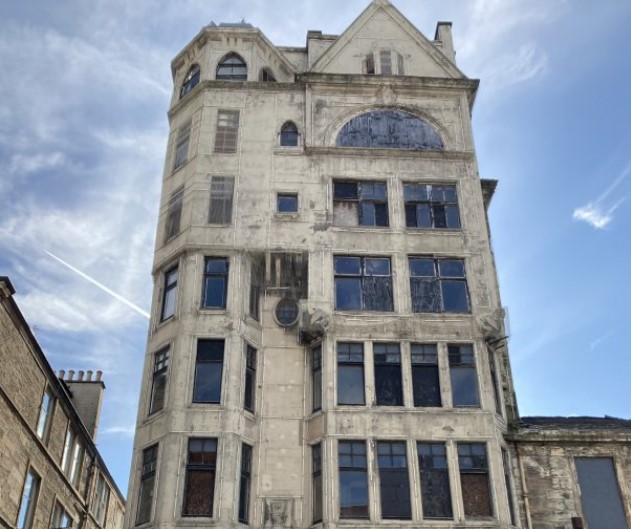
The Lion Chambers, a notable Glasgow landmark, is experiencing significant decline as preservation efforts struggle to rectify its deteriorating condition. Located at 172 Hope Street, the building was commissioned in the early 20th century by William George Black, a lawyer with deep ties to the city’s artistic community. Designed by architect James Salmon Jnr, Lion Chambers was intended to be a modern commercial tower, combining legal offices on its lower floors with art studio spaces above.
Construction of Lion Chambers began in 1904 and was completed in 1907. Its innovative design featured large windows on the upper levels, allowing natural light to inspire creativity among artists. The building was recognized for its architectural and historical importance, receiving Category A listing in 1966, which is the highest level of protection in Scotland for structures of national or international significance.
By the 1990s, however, Lion Chambers faced mounting challenges. Reports indicated that the building’s condition had severely deteriorated, raising concerns about safety and structural integrity. In 1995, a dangerous buildings order was issued, leading to the clearance of the upper floors. Public safety measures were implemented to address the risk of falling debris, marking the beginning of a long struggle to preserve this iconic structure.
Efforts to restore Lion Chambers have been complicated by financial constraints and ownership issues. Various proposals for repair and reuse have been explored, but the building has consistently appeared on at-risk registers. The complex requirements for reinforced concrete repair, weatherproofing, and fabric conservation have made it difficult to establish a sustainable plan for the building’s future.
To gain insights into the building’s state, Scott Abercrombie, Associate Director at John Gilbert Architects, visited Lion Chambers in 2019 in collaboration with the Four Acres Trust and other conservation professionals. He noted that while structural issues could be addressed, there is a significant gap in conservation funding compared to the potential value of the property.
The upper floors are now largely abandoned, with issues exacerbated by vandalism and the presence of pigeons. Lead has been stolen from the roof, windows are missing, and graffiti mars the exterior. These factors contribute to the ongoing decline of a building that once served as a vibrant hub for lawyers and artists alike.
The future of Lion Chambers hinges on critical decisions regarding Glasgow’s architectural heritage. As city officials contemplate the fate of this historic site, they must weigh the costs and benefits of investing in its restoration against the backdrop of a rapidly changing urban landscape.
As Abercrombie succinctly put it, “Cash is king.” The implications of choosing to revitalize or abandon such structures extend beyond mere aesthetics; they shape the identity of Glasgow and reflect the value placed on its historical legacy. The clock is ticking for Lion Chambers, and the choices made this year could determine whether this landmark is given a new lease on life or left to fade into obscurity.

Cosmic Mystery Deepens: Where Are the Universe’s Defects?

Lady Bulldogs Shine in Postseason Awards Following Final Four Run

CALV Hosts Essential Class for Local Real Estate Professionals

Urgent Alert: “Spaving” Surges as Shoppers Overspend Online

Jefferies Initiates Coverage on Insmed with “Buy” Rating

Three Dog Night to Perform with Ambrosia at Mayo Civic Center

Urgent Announcement: Charles M. Payment Passes Away at 78

Houston Education Foundation Donates $4,592 for Student Programs

Beeks Financial Cloud Shares Drop 7% Amid Increased Trading Volume

Foreign Inflows into Japan Stocks Surge to ¥1.34 Trillion

University of Hawaiʻi Joins $25.6M AI Project to Monitor Disasters

Sydney Sweeney Embraces Body Positivity Amid Hollywood Challenges

Hudson Williams Gains Popularity as Breakout Star on Heated Rivalry

Urgent Farewell: Joleen Chaney Leaves Legacy at KFOR

Boeing’s Merger with McDonnell Douglas: A Strategic Move Explained

$1.25M Grant Advances Hawaiʻi’s Real-Time Hazard Monitoring

Derrick Dove and ABAC Band Set for Free Americana Concert

BOYNEXTDOOR’s Jaehyun Faces Backlash Amid BTS-TWICE Controversy
-
Business9 months ago
Foreign Inflows into Japan Stocks Surge to ¥1.34 Trillion
-
Science9 months ago
University of Hawaiʻi Joins $25.6M AI Project to Monitor Disasters
-
 Entertainment9 months ago
Sydney Sweeney Embraces Body Positivity Amid Hollywood Challenges
-
 Entertainment7 months ago
Hudson Williams Gains Popularity as Breakout Star on Heated Rivalry
-
 Top Stories8 months ago
Urgent Farewell: Joleen Chaney Leaves Legacy at KFOR
-
 World9 months ago
Boeing’s Merger with McDonnell Douglas: A Strategic Move Explained
-
 Science7 months ago
$1.25M Grant Advances Hawaiʻi’s Real-Time Hazard Monitoring
-
 Entertainment8 months ago
Derrick Dove and ABAC Band Set for Free Americana Concert
-
 Top Stories9 months ago
BOYNEXTDOOR’s Jaehyun Faces Backlash Amid BTS-TWICE Controversy
-

 Health6 months ago
Bodybuilder Eugene Teo Transitions to Mindful Movement for Health
-

 World6 months ago
San Francisco Airport to Host 16 Nonstop Airlines to Europe in 2026
-

 Top Stories7 months ago
National Coast Guard Museum Set to Open in 2027 After Funding Secured