
Business
Trump Pushes for Venezuelan Oil as China Shifts to Clean Energy

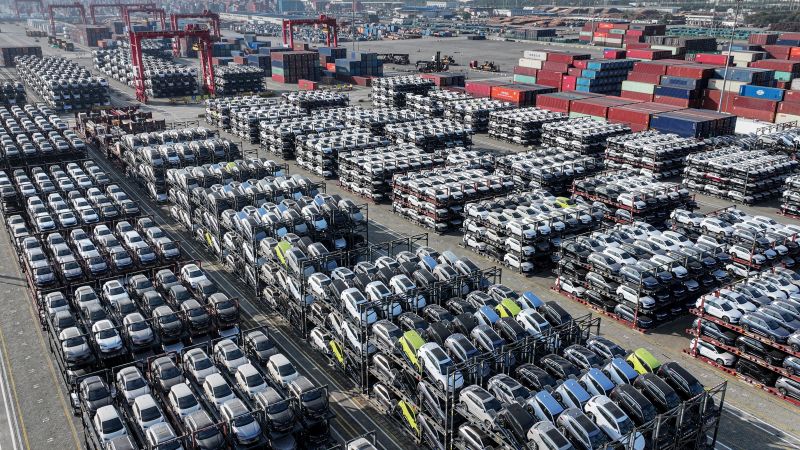
President Donald Trump is advocating for the United States to take control of Venezuela’s oil resources. This initiative comes at a time when Venezuela’s largest oil customer, China, is rapidly transitioning to clean energy solutions, particularly electric vehicles (EVs). As a result, experts suggest that China’s demand for Venezuelan oil may diminish significantly, despite the current level of imports.
China has historically been one of Venezuela’s largest oil customers, importing approximately 400,000-500,000 barrels per day. However, with the country’s swift move towards EV adoption, its reliance on oil is likely to decrease. According to research by UK firm Rho Motion, over 11 million out of 18.5 million electric vehicles sold globally last year were purchased in China. This shift indicates that analysts believe China may have already reached or will soon reach its “peak oil” consumption.
In response to Trump’s request, the Trump administration has communicated to Venezuela’s interim president, Delcy Rodriguez, that the nation must sever ties with China, Iran, Russia, and Cuba, opting instead to collaborate exclusively with the United States on oil production. In a statement issued on September 19, 2023, Chinese foreign ministry spokesperson Mao Ning condemned these actions as “bullying” and argued that they violate international law.
China’s evolving energy needs have significant implications for the global oil market, as it remains the world’s largest oil importer. The current U.S. military operations in Venezuela, aimed at revitalizing the country’s oil infrastructure, may not disrupt China’s oil supplies as it can turn to other suppliers, such as Russia or Iran. According to Janiv Shah, a vice president at Norwegian energy firm Rystad, any reduction in Venezuelan oil imports could lead China to pivot towards other discounted oil sources.
Venezuela’s reliance on China for its oil market has become increasingly evident. As Li Shuo, director of the China climate hub at the Asia Society Policy Institute, states, “Venezuela is very much reliant on China as a market; there is no question about that.” In the long term, U.S. intervention might only serve to reinforce China’s efforts towards energy independence, as it aims to reduce dependence on foreign oil sources.
China is not just focusing on transitioning to electric vehicles; it is also enhancing its renewable energy capacity. Recent data from Global Energy Monitor reveals that China is constructing 510 gigawatts of utility-scale solar and wind capacity, building upon the already impressive 1,400 gigawatts in operation. In September 2023, China committed to increasing its renewable energy output to 3,600 gigawatts by 2025, marking a significant expansion of its clean energy initiatives.
The contrasting energy strategies of the U.S. and China underscore a growing divide. While China accelerates its transition to renewable energy, the U.S. appears focused on maintaining its status as a petrostate. As Shuo notes, “The largest economy in the world is embracing a petrostate approach,” emphasizing that the U.S. is increasingly moving backwards in the energy transition while willing to deploy military force to secure its interests.
In conclusion, as the global energy landscape shifts towards sustainability, Venezuela’s fate in the oil market remains uncertain. With China’s demand for oil on a downward trend, the implications of U.S. intervention in Venezuela could reshape not only the country’s economy but also its relationship with major powers like China.

Cosmic Mystery Deepens: Where Are the Universe’s Defects?

Lady Bulldogs Shine in Postseason Awards Following Final Four Run

CALV Hosts Essential Class for Local Real Estate Professionals

Urgent Alert: “Spaving” Surges as Shoppers Overspend Online

Jefferies Initiates Coverage on Insmed with “Buy” Rating

Three Dog Night to Perform with Ambrosia at Mayo Civic Center

Urgent Announcement: Charles M. Payment Passes Away at 78

Houston Education Foundation Donates $4,592 for Student Programs

Beeks Financial Cloud Shares Drop 7% Amid Increased Trading Volume

Foreign Inflows into Japan Stocks Surge to ¥1.34 Trillion

University of Hawaiʻi Joins $25.6M AI Project to Monitor Disasters

Sydney Sweeney Embraces Body Positivity Amid Hollywood Challenges

Hudson Williams Gains Popularity as Breakout Star on Heated Rivalry

Urgent Farewell: Joleen Chaney Leaves Legacy at KFOR

Boeing’s Merger with McDonnell Douglas: A Strategic Move Explained

$1.25M Grant Advances Hawaiʻi’s Real-Time Hazard Monitoring

Derrick Dove and ABAC Band Set for Free Americana Concert

BOYNEXTDOOR’s Jaehyun Faces Backlash Amid BTS-TWICE Controversy
-
Business9 months ago
Foreign Inflows into Japan Stocks Surge to ¥1.34 Trillion
-
Science9 months ago
University of Hawaiʻi Joins $25.6M AI Project to Monitor Disasters
-
 Entertainment9 months ago
Sydney Sweeney Embraces Body Positivity Amid Hollywood Challenges
-
 Entertainment8 months ago
Hudson Williams Gains Popularity as Breakout Star on Heated Rivalry
-
 Top Stories9 months ago
Urgent Farewell: Joleen Chaney Leaves Legacy at KFOR
-
 World9 months ago
Boeing’s Merger with McDonnell Douglas: A Strategic Move Explained
-
 Science8 months ago
$1.25M Grant Advances Hawaiʻi’s Real-Time Hazard Monitoring
-
 Entertainment8 months ago
Derrick Dove and ABAC Band Set for Free Americana Concert
-
 Top Stories9 months ago
BOYNEXTDOOR’s Jaehyun Faces Backlash Amid BTS-TWICE Controversy
-

 Health6 months ago
Bodybuilder Eugene Teo Transitions to Mindful Movement for Health
-

 World6 months ago
San Francisco Airport to Host 16 Nonstop Airlines to Europe in 2026
-

 Top Stories7 months ago
National Coast Guard Museum Set to Open in 2027 After Funding Secured