
Science
Researchers Capture Shockwave in Water to Revolutionize Fusion

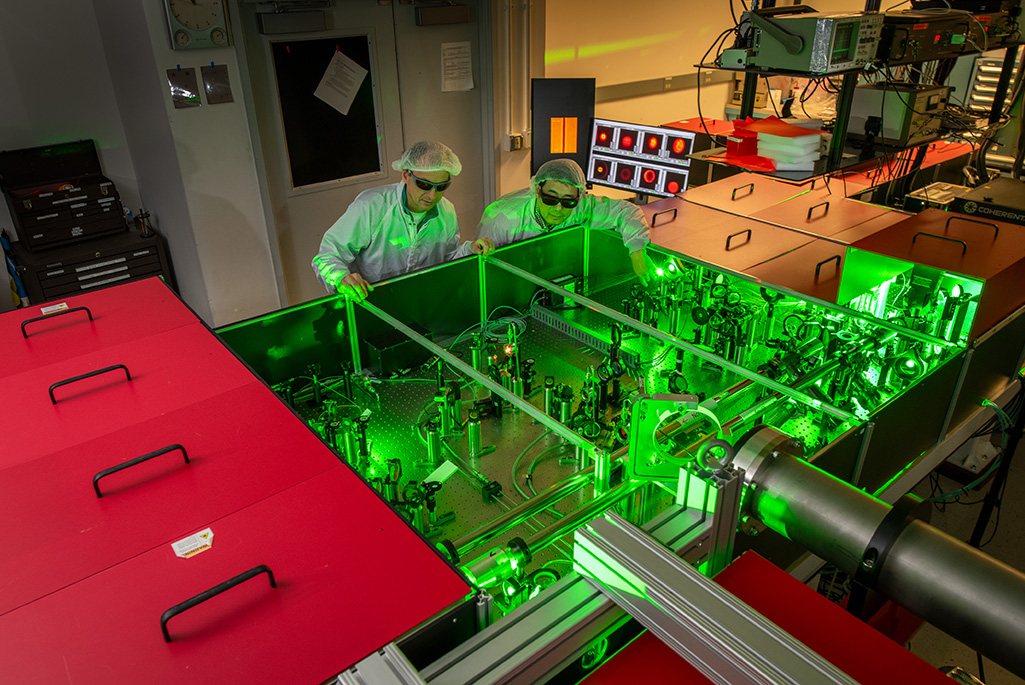
A groundbreaking experiment conducted by researchers at the Lawrence Berkeley National Laboratory has revealed new insights into shockwaves, potentially advancing fusion energy research. For the first time, scientists employed ultrafast X-rays and electron beams to simultaneously image a shockwave moving through water. This innovative “multi-messenger” approach unveiled details that previous studies had missed, including an unexpected layer of water vapor that contributed to the symmetry of the shockwave.
The study, published on December 16, 2025, in the journal Nature Communications, underscores the potential of small-scale systems known as laser-plasma accelerators to enhance our understanding of the microphysics involved in fusion reactions. Fusion, the process that powers our sun, occurs when hydrogen atoms merge to form helium, releasing energy in the process. Researchers aim to replicate this phenomenon on Earth to provide a sustainable and abundant energy source.
In inertial confinement fusion (ICF), scientists direct lasers at a fuel-filled capsule, generating shockwaves that heat and compress the target, initiating fusion. Understanding the complex interactions at play during these events is critical for improving control over the process. The team from the University of Michigan, which led the research through the Department of Energy’s LaserNetUS program, collaborated with experts from the Berkeley Lab’s Accelerator Technology & Applied Physics (ATAP) Division and additional institutions.
The experiment utilized a flowing jet of water, equivalent in size to a human hair, as a novel target. This required extensive engineering to maintain the water stream’s integrity in a vacuum environment. Unlike traditional solid targets that need replacement after each interaction, the flowing water allowed for rapid and repeated laser firings, significantly increasing experimental efficiency.
Researchers used a laser-plasma accelerator to create ultrafast X-rays and high-energy electron beams, which then captured the shockwave’s evolution through the water. The ability to adjust the timing between the two laser pulses enabled the team to compile a high-speed “movie” of the shockwave as it moved through the jet.
Initially, observations from the X-ray images presented unexpected results. According to Hai-En Tsai, a research scientist in ATAP, the discrepancies between the simulations and experimental data prompted further investigation. In follow-up experiments conducted in 2020 and 2023, the team integrated an electron probe with the X-ray imaging, unveiling a thin layer of water vapor that cushioned the shockwave and enhanced its symmetry. This phenomenon closely resembles conditions in certain ICF targets, where a low-density foam layer promotes uniform compression critical for successful fusion.
The implications of this research are significant. It opens new avenues for small- and mid-scale experiments that can refine existing models and inform the design of more effective fusion systems. Cameron Geddes, director of ATAP, emphasized the collaboration between various institutions involved in the LaserNetUS initiative, highlighting how it enables unprecedented insights into the processes that could lead to high-gain fusion.
By employing this dual-probe technique, researchers have addressed challenges that have long hindered the study of fusion microphysics. Jeroen van Tilborg, a senior scientist at the BELLA Center, noted that using two types of radiation pulses simultaneously provides a more comprehensive understanding of the phenomena at play. The advancements in laser-plasma technology could allow for installation at fusion facilities, enhancing imaging of the fusion process.
This experiment was conducted using the BELLA Center’s 100-terawatt laser system, marking the first user experiment on that beamline and involving experts from six institutions: Berkeley Lab, University of Michigan, SLAC National Accelerator Laboratory, Lawrence Livermore National Laboratory, The University of Texas at Austin, and Imperial College London.
Funding for this pioneering research came from the U.S. Department of Energy’s Office of Fusion Energy Sciences and other associated offices. As scientists continue to explore the complexities of fusion, the findings from this study represent a significant step towards harnessing the power of the stars for sustainable energy on Earth.

Cosmic Mystery Deepens: Where Are the Universe’s Defects?

Lady Bulldogs Shine in Postseason Awards Following Final Four Run

CALV Hosts Essential Class for Local Real Estate Professionals

Urgent Alert: “Spaving” Surges as Shoppers Overspend Online

Jefferies Initiates Coverage on Insmed with “Buy” Rating

Three Dog Night to Perform with Ambrosia at Mayo Civic Center

Urgent Announcement: Charles M. Payment Passes Away at 78

Houston Education Foundation Donates $4,592 for Student Programs

Beeks Financial Cloud Shares Drop 7% Amid Increased Trading Volume

Foreign Inflows into Japan Stocks Surge to ¥1.34 Trillion

University of Hawaiʻi Joins $25.6M AI Project to Monitor Disasters

Sydney Sweeney Embraces Body Positivity Amid Hollywood Challenges

Hudson Williams Gains Popularity as Breakout Star on Heated Rivalry

Urgent Farewell: Joleen Chaney Leaves Legacy at KFOR

Boeing’s Merger with McDonnell Douglas: A Strategic Move Explained

$1.25M Grant Advances Hawaiʻi’s Real-Time Hazard Monitoring

Derrick Dove and ABAC Band Set for Free Americana Concert

BOYNEXTDOOR’s Jaehyun Faces Backlash Amid BTS-TWICE Controversy
-
Business9 months ago
Foreign Inflows into Japan Stocks Surge to ¥1.34 Trillion
-
Science9 months ago
University of Hawaiʻi Joins $25.6M AI Project to Monitor Disasters
-
 Entertainment9 months ago
Sydney Sweeney Embraces Body Positivity Amid Hollywood Challenges
-
 Entertainment8 months ago
Hudson Williams Gains Popularity as Breakout Star on Heated Rivalry
-
 Top Stories9 months ago
Urgent Farewell: Joleen Chaney Leaves Legacy at KFOR
-
 World9 months ago
Boeing’s Merger with McDonnell Douglas: A Strategic Move Explained
-
 Science8 months ago
$1.25M Grant Advances Hawaiʻi’s Real-Time Hazard Monitoring
-
 Entertainment8 months ago
Derrick Dove and ABAC Band Set for Free Americana Concert
-
 Top Stories9 months ago
BOYNEXTDOOR’s Jaehyun Faces Backlash Amid BTS-TWICE Controversy
-

 Health6 months ago
Bodybuilder Eugene Teo Transitions to Mindful Movement for Health
-

 World6 months ago
San Francisco Airport to Host 16 Nonstop Airlines to Europe in 2026
-

 Top Stories7 months ago
National Coast Guard Museum Set to Open in 2027 After Funding Secured