
Science
New Study Reveals Uncertainty in Water Content of Exoplanets

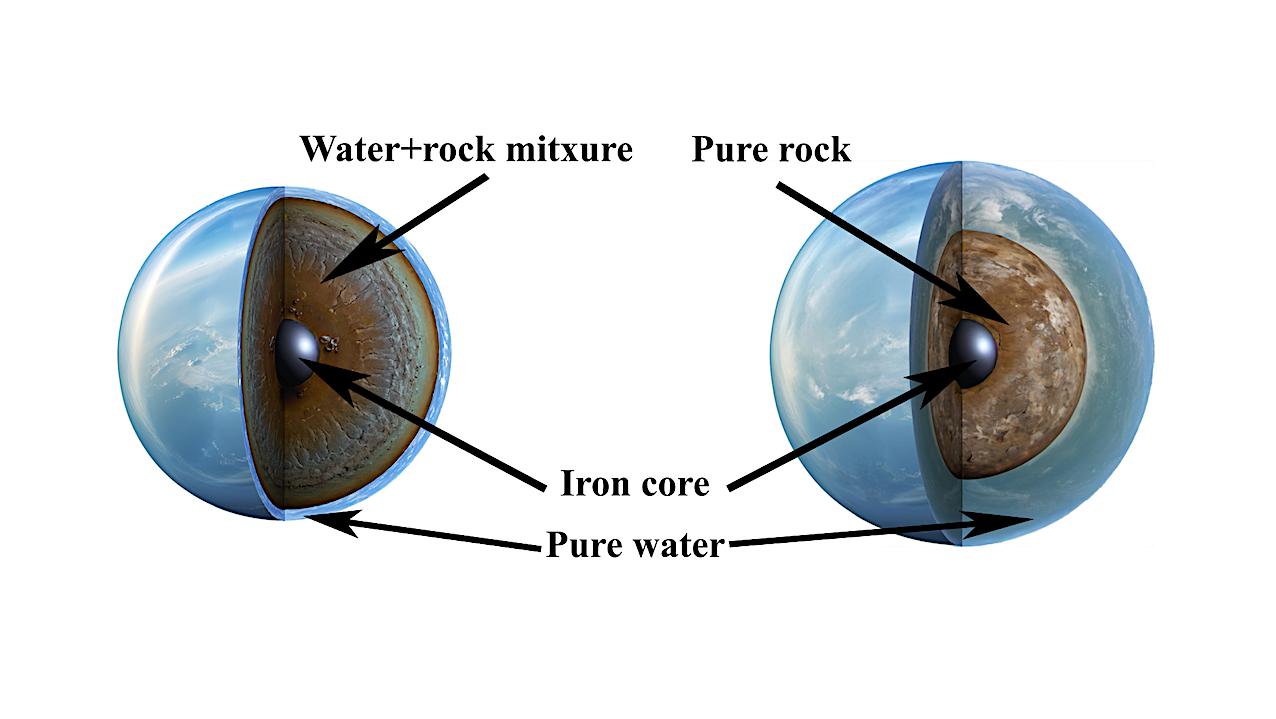
Recent research led by Michael Lozovsky sheds light on the water content of planets with masses between Earth and Neptune, revealing significant uncertainties. These planets often show characteristics that imply the presence of volatiles, including water, deep within their interiors. Despite this implication, accurately measuring the precise water mass fraction and its distribution remains a challenging task.
The study utilizes an internal structure code called MAGRATHEA to model planets with high water content. By moving away from conventional assumptions of a layered structure, the research explores water and rock distribution based on water-rock miscibility criteria. This innovative approach offers new insights into the interior composition of wet planets, which are believed to possess an iron core surrounded by a homogeneous mixture of rock and water.
Modeling the Water-Rock Relationship
In the outer layers of these planets, conditions such as pressure and temperature fall below the rock-water miscibility point, also known as the second critical point. This phenomenon causes a separation of water and rock, resulting in the formation of a water-rich shell in the planet’s uppermost regions. By integrating water-rock miscibility and considering the vapor state of water, the study emphasizes the complexities involved in estimating the water mass fraction of detected exoplanets.
The findings underscore the importance of understanding the internal structures of exoplanets, as this knowledge has implications for planetary habitability and the search for extraterrestrial life. The research highlights that while the presence of water may be suggested, the exact distribution and mass fraction can vary widely, leading to uncertainties that affect our models of planetary formation and evolution.
This study, documented in detail on arXiv and submitted on January 7, 2026, contributes to the field of Earth and Planetary Astrophysics. It serves as a reminder of the complexities that lie beneath the surfaces of planets, reinforcing the notion that our understanding of these celestial bodies is still evolving.
As scientists continue to refine their models and enhance observational technologies, the quest to uncover the secrets of water on exoplanets remains an exciting frontier in astrophysics. The research not only deepens our understanding of planetary systems but also raises intriguing questions about the potential for life beyond Earth.

Cosmic Mystery Deepens: Where Are the Universe’s Defects?

Lady Bulldogs Shine in Postseason Awards Following Final Four Run

CALV Hosts Essential Class for Local Real Estate Professionals

Urgent Alert: “Spaving” Surges as Shoppers Overspend Online

Jefferies Initiates Coverage on Insmed with “Buy” Rating

Three Dog Night to Perform with Ambrosia at Mayo Civic Center

Urgent Announcement: Charles M. Payment Passes Away at 78

Houston Education Foundation Donates $4,592 for Student Programs

Beeks Financial Cloud Shares Drop 7% Amid Increased Trading Volume

Foreign Inflows into Japan Stocks Surge to ¥1.34 Trillion

University of Hawaiʻi Joins $25.6M AI Project to Monitor Disasters

Sydney Sweeney Embraces Body Positivity Amid Hollywood Challenges

Hudson Williams Gains Popularity as Breakout Star on Heated Rivalry

Urgent Farewell: Joleen Chaney Leaves Legacy at KFOR

Boeing’s Merger with McDonnell Douglas: A Strategic Move Explained

$1.25M Grant Advances Hawaiʻi’s Real-Time Hazard Monitoring

Derrick Dove and ABAC Band Set for Free Americana Concert

BOYNEXTDOOR’s Jaehyun Faces Backlash Amid BTS-TWICE Controversy
-
Business9 months ago
Foreign Inflows into Japan Stocks Surge to ¥1.34 Trillion
-
Science9 months ago
University of Hawaiʻi Joins $25.6M AI Project to Monitor Disasters
-
 Entertainment9 months ago
Sydney Sweeney Embraces Body Positivity Amid Hollywood Challenges
-
 Entertainment8 months ago
Hudson Williams Gains Popularity as Breakout Star on Heated Rivalry
-
 Top Stories9 months ago
Urgent Farewell: Joleen Chaney Leaves Legacy at KFOR
-
 World9 months ago
Boeing’s Merger with McDonnell Douglas: A Strategic Move Explained
-
 Science8 months ago
$1.25M Grant Advances Hawaiʻi’s Real-Time Hazard Monitoring
-
 Entertainment8 months ago
Derrick Dove and ABAC Band Set for Free Americana Concert
-
 Top Stories9 months ago
BOYNEXTDOOR’s Jaehyun Faces Backlash Amid BTS-TWICE Controversy
-

 Health6 months ago
Bodybuilder Eugene Teo Transitions to Mindful Movement for Health
-

 World6 months ago
San Francisco Airport to Host 16 Nonstop Airlines to Europe in 2026
-

 Top Stories7 months ago
National Coast Guard Museum Set to Open in 2027 After Funding Secured