
Science
Astronomers Examine Red Dwarf Flares and Their Impact on Exoplanet Habitability

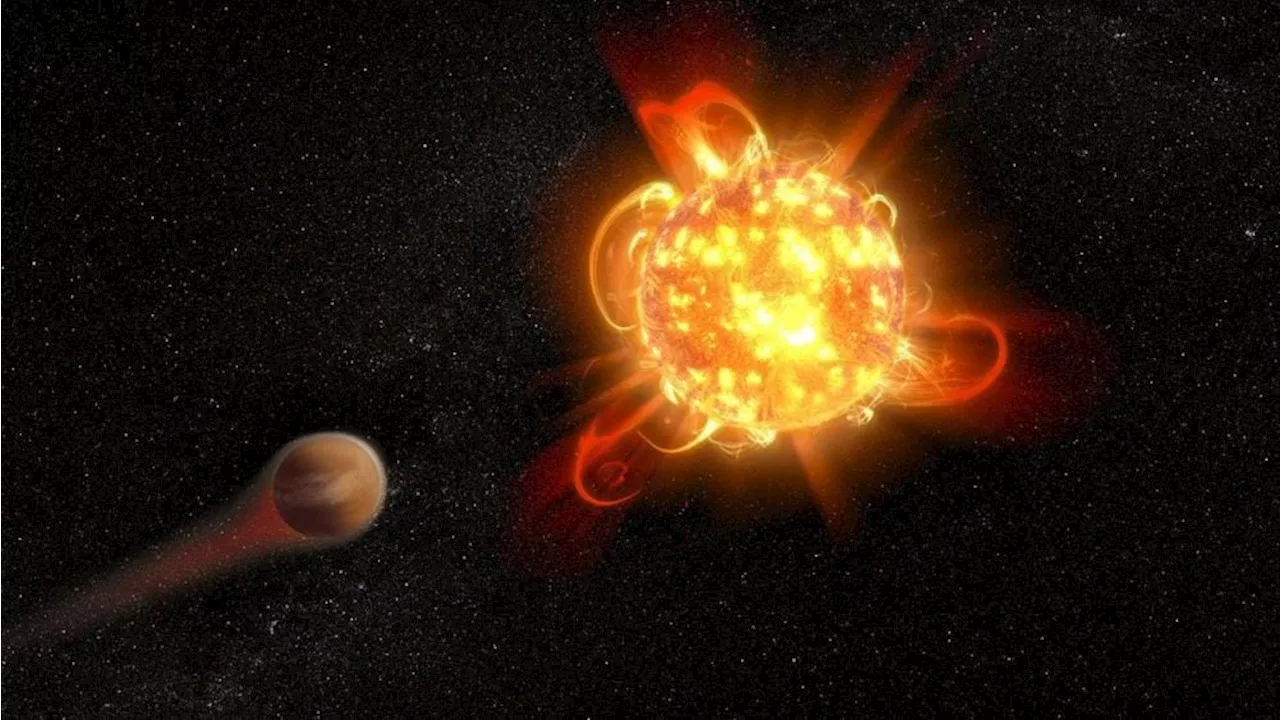
Astronomers are delving into the effects of intense flares from red dwarf stars on the habitability of orbiting exoplanets. The close proximity of habitable zones to these stars subjects potential planets to harmful radiation, raising critical questions about their potential to support life. The upcoming launch of advanced telescopes, including the Extremely Large Telescope and the PLATO space telescope, is expected to play a pivotal role in addressing these challenges.
The research centers on M dwarfs, a class of stars known for their energetic flaring activity. With up to 70% of stars in the Milky Way categorized as red dwarfs, understanding their behavior is crucial for determining the habitability of rocky planets within their orbits. While M dwarfs have been attractive targets for exoplanet research due to their stable and long-lived habitable zones, their propensity for flaring presents significant obstacles.
A recent white paper submitted to the European Southern Observatory (ESO) highlights this dilemma. It notes that while many Earth-like exoplanets have been discovered in habitable zones, the high levels of stellar activity found in M dwarfs could jeopardize their atmospheres, which are essential for sustaining life. The paper cites the well-known TRAPPIST-1 system, where seven rocky exoplanets orbit a small red dwarf. Three of these planets are located within the habitable zone, yet their viability as potential habitats is threatened by the star’s flaring activity.
“As of late 2025, there are about 70 exoplanets that meet the formal criterion of having equilibrium temperatures allowing for the presence of liquid water, with around 50 of them orbiting M stars,” the authors state. They emphasize that strong chromospheric activity, which includes flaring and coronal mass ejections, can erode the atmospheres necessary for habitability.
Typically, the energy released during a flare is accompanied by emissions of extreme ultraviolet (EUV) and X-ray radiation, as well as eruptions of hot plasma. These conditions can be more extreme in red dwarfs than in sun-like stars, as some red dwarfs frequently emit superflares—flares with ten times the energy of the Sun’s most powerful flares.
Understanding the effects of stellar flares on planetary environments is essential for advancing the study of exoplanet habitability. The authors of the white paper stress the need for accurate estimates of flare energies and their impact on planetary atmospheres. Research indicates that high-energy flares occurring at least once a month can completely eliminate a planet’s ozone layer, exposing the surface to harmful UV radiation and potentially sterilizing it.
Currently, astronomers have the capability to closely study the Sun’s activity through missions like the Parker Solar Probe and the Solar Dynamics Observatory. However, comprehensive spectroscopic information on flares from other stars remains limited. The authors of the white paper advocate for more extensive observations to address this gap in knowledge.
In addition to the atmospheric implications, flares may also influence the formation of biotic compounds necessary for life. “We can connect the prebiotic chemistry to the stellar ultraviolet spectrum to determine whether these reactions can happen on rocky planets around other stars,” they note. While stellar flares can provide the UV radiation necessary for these reactions, excessive exposure could hinder life’s emergence.
The proposed Wide Field Survey Telescope (WFST) could be instrumental in making progress in this area. This 2.5-meter telescope is designed for time-domain studies and could monitor a large number of late-type stars to gather vital data on flaring frequency and intensity. The authors suggest that such a facility should feature a primary mirror larger than four meters, a wide field of view, and the capacity for extreme multiplexity to observe multiple targets simultaneously.
Ultimately, the research points to a need for a comprehensive study focused on the properties of flaring exoplanet hosts. “A detailed investigation on a much larger scale than the few tens of stars currently known to harbor habitable planets is essential to address whether these stars can indeed support life,” the authors conclude.
As astronomers continue to refine their understanding of the relationship between stellar activity and planetary habitability, future observations may help illuminate the potential for life on exoplanets orbiting red dwarfs.

Cosmic Mystery Deepens: Where Are the Universe’s Defects?

Lady Bulldogs Shine in Postseason Awards Following Final Four Run

CALV Hosts Essential Class for Local Real Estate Professionals

Urgent Alert: “Spaving” Surges as Shoppers Overspend Online

Jefferies Initiates Coverage on Insmed with “Buy” Rating

Three Dog Night to Perform with Ambrosia at Mayo Civic Center

Urgent Announcement: Charles M. Payment Passes Away at 78

Houston Education Foundation Donates $4,592 for Student Programs

Beeks Financial Cloud Shares Drop 7% Amid Increased Trading Volume

Foreign Inflows into Japan Stocks Surge to ¥1.34 Trillion

University of Hawaiʻi Joins $25.6M AI Project to Monitor Disasters

Sydney Sweeney Embraces Body Positivity Amid Hollywood Challenges

Hudson Williams Gains Popularity as Breakout Star on Heated Rivalry

Urgent Farewell: Joleen Chaney Leaves Legacy at KFOR

Boeing’s Merger with McDonnell Douglas: A Strategic Move Explained

$1.25M Grant Advances Hawaiʻi’s Real-Time Hazard Monitoring

Derrick Dove and ABAC Band Set for Free Americana Concert

BOYNEXTDOOR’s Jaehyun Faces Backlash Amid BTS-TWICE Controversy
-
Business9 months ago
Foreign Inflows into Japan Stocks Surge to ¥1.34 Trillion
-
Science9 months ago
University of Hawaiʻi Joins $25.6M AI Project to Monitor Disasters
-
 Entertainment9 months ago
Sydney Sweeney Embraces Body Positivity Amid Hollywood Challenges
-
 Entertainment7 months ago
Hudson Williams Gains Popularity as Breakout Star on Heated Rivalry
-
 Top Stories8 months ago
Urgent Farewell: Joleen Chaney Leaves Legacy at KFOR
-
 World9 months ago
Boeing’s Merger with McDonnell Douglas: A Strategic Move Explained
-
 Science7 months ago
$1.25M Grant Advances Hawaiʻi’s Real-Time Hazard Monitoring
-
 Entertainment8 months ago
Derrick Dove and ABAC Band Set for Free Americana Concert
-
 Top Stories9 months ago
BOYNEXTDOOR’s Jaehyun Faces Backlash Amid BTS-TWICE Controversy
-

 Health6 months ago
Bodybuilder Eugene Teo Transitions to Mindful Movement for Health
-

 World6 months ago
San Francisco Airport to Host 16 Nonstop Airlines to Europe in 2026
-

 Top Stories7 months ago
National Coast Guard Museum Set to Open in 2027 After Funding Secured