
Science
Researchers Unlock Potential of Gravitational Waves to Study Dark Matter

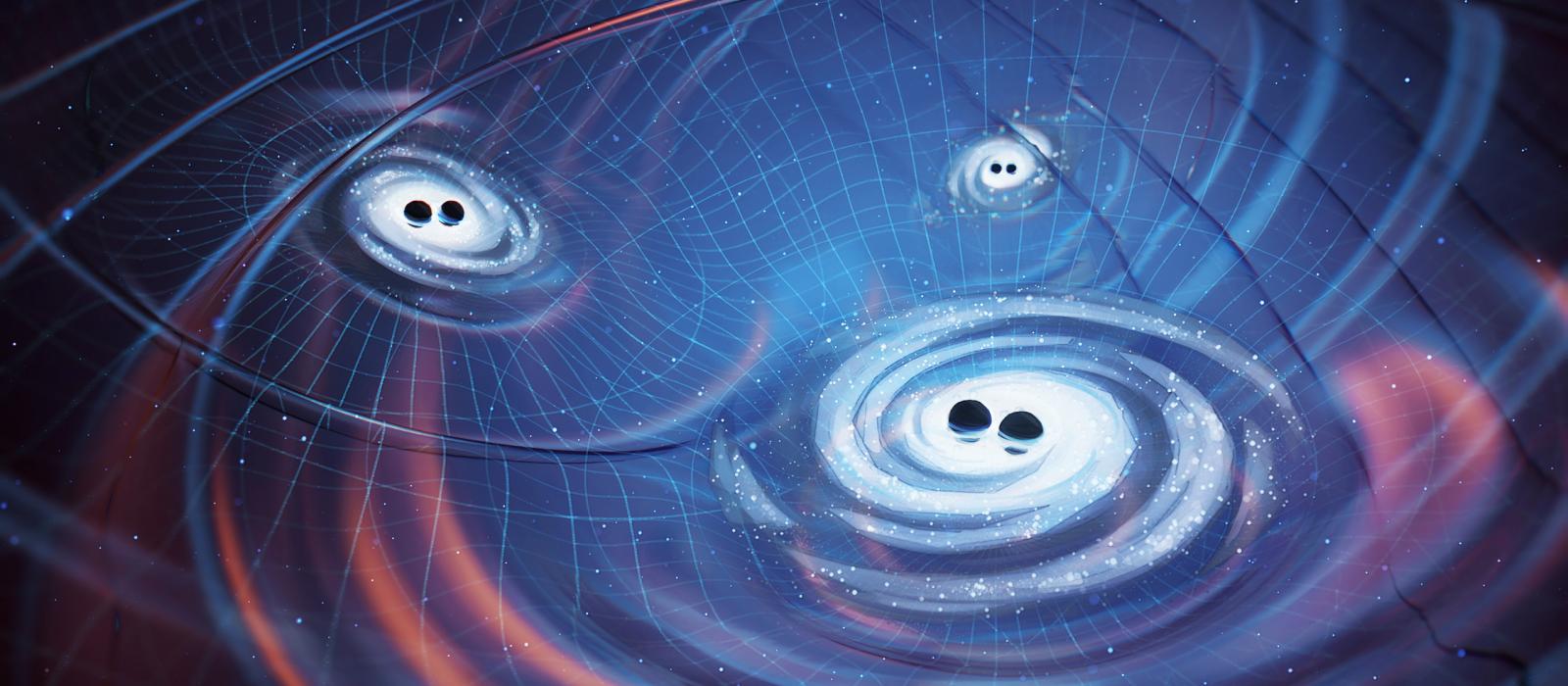
The study of gravitational waves (GWs) may soon provide insights into one of the universe’s most confounding mysteries: dark matter. Research from the University of Amsterdam (UvA) reveals how GWs generated by merging black holes could be utilized to explore dark matter’s effects on the cosmos. This groundbreaking work, published in the journal Physical Review Letters, represents a significant advancement in astrophysics.
The findings stem from the UvA’s Institute of Physics (IoP) and the Gravitation & Astroparticle Physics Amsterdam (GRAPPA) centre. Led by researchers Rodrigo Vicente, Theophanes K. Karydas, and Gianfranco Bertone, the study enhances existing models concerning how dark matter interacts with gravitational waves produced during black hole mergers.
New Framework for Understanding Gravitational Waves
The research introduces a novel approach to modeling the influence of dark matter on GWs, particularly focusing on extreme mass-ratio inspirals (EMRIs). These occur when smaller compact objects, such as neutron stars, coalesce with massive black holes. By applying principles from General Relativity, rather than relying on Newtonian gravity, the team has created a more comprehensive framework for understanding these interactions.
Their analysis indicates that concentrated regions of dark matter may form around massive black holes, creating discernible “spikes” or “mounds” in the gravitational wave signals. This insight could allow scientists to detect dark matter’s presence and study its distribution throughout the universe, which is believed to account for approximately 65% of its total mass.
Future Implications for Gravitational Wave Observatories
The implications of this research are significant, particularly with the upcoming launch of the Laser Interferometer Space Antenna (LISA) by the European Space Agency (ESA). Scheduled for deployment in the coming decade, LISA will be the first space-based observatory dedicated to detecting gravitational waves. Equipped with three spacecraft and six lasers, it is expected to identify over 10,000 gravitational wave signals during its mission.
This innovative approach not only prepares astronomers for the types of signals they may encounter but also enhances the capabilities of current detectors, including the Laser Interferometer Gravitational Wave Observatory (LIGO), the Virgo Collaboration, and the Kamioka Gravitational-wave Detector (KAGRA).
The ongoing research into gravitational waves represents an exciting frontier in astrophysics, with the potential to unravel the properties and composition of dark matter. As scientists continue to refine their models, the hope is that these waves will serve as a key tool in mapping dark matter and enhancing our understanding of the universe. Further developments are eagerly anticipated as the field progresses, paving the way for groundbreaking discoveries.

Cosmic Mystery Deepens: Where Are the Universe’s Defects?

Lady Bulldogs Shine in Postseason Awards Following Final Four Run

CALV Hosts Essential Class for Local Real Estate Professionals

Urgent Alert: “Spaving” Surges as Shoppers Overspend Online

Jefferies Initiates Coverage on Insmed with “Buy” Rating

Three Dog Night to Perform with Ambrosia at Mayo Civic Center

Urgent Announcement: Charles M. Payment Passes Away at 78

Houston Education Foundation Donates $4,592 for Student Programs

Beeks Financial Cloud Shares Drop 7% Amid Increased Trading Volume

Foreign Inflows into Japan Stocks Surge to ¥1.34 Trillion

University of Hawaiʻi Joins $25.6M AI Project to Monitor Disasters

Hudson Williams Gains Popularity as Breakout Star on Heated Rivalry

Sydney Sweeney Embraces Body Positivity Amid Hollywood Challenges

Urgent Farewell: Joleen Chaney Leaves Legacy at KFOR

Boeing’s Merger with McDonnell Douglas: A Strategic Move Explained

$1.25M Grant Advances Hawaiʻi’s Real-Time Hazard Monitoring

BOYNEXTDOOR’s Jaehyun Faces Backlash Amid BTS-TWICE Controversy

Bodybuilder Eugene Teo Transitions to Mindful Movement for Health
-
Business5 months ago
Foreign Inflows into Japan Stocks Surge to ¥1.34 Trillion
-
Science5 months ago
University of Hawaiʻi Joins $25.6M AI Project to Monitor Disasters
-
 Entertainment4 months ago
Hudson Williams Gains Popularity as Breakout Star on Heated Rivalry
-
 Entertainment6 months ago
Sydney Sweeney Embraces Body Positivity Amid Hollywood Challenges
-
 Top Stories5 months ago
Urgent Farewell: Joleen Chaney Leaves Legacy at KFOR
-
 World6 months ago
Boeing’s Merger with McDonnell Douglas: A Strategic Move Explained
-
 Science4 months ago
$1.25M Grant Advances Hawaiʻi’s Real-Time Hazard Monitoring
-
 Top Stories6 months ago
BOYNEXTDOOR’s Jaehyun Faces Backlash Amid BTS-TWICE Controversy
-
 Health3 months ago
Bodybuilder Eugene Teo Transitions to Mindful Movement for Health
-

 Health3 months ago
Hartford’s Abandoned Tower Faces Growing Safety Concerns
-

 World6 months ago
French Film Explores Group Therapy in ‘Group – The Schopenhauer Project’
-

 World4 months ago
Nicolas Maduro’s Surprising Tenure: Defiance and Controversy