
Science
Euclid Space Telescope Uncovers Secrets of Active Black Holes

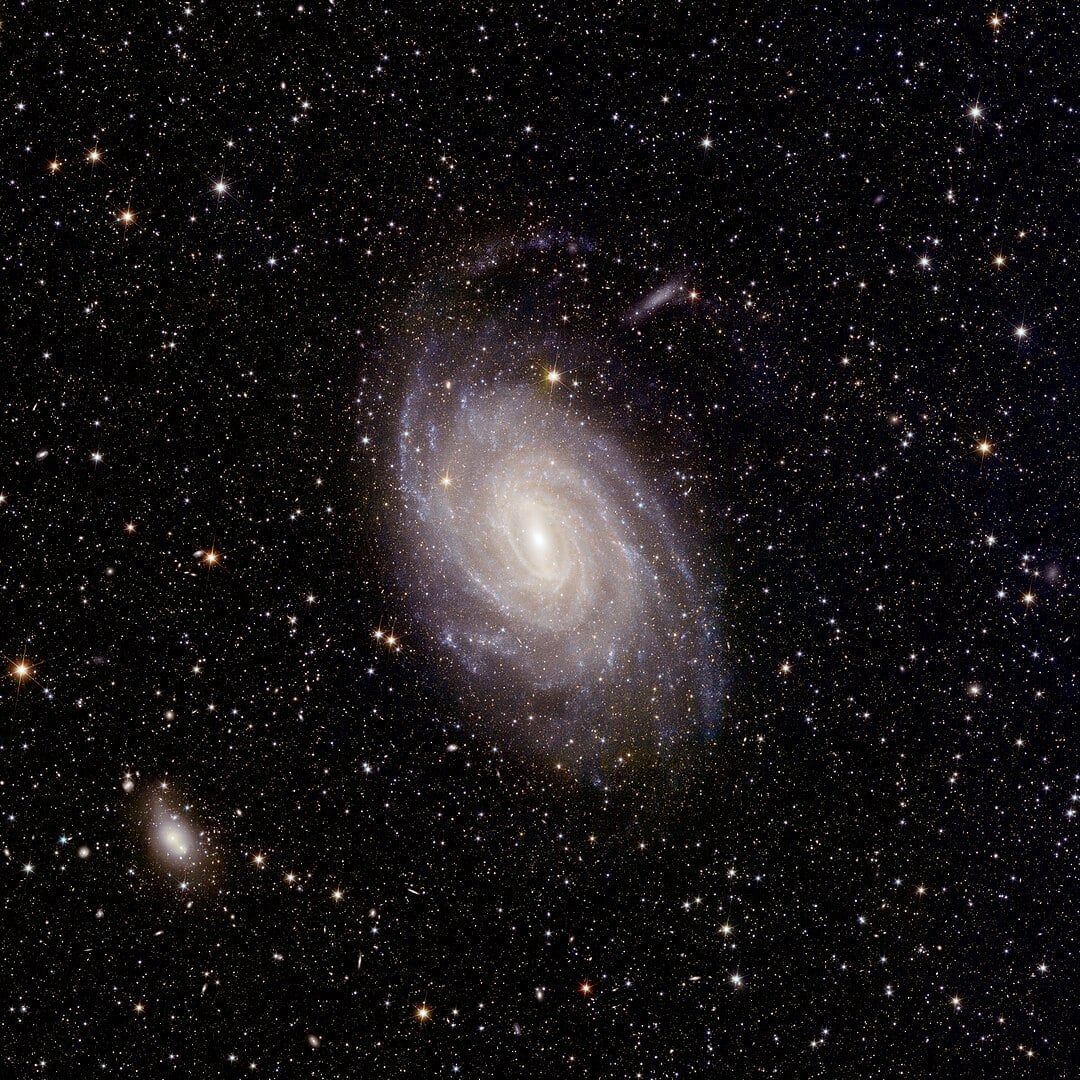
New observations from the Euclid Space Telescope have shed light on the mechanisms that awaken dormant supermassive black holes at the centers of galaxies. While many of these colossal objects quietly consume surrounding material, a small fraction emerge as bright, active galactic nuclei (AGN), emitting vast amounts of energy. Researchers now believe that violent galaxy collisions are a primary driver behind this transition.
When two galaxies merge, the resulting gravitational chaos can propel gas, dust, and stars across immense distances. This turbulence funnels additional material toward the central black holes, creating an accretion disk. As the material accumulates, friction and compression heat it to extreme temperatures, resulting in an AGN that can outshine its entire host galaxy.
Understanding this phenomenon has long posed challenges for astronomers. Previous studies often relied on limited samples and lacked the image quality necessary to accurately identify both galaxy mergers and faint AGN. The arrival of the Euclid Space Telescope has changed that landscape significantly.
Transformative Data from Euclid
In just one week of operation, the Euclid telescope captured high-quality images of the sky that took the Hubble Space Telescope more than three decades to compile. To leverage this unprecedented dataset, scientists at the SRON Netherlands Institute for Space Research developed an innovative AI-powered image decomposition tool. This new technology can detect AGN that previous methods overlooked and measure their energy output with remarkable accuracy.
Applying this approach to a dataset of one million galaxies—far larger than any prior study—yielded compelling results. The research team discovered that merging galaxies host significantly more AGN than isolated ones. Notably, the ratio of active black holes is highly dependent on the stage of the merger.
In dynamically young mergers with abundant dust, where AGN visibility is limited to infrared wavelengths, researchers found six times more active black holes compared to isolated galaxies. As mergers progress and dust settles, this ratio decreases to two times higher in nearly completed mergers. This decline may indicate that some galaxies previously thought to be isolated could actually be post-merger systems that have simply settled into a more stable appearance.
Implications for Understanding the Universe
The study’s most striking finding is that the most luminous AGN appear almost exclusively in merging systems. This suggests that while other processes may activate black holes to a moderate extent, collisions between galaxies are likely essential for fueling the universe’s most extreme objects.
The research reveals that throughout cosmic history, as galaxies merge, their central black holes not only grow larger but also ignite into life, emitting powerful radiation and outflows. These phenomena can significantly affect their surroundings, potentially halting star formation across the entire merged system.
The findings from the Euclid dataset provide critical insights into the interplay between galaxy mergers and AGN activity, enhancing our understanding of the dynamic processes that shape the universe. As this research continues, it may lead to further revelations about the evolution of galaxies and the supermassive black holes at their cores.

Cosmic Mystery Deepens: Where Are the Universe’s Defects?

Lady Bulldogs Shine in Postseason Awards Following Final Four Run

CALV Hosts Essential Class for Local Real Estate Professionals

Urgent Alert: “Spaving” Surges as Shoppers Overspend Online

Jefferies Initiates Coverage on Insmed with “Buy” Rating

Three Dog Night to Perform with Ambrosia at Mayo Civic Center

Urgent Announcement: Charles M. Payment Passes Away at 78

Houston Education Foundation Donates $4,592 for Student Programs

Beeks Financial Cloud Shares Drop 7% Amid Increased Trading Volume

Foreign Inflows into Japan Stocks Surge to ¥1.34 Trillion

University of Hawaiʻi Joins $25.6M AI Project to Monitor Disasters

Sydney Sweeney Embraces Body Positivity Amid Hollywood Challenges

Hudson Williams Gains Popularity as Breakout Star on Heated Rivalry

Urgent Farewell: Joleen Chaney Leaves Legacy at KFOR

Boeing’s Merger with McDonnell Douglas: A Strategic Move Explained

$1.25M Grant Advances Hawaiʻi’s Real-Time Hazard Monitoring

Derrick Dove and ABAC Band Set for Free Americana Concert

BOYNEXTDOOR’s Jaehyun Faces Backlash Amid BTS-TWICE Controversy
-
Business9 months ago
Foreign Inflows into Japan Stocks Surge to ¥1.34 Trillion
-
Science9 months ago
University of Hawaiʻi Joins $25.6M AI Project to Monitor Disasters
-
 Entertainment9 months ago
Sydney Sweeney Embraces Body Positivity Amid Hollywood Challenges
-
 Entertainment7 months ago
Hudson Williams Gains Popularity as Breakout Star on Heated Rivalry
-
 Top Stories8 months ago
Urgent Farewell: Joleen Chaney Leaves Legacy at KFOR
-
 World9 months ago
Boeing’s Merger with McDonnell Douglas: A Strategic Move Explained
-
 Science7 months ago
$1.25M Grant Advances Hawaiʻi’s Real-Time Hazard Monitoring
-
 Entertainment8 months ago
Derrick Dove and ABAC Band Set for Free Americana Concert
-
 Top Stories9 months ago
BOYNEXTDOOR’s Jaehyun Faces Backlash Amid BTS-TWICE Controversy
-

 Health6 months ago
Bodybuilder Eugene Teo Transitions to Mindful Movement for Health
-

 World6 months ago
San Francisco Airport to Host 16 Nonstop Airlines to Europe in 2026
-

 Top Stories7 months ago
National Coast Guard Museum Set to Open in 2027 After Funding Secured