
Science
Radboud Chemists Leverage Robotics to Shift to Bio-based Materials


Researchers at Radboud University are collaborating with companies and employing robotics to facilitate the transition from oil-based materials to bio-based alternatives. This shift is crucial as many everyday chemical products, including medicines, plastics, and paints, remain heavily reliant on fossil fuels, raising sustainability concerns.
The initiative is part of the larger Big Chemistry programme, aimed at developing materials derived from biological sources. The transition, however, poses significant challenges. It requires replacing fossil-based raw materials without compromising the quality of the final products. According to Wilhelm Huck, a professor of physical-organic chemistry at Radboud University, understanding the molecular properties and interactions of these new materials is essential.
Understanding Complex Interactions
Huck highlights that most chemical interactions are non-additive. For instance, the behavior of a mixture cannot be easily predicted by simply combining the behaviors of individual components. “In many cases, the interaction between molecules leads to an outcome that you couldn’t have predicted,” he stated. The vast number of potential interactions complicates matters further, as suppliers may offer tens of thousands of components that can be mixed in various ways, resulting in millions of possible interactions.
To tackle this complexity, Huck emphasizes the need for predictive models that can simulate the properties of mixtures. This approach requires extensive data collection through experimentation, enabling researchers to train these models effectively.
Innovative Projects in Focus
This fall, three significant projects received funding under the Big Chemistry programme of the National Growth Fund. Led by Huck, along with fellow chemists Mathijs Mabesoone and Peter Korevaar, the projects will explore bio-based materials for paints and soaps among other applications.
Korevaar’s project, in collaboration with Van Wijhe Verf, focuses on developing paints that maintain essential properties such as waterproofing and stability, which are often reliant on oil-based components. “If you try to design that based on new, bio-based ingredients, you need a lot of experimental data,” he explained.
Mabesoone is working with Croda International to study soaps. His research aims to create a comprehensive database of measurements to predict how mixtures behave, especially since certain properties can dramatically change at different concentrations.
The third project involves fundamental research into polymers, large molecules that frequently occur in mixtures. Huck notes that there is currently insufficient data for effective theoretical calculations regarding these materials. Collaborating with TNO and Van Loon Chemical Innovations (VLCI), the team will collect more data to enhance AI models for better predictions.
Harnessing Robotics for Data Collection
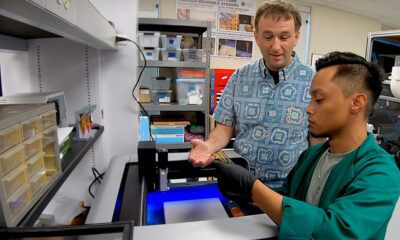
A key aspect of these projects is the use of robotics to generate large amounts of unique data. Although a state-of-the-art robot lab is set to open at Noviotech Campus in Nijmegen in 2026, researchers are currently utilizing smaller robots to conduct experiments. These robots autonomously test and measure various mixtures, significantly speeding up the data collection process.
Mabesoone describes the process: “You supply such a robot with a few samples of basic solutions, and then you put it to work testing, mixing, and measuring. The robot decides which are the best samples to make, and you only need to supply a small amount to obtain a lot of data.”
Future Implications for Consumers
As for the potential impact on consumers, Huck suggests that while the transition may not be immediately noticeable, it is essential for the future of product availability. “If we don’t do this, you may find at some point you can no longer get certain products because they contain substances that are no longer permitted or available,” he cautioned.
In the long run, successful implementation of these bio-based materials could lead to more biodegradable products that maintain high quality. The integration of robotics and AI in the development process not only expands the range of combinations that can be explored but also holds the promise of discovering new properties that enhance product performance.
The research initiatives at Radboud University represent a significant step toward sustainable chemistry, demonstrating how innovation can drive the transition to environmentally friendly materials.

Cosmic Mystery Deepens: Where Are the Universe’s Defects?

Lady Bulldogs Shine in Postseason Awards Following Final Four Run

CALV Hosts Essential Class for Local Real Estate Professionals

Urgent Alert: “Spaving” Surges as Shoppers Overspend Online

Jefferies Initiates Coverage on Insmed with “Buy” Rating

Three Dog Night to Perform with Ambrosia at Mayo Civic Center

Urgent Announcement: Charles M. Payment Passes Away at 78

Houston Education Foundation Donates $4,592 for Student Programs

Beeks Financial Cloud Shares Drop 7% Amid Increased Trading Volume

Foreign Inflows into Japan Stocks Surge to ¥1.34 Trillion

University of Hawaiʻi Joins $25.6M AI Project to Monitor Disasters

Sydney Sweeney Embraces Body Positivity Amid Hollywood Challenges

Hudson Williams Gains Popularity as Breakout Star on Heated Rivalry

Urgent Farewell: Joleen Chaney Leaves Legacy at KFOR

Boeing’s Merger with McDonnell Douglas: A Strategic Move Explained

$1.25M Grant Advances Hawaiʻi’s Real-Time Hazard Monitoring

Derrick Dove and ABAC Band Set for Free Americana Concert

BOYNEXTDOOR’s Jaehyun Faces Backlash Amid BTS-TWICE Controversy
-
Business9 months ago
Foreign Inflows into Japan Stocks Surge to ¥1.34 Trillion
-
Science9 months ago
University of Hawaiʻi Joins $25.6M AI Project to Monitor Disasters
-
 Entertainment9 months ago
Sydney Sweeney Embraces Body Positivity Amid Hollywood Challenges
-
 Entertainment7 months ago
Hudson Williams Gains Popularity as Breakout Star on Heated Rivalry
-
 Top Stories8 months ago
Urgent Farewell: Joleen Chaney Leaves Legacy at KFOR
-
 World9 months ago
Boeing’s Merger with McDonnell Douglas: A Strategic Move Explained
-
 Science7 months ago
$1.25M Grant Advances Hawaiʻi’s Real-Time Hazard Monitoring
-
 Entertainment8 months ago
Derrick Dove and ABAC Band Set for Free Americana Concert
-
 Top Stories9 months ago
BOYNEXTDOOR’s Jaehyun Faces Backlash Amid BTS-TWICE Controversy
-

 Health6 months ago
Bodybuilder Eugene Teo Transitions to Mindful Movement for Health
-

 World6 months ago
San Francisco Airport to Host 16 Nonstop Airlines to Europe in 2026
-

 Top Stories7 months ago
National Coast Guard Museum Set to Open in 2027 After Funding Secured