
World
Researchers Discover Unexpected Break in Milky Way’s Structure

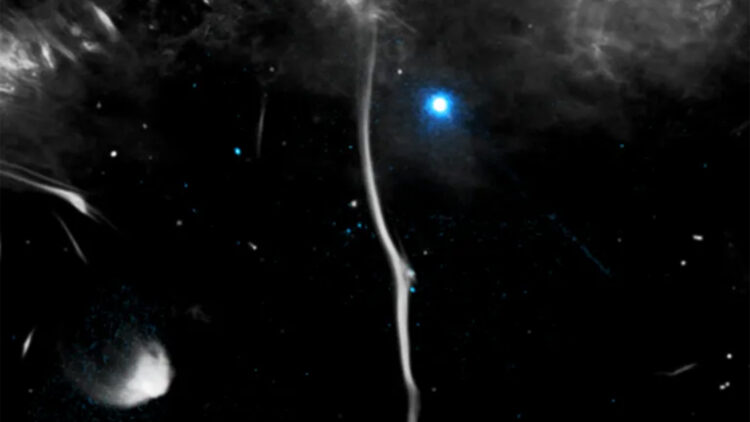
Astronomers have made a groundbreaking discovery regarding the structure of the Milky Way, revealing an unexpected discontinuity within one of the galaxy’s key filaments. This finding, confirmed by the Hubble Space Telescope and a team from NASA, challenges previously held beliefs about the stability of our galaxy and its evolutionary processes.
A Galactic Filament in Distress
The filament in question, officially designated as G359.13142-0.20005, has been affectionately nicknamed the “Snake” by researchers. Spanning approximately 230 light-years, this structure was previously regarded as one of the most stable components of the Milky Way. However, upon closer examination using advanced high-resolution X-ray and infrared telescopes, scientists detected anomalies within the filament that suggested a significant disruption.
Initially, researchers observed peculiar, dark regions within the filament that appeared as shadows. A deeper analysis of the infrared data revealed a pronounced break in the filament, indicating that it had been twisted or deformed. This investigation was spearheaded by the Chandra X-ray Observatory, which orbits Earth and specializes in detecting powerful cosmic events.
The Role of Pulsars
Further examination of the Snake led scientists to discover a pulsar—an astronomical object formed from the remnants of a supernova explosion. Pulsars are known for their rapid rotation, intense magnetic fields, and remarkable density. They emit regular waves of radiation, functioning like cosmic lighthouses.
The data indicated that this particular pulsar was traveling through the filament at extraordinary speeds, estimated between 1,609,000 and 3,218,000 kilometers per hour. The interaction between the pulsar and the filament caused enough force to deform the galactic structure, disrupting its radio signals. Rather than a simple gap, the fracture exhibited a sharp angle, suggesting a complex interaction rather than a straightforward collision.
To validate these findings, researchers conducted simulations that confirmed a pulsar could indeed exert enough force to redirect and deform a galactic filament. This incident appears to have occurred recently in cosmic terms, as indicated by the unusual curvature and density variations surrounding the break.
Rethinking the Milky Way’s Structure
The implications of this discovery extend far beyond the Snake filament. Scientists are now prompted to reevaluate their understanding of the Milky Way’s overall structure and stability. If such a critical component can experience deformation, it raises questions about how many other segments of the galaxy may have undergone similar changes that remain undetected.
To address these uncertainties, astronomers will need to utilize more advanced telescopes, particularly those capable of detecting X-rays and infrared light. These observations can penetrate the gas and dust that often obscure features from traditional optical telescopes. Exploring other galaxies in a similar manner may unveil additional cracks and distortions that have gone unnoticed until now.
This remarkable finding not only sheds light on the dynamic nature of our galaxy but also encourages further inquiry into the cosmic forces at play. As researchers continue to investigate, they may uncover even deeper insights into the complex evolution of the universe.

Cosmic Mystery Deepens: Where Are the Universe’s Defects?

Lady Bulldogs Shine in Postseason Awards Following Final Four Run

CALV Hosts Essential Class for Local Real Estate Professionals

Urgent Alert: “Spaving” Surges as Shoppers Overspend Online

Jefferies Initiates Coverage on Insmed with “Buy” Rating

Three Dog Night to Perform with Ambrosia at Mayo Civic Center

Urgent Announcement: Charles M. Payment Passes Away at 78

Houston Education Foundation Donates $4,592 for Student Programs

Beeks Financial Cloud Shares Drop 7% Amid Increased Trading Volume

Foreign Inflows into Japan Stocks Surge to ¥1.34 Trillion

University of Hawaiʻi Joins $25.6M AI Project to Monitor Disasters

Sydney Sweeney Embraces Body Positivity Amid Hollywood Challenges

Hudson Williams Gains Popularity as Breakout Star on Heated Rivalry

Urgent Farewell: Joleen Chaney Leaves Legacy at KFOR

Boeing’s Merger with McDonnell Douglas: A Strategic Move Explained

$1.25M Grant Advances Hawaiʻi’s Real-Time Hazard Monitoring

Derrick Dove and ABAC Band Set for Free Americana Concert

BOYNEXTDOOR’s Jaehyun Faces Backlash Amid BTS-TWICE Controversy
-
Business9 months ago
Foreign Inflows into Japan Stocks Surge to ¥1.34 Trillion
-
Science8 months ago
University of Hawaiʻi Joins $25.6M AI Project to Monitor Disasters
-
 Entertainment9 months ago
Sydney Sweeney Embraces Body Positivity Amid Hollywood Challenges
-
 Entertainment7 months ago
Hudson Williams Gains Popularity as Breakout Star on Heated Rivalry
-
 Top Stories8 months ago
Urgent Farewell: Joleen Chaney Leaves Legacy at KFOR
-
 World9 months ago
Boeing’s Merger with McDonnell Douglas: A Strategic Move Explained
-
 Science7 months ago
$1.25M Grant Advances Hawaiʻi’s Real-Time Hazard Monitoring
-
 Entertainment8 months ago
Derrick Dove and ABAC Band Set for Free Americana Concert
-
 Top Stories9 months ago
BOYNEXTDOOR’s Jaehyun Faces Backlash Amid BTS-TWICE Controversy
-

 Health6 months ago
Bodybuilder Eugene Teo Transitions to Mindful Movement for Health
-

 World6 months ago
San Francisco Airport to Host 16 Nonstop Airlines to Europe in 2026
-

 Top Stories7 months ago
National Coast Guard Museum Set to Open in 2027 After Funding Secured