
Top Stories
AI Pioneer Fei-Fei Li Urges Balanced Messaging Amid Extremes

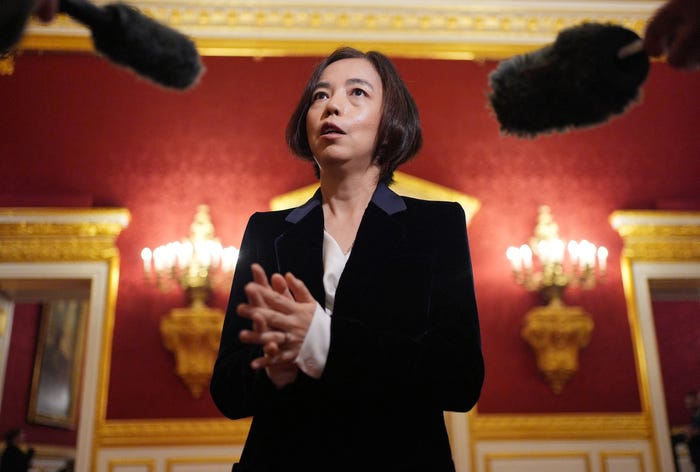
URGENT UPDATE: Renowned AI leader and Stanford professor Fei-Fei Li has voiced her deep disappointment over the polarized messaging surrounding artificial intelligence, stating it is either excessively alarmist or overly optimistic. In a recent talk at Stanford University, published on July 6, 2023, Li emphasized that extreme rhetoric is misleading the public, especially those outside the tech world.
Li, often referred to as the Godmother of AI, expressed concern that sensational claims about AI’s potential—ranging from “doomsday” scenarios to “total utopian” visions—are not only misleading but are also detrimental to public discourse. “I like to say I’m the most boring speaker in AI these days because precisely my disappointment is the hyperbole on both sides,” she stated, highlighting the urgent need for factual communication about AI’s real-world implications.
In her remarks, Li pointed out that the narrative around AI is currently dominated by dramatic extremes. “We’ve got the total extinction, doomsday, and all that talk about AI will ruin humanity, machine overlord,” she explained. On the flip side, she criticized the overly optimistic perspectives that promise a future of “post-scarcity” and “infinite productivity.”
Li’s concerns resonate with other prominent figures in AI, including Andrew Ng and Yann LeCun, both of whom have recently called for a more measured approach to discussing AI. Ng, the founder of Google Brain, noted that artificial general intelligence (AGI) is often overrated, stating during a talk at Y Combinator, “For a long time, there’ll be a lot of things that humans can do that AI cannot.”
Similarly, LeCun, the former chief AI scientist at Meta, shared his skepticism about large language models, stating, “They’re not a road towards what people call AGI.” He recently announced his departure from Meta to embark on a new AI startup, emphasizing the need for realistic expectations in the field.
Li’s message at Stanford underscores the urgency for balanced discourse in technological advancements. “The world’s population, especially those who are not in Silicon Valley, need to hear the facts, need to hear what this truly is,” she urged. She believes that the current communication strategies fall short of effectively educating the public about AI’s capabilities and limitations.
As discussions around AI continue to evolve, the demand for accurate and balanced information grows. Li’s call for a shift in narrative is critical not only for those directly involved in tech but also for the general public, who are increasingly affected by AI’s integration into everyday life.
The AI community is urged to take heed of these developments, as the conversation around AI’s future will shape its impact on society. Stakeholders and tech leaders are now called upon to engage in constructive dialogue that prioritizes factual representation over fear-mongering or unrealistic optimism.
Stay tuned for more updates as this story develops.

Cosmic Mystery Deepens: Where Are the Universe’s Defects?

Lady Bulldogs Shine in Postseason Awards Following Final Four Run

CALV Hosts Essential Class for Local Real Estate Professionals

Urgent Alert: “Spaving” Surges as Shoppers Overspend Online

Jefferies Initiates Coverage on Insmed with “Buy” Rating

Three Dog Night to Perform with Ambrosia at Mayo Civic Center

Urgent Announcement: Charles M. Payment Passes Away at 78

Houston Education Foundation Donates $4,592 for Student Programs

Beeks Financial Cloud Shares Drop 7% Amid Increased Trading Volume

Foreign Inflows into Japan Stocks Surge to ¥1.34 Trillion

University of Hawaiʻi Joins $25.6M AI Project to Monitor Disasters

Sydney Sweeney Embraces Body Positivity Amid Hollywood Challenges

Hudson Williams Gains Popularity as Breakout Star on Heated Rivalry

Urgent Farewell: Joleen Chaney Leaves Legacy at KFOR

Boeing’s Merger with McDonnell Douglas: A Strategic Move Explained

$1.25M Grant Advances Hawaiʻi’s Real-Time Hazard Monitoring

Derrick Dove and ABAC Band Set for Free Americana Concert

BOYNEXTDOOR’s Jaehyun Faces Backlash Amid BTS-TWICE Controversy
-
Business9 months ago
Foreign Inflows into Japan Stocks Surge to ¥1.34 Trillion
-
Science8 months ago
University of Hawaiʻi Joins $25.6M AI Project to Monitor Disasters
-
 Entertainment9 months ago
Sydney Sweeney Embraces Body Positivity Amid Hollywood Challenges
-
 Entertainment7 months ago
Hudson Williams Gains Popularity as Breakout Star on Heated Rivalry
-
 Top Stories8 months ago
Urgent Farewell: Joleen Chaney Leaves Legacy at KFOR
-
 World9 months ago
Boeing’s Merger with McDonnell Douglas: A Strategic Move Explained
-
 Science7 months ago
$1.25M Grant Advances Hawaiʻi’s Real-Time Hazard Monitoring
-
 Entertainment8 months ago
Derrick Dove and ABAC Band Set for Free Americana Concert
-
 Top Stories9 months ago
BOYNEXTDOOR’s Jaehyun Faces Backlash Amid BTS-TWICE Controversy
-

 Health6 months ago
Bodybuilder Eugene Teo Transitions to Mindful Movement for Health
-

 World6 months ago
San Francisco Airport to Host 16 Nonstop Airlines to Europe in 2026
-

 Top Stories7 months ago
National Coast Guard Museum Set to Open in 2027 After Funding Secured