
Science
Webb Space Telescope Discovers Oldest Supernova Ever Recorded

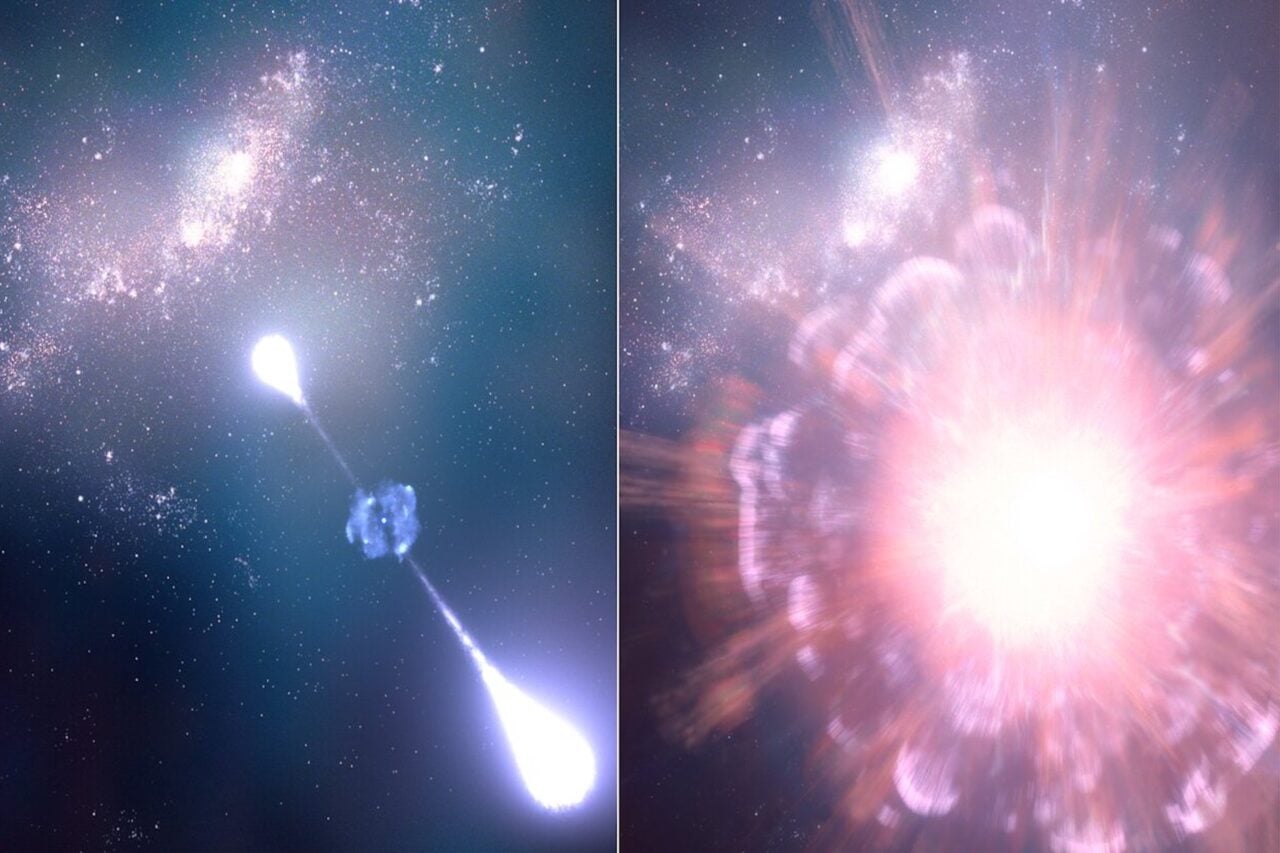
A remarkable discovery has been made by the James Webb Space Telescope, which has traced a powerful gamma-ray burst back to the oldest supernova ever observed. This event occurred when the universe was just 730 million years old, significantly earlier than previously detected stellar explosions. The findings not only set a new record but also enhance our understanding of the early universe.
The initial detection of the gamma-ray burst was made on March 14, 2023, by the SVOM mission (Space-based multi-band astronomical Variable Objects Monitor). In a matter of hours, a collaborative effort involving multiple telescopes allowed astronomers to locate the source in the cosmos and estimate its timing within the cosmic timeline. “There are only a handful of gamma-ray bursts in the last 50 years that have been detected in the first billion years of the Universe,” stated Andrew Levan, an astrophysics professor at Radboud University in the Netherlands and lead author of a recent paper published in *Astronomy and Astrophysics Letters*.
The gamma-ray burst observed lasted for approximately 10 seconds, indicating it was likely caused by the explosive death of a massive star, as opposed to the more common collisions between neutron stars or between a neutron star and a black hole. The Webb telescope observed the aftermath of the supernova on July 1, 2023, allowing sufficient time for the event’s brightness to increase, which made it easier to detect.
Understanding the Early Universe
The light from this early supernova had been stretched as the universe expanded, causing it to take longer for astronomers to analyze it. As they examined the characteristics of this ancient explosion, they compared it with more recent supernovae that occurred closer to our galaxy. They were surprised to find that this ancient supernova shared similarities with its modern counterparts, despite expectations that it would appear quite different due to its age.
“We went in with open minds,” said Nial Tanvir, a professor at the University of Leicester and co-author of the paper. “And lo and behold, Webb showed that this supernova looks exactly like modern supernovae.” This finding suggests that the fundamental processes governing star deaths have remained consistent over billions of years.
The significance of this discovery extends beyond the supernova itself. The team of astronomers plans to utilize the Webb telescope to further investigate the afterglow of distant gamma-ray bursts. Such observations can provide insights into galaxy evolution and the formation of stars in the early universe. “That glow will help Webb see more and give us a ‘fingerprint’ of the galaxy,” Levan noted.
As the James Webb Space Telescope continues to redefine our understanding of cosmic history, this latest observation underscores the power of modern astronomy to peer into the depths of time and space, revealing the universe’s storied past.

Cosmic Mystery Deepens: Where Are the Universe’s Defects?

Lady Bulldogs Shine in Postseason Awards Following Final Four Run

CALV Hosts Essential Class for Local Real Estate Professionals

Urgent Alert: “Spaving” Surges as Shoppers Overspend Online

Jefferies Initiates Coverage on Insmed with “Buy” Rating

Three Dog Night to Perform with Ambrosia at Mayo Civic Center

Urgent Announcement: Charles M. Payment Passes Away at 78

Houston Education Foundation Donates $4,592 for Student Programs

Beeks Financial Cloud Shares Drop 7% Amid Increased Trading Volume

Foreign Inflows into Japan Stocks Surge to ¥1.34 Trillion

University of Hawaiʻi Joins $25.6M AI Project to Monitor Disasters

Sydney Sweeney Embraces Body Positivity Amid Hollywood Challenges

Hudson Williams Gains Popularity as Breakout Star on Heated Rivalry

Urgent Farewell: Joleen Chaney Leaves Legacy at KFOR

Boeing’s Merger with McDonnell Douglas: A Strategic Move Explained

$1.25M Grant Advances Hawaiʻi’s Real-Time Hazard Monitoring

Derrick Dove and ABAC Band Set for Free Americana Concert

BOYNEXTDOOR’s Jaehyun Faces Backlash Amid BTS-TWICE Controversy
-
Business9 months ago
Foreign Inflows into Japan Stocks Surge to ¥1.34 Trillion
-
Science9 months ago
University of Hawaiʻi Joins $25.6M AI Project to Monitor Disasters
-
 Entertainment9 months ago
Sydney Sweeney Embraces Body Positivity Amid Hollywood Challenges
-
 Entertainment8 months ago
Hudson Williams Gains Popularity as Breakout Star on Heated Rivalry
-
 Top Stories9 months ago
Urgent Farewell: Joleen Chaney Leaves Legacy at KFOR
-
 World9 months ago
Boeing’s Merger with McDonnell Douglas: A Strategic Move Explained
-
 Science8 months ago
$1.25M Grant Advances Hawaiʻi’s Real-Time Hazard Monitoring
-
 Entertainment8 months ago
Derrick Dove and ABAC Band Set for Free Americana Concert
-
 Top Stories9 months ago
BOYNEXTDOOR’s Jaehyun Faces Backlash Amid BTS-TWICE Controversy
-

 Health6 months ago
Bodybuilder Eugene Teo Transitions to Mindful Movement for Health
-

 World6 months ago
San Francisco Airport to Host 16 Nonstop Airlines to Europe in 2026
-

 Top Stories7 months ago
National Coast Guard Museum Set to Open in 2027 After Funding Secured