
Science
Voyager 2 Data Reveals New Insights About Uranus’s Magnetosphere

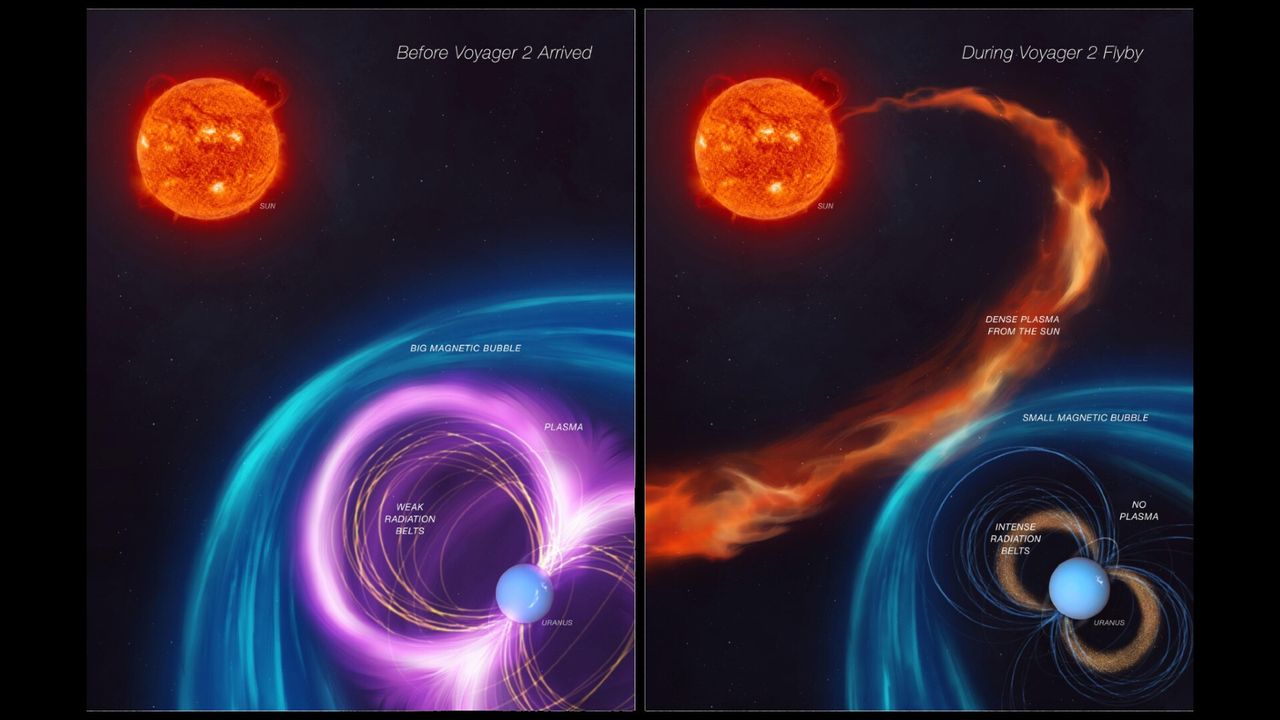
Recent analysis of data from the Voyager 2 mission suggests that Uranus may share more similarities with Earth than previously understood. This revelation stems from a reinterpretation of data collected during Voyager 2’s flyby on January 24, 1986, which indicates that Uranus’s radiation belts may have been influenced by a phenomenon akin to those causing geomagnetic storms on Earth.
By examining the conditions surrounding Voyager 2’s encounter, researchers from the Southwest Research Institute discovered that at the time, a co-rotating interaction region (CIR) may have been affecting Uranus’s magnetosphere. This region occurs when fast solar wind from coronal holes collides with slower solar wind, generating electromagnetic shocks. This interaction can lead to significant energy transfer within a planet’s magnetosphere, similar to events witnessed on Earth.
When Voyager 2 reached Uranus, it recorded an unusual state of the planet’s magnetosphere, which showed a tilt of 59 degrees relative to its rotational axis. This configuration is striking, given that Uranus itself is tilted by 98 degrees relative to the ecliptic plane. Despite the presence of charged particles, the probe found that plasma levels were unexpectedly low, with a surprising abundance of electrons instead.
According to Robert Allen, a scientist at Southwest Research Institute, “Science has come a long way since the Voyager 2 fly-by.” His team took a comparative approach, examining the data alongside decades of observations from Earth. They noted that while CIRs can scatter electrons into a planet’s atmosphere, they can also infuse energy into the magnetosphere.
In a statement, Sarah Vines, also from the Southwest Research Institute, highlighted a 2019 solar event that resulted in significant radiation-belt electron acceleration on Earth. She speculated that a similar mechanism could explain the unexpected energy levels observed by Voyager 2 on Uranus. This connection could potentially unravel a mystery that has perplexed scientists for almost four decades.
The ongoing analysis of Voyager 2’s data is crucial, as it remains the only mission to visit Uranus and Neptune. Recent studies have indicated that the solar wind indeed compressed Uranus’s magnetosphere during the Voyager flyby, further complicating the understanding of the planet’s magnetic environment.
The implications of these findings extend beyond Uranus. Both Uranus and Neptune exhibit displaced and tilted magnetospheres, suggesting that this might be a common feature among ice giants. Allen notes that “this is just one more reason to send a mission targeting Uranus,” emphasizing the need for updated data after nearly 40 years.
With a new mission to Uranus currently a top priority for NASA, scientists are eager to obtain fresh insights into this enigmatic ice giant. The new analysis was published on November 21, 2023, in the scientific journal Geophysical Research Letters.
As researchers continue to glean insights from the Voyager 2 data, the understanding of Uranus’s complex magnetosphere is evolving, highlighting the importance of both historical data and future exploration in unraveling the mysteries of our solar system.

Cosmic Mystery Deepens: Where Are the Universe’s Defects?

Lady Bulldogs Shine in Postseason Awards Following Final Four Run

CALV Hosts Essential Class for Local Real Estate Professionals

Urgent Alert: “Spaving” Surges as Shoppers Overspend Online

Jefferies Initiates Coverage on Insmed with “Buy” Rating

Three Dog Night to Perform with Ambrosia at Mayo Civic Center

Urgent Announcement: Charles M. Payment Passes Away at 78

Houston Education Foundation Donates $4,592 for Student Programs

Beeks Financial Cloud Shares Drop 7% Amid Increased Trading Volume

Foreign Inflows into Japan Stocks Surge to ¥1.34 Trillion

University of Hawaiʻi Joins $25.6M AI Project to Monitor Disasters

Sydney Sweeney Embraces Body Positivity Amid Hollywood Challenges

Hudson Williams Gains Popularity as Breakout Star on Heated Rivalry

Urgent Farewell: Joleen Chaney Leaves Legacy at KFOR

Boeing’s Merger with McDonnell Douglas: A Strategic Move Explained

$1.25M Grant Advances Hawaiʻi’s Real-Time Hazard Monitoring

Derrick Dove and ABAC Band Set for Free Americana Concert

BOYNEXTDOOR’s Jaehyun Faces Backlash Amid BTS-TWICE Controversy
-
Business9 months ago
Foreign Inflows into Japan Stocks Surge to ¥1.34 Trillion
-
Science9 months ago
University of Hawaiʻi Joins $25.6M AI Project to Monitor Disasters
-
 Entertainment9 months ago
Sydney Sweeney Embraces Body Positivity Amid Hollywood Challenges
-
 Entertainment7 months ago
Hudson Williams Gains Popularity as Breakout Star on Heated Rivalry
-
 Top Stories8 months ago
Urgent Farewell: Joleen Chaney Leaves Legacy at KFOR
-
 World9 months ago
Boeing’s Merger with McDonnell Douglas: A Strategic Move Explained
-
 Science7 months ago
$1.25M Grant Advances Hawaiʻi’s Real-Time Hazard Monitoring
-
 Entertainment8 months ago
Derrick Dove and ABAC Band Set for Free Americana Concert
-
 Top Stories9 months ago
BOYNEXTDOOR’s Jaehyun Faces Backlash Amid BTS-TWICE Controversy
-

 Health6 months ago
Bodybuilder Eugene Teo Transitions to Mindful Movement for Health
-

 World6 months ago
San Francisco Airport to Host 16 Nonstop Airlines to Europe in 2026
-

 Top Stories7 months ago
National Coast Guard Museum Set to Open in 2027 After Funding Secured