
Science
Researchers Unveil ‘OCTOID’: A Shape-Shifting Robot Inspired by Octopuses

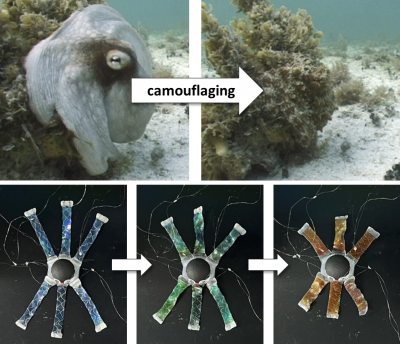
A research team led by Dr. Dae-Yoon Kim at the Korea Institute of Science and Technology (KIST) has developed a groundbreaking soft robot named ‘OCTOID’. This innovative robot, which draws inspiration from the extraordinary camouflage and movement capabilities of octopuses, can change both its color and shape in response to external stimuli.
The team at the Functional Composite Materials Research Center has designed OCTOID to perform more than just basic movements. Unlike traditional robots, which may only bend or stretch, this advanced model can adapt its appearance and functionality dynamically. The robot alters its color when exposed to electrical stimulation, allowing it to blend into different environments seamlessly. This remarkable ability to mimic its surroundings enhances the potential applications of OCTOID in various fields.
Technological Innovations and Applications
OCTOID represents a significant advancement in soft robotics, combining flexibility with smart technology. The robot is engineered to move fluidly, resembling the natural locomotion of an octopus. Its design enables it to grasp objects, making it suitable for tasks ranging from delicate handling in medical applications to exploring complex environments in search and rescue operations.
With a focus on creating robots that can operate in unpredictable situations, the research team aims to address challenges in human-robot interaction. The ability of OCTOID to change colors and shapes could lead to breakthroughs in areas such as environmental monitoring, where robots must adapt to varying conditions.
The innovative work was reported in October 2023, marking a milestone for KIST and the field of robotics. According to the research team, the implications of this technology extend beyond mere novelty. It has the potential to revolutionize the way robots are integrated into daily life, enabling them to become more versatile and effective in a range of applications.
Future Directions and Research Impact
As the field of soft robotics continues to evolve, OCTOID stands out as a prime example of how biomimicry can inspire technological advancement. The research led by Dr. Kim not only showcases the capabilities of soft robots but also highlights the importance of interdisciplinary collaboration in scientific research.
Looking ahead, the team plans to further refine the technology behind OCTOID, exploring additional functionalities and enhancing its performance. The ability to develop robots that can interact with their environment in real-time could lead to significant improvements in automation and robotics.
The work of the Korea Institute of Science and Technology under the leadership of Sangrok Oh demonstrates the potential for soft robotics to impact various industries, from healthcare to environmental sciences. As OCTOID continues to develop, it may pave the way for a new generation of robots that are not just tools but partners in various fields, adapting to our needs with remarkable agility and intelligence.

Cosmic Mystery Deepens: Where Are the Universe’s Defects?

Lady Bulldogs Shine in Postseason Awards Following Final Four Run

CALV Hosts Essential Class for Local Real Estate Professionals

Urgent Alert: “Spaving” Surges as Shoppers Overspend Online

Jefferies Initiates Coverage on Insmed with “Buy” Rating

Three Dog Night to Perform with Ambrosia at Mayo Civic Center

Urgent Announcement: Charles M. Payment Passes Away at 78

Houston Education Foundation Donates $4,592 for Student Programs

Beeks Financial Cloud Shares Drop 7% Amid Increased Trading Volume

Foreign Inflows into Japan Stocks Surge to ¥1.34 Trillion

University of Hawaiʻi Joins $25.6M AI Project to Monitor Disasters

Sydney Sweeney Embraces Body Positivity Amid Hollywood Challenges

Hudson Williams Gains Popularity as Breakout Star on Heated Rivalry

Urgent Farewell: Joleen Chaney Leaves Legacy at KFOR

Boeing’s Merger with McDonnell Douglas: A Strategic Move Explained

$1.25M Grant Advances Hawaiʻi’s Real-Time Hazard Monitoring

Derrick Dove and ABAC Band Set for Free Americana Concert

BOYNEXTDOOR’s Jaehyun Faces Backlash Amid BTS-TWICE Controversy
-
Business9 months ago
Foreign Inflows into Japan Stocks Surge to ¥1.34 Trillion
-
Science8 months ago
University of Hawaiʻi Joins $25.6M AI Project to Monitor Disasters
-
 Entertainment9 months ago
Sydney Sweeney Embraces Body Positivity Amid Hollywood Challenges
-
 Entertainment7 months ago
Hudson Williams Gains Popularity as Breakout Star on Heated Rivalry
-
 Top Stories8 months ago
Urgent Farewell: Joleen Chaney Leaves Legacy at KFOR
-
 World9 months ago
Boeing’s Merger with McDonnell Douglas: A Strategic Move Explained
-
 Science7 months ago
$1.25M Grant Advances Hawaiʻi’s Real-Time Hazard Monitoring
-
 Entertainment8 months ago
Derrick Dove and ABAC Band Set for Free Americana Concert
-
 Top Stories9 months ago
BOYNEXTDOOR’s Jaehyun Faces Backlash Amid BTS-TWICE Controversy
-

 Health6 months ago
Bodybuilder Eugene Teo Transitions to Mindful Movement for Health
-

 World6 months ago
San Francisco Airport to Host 16 Nonstop Airlines to Europe in 2026
-

 Top Stories7 months ago
National Coast Guard Museum Set to Open in 2027 After Funding Secured