
Science
Researchers Uncover Key Enzyme in Hops for Beer Flavor

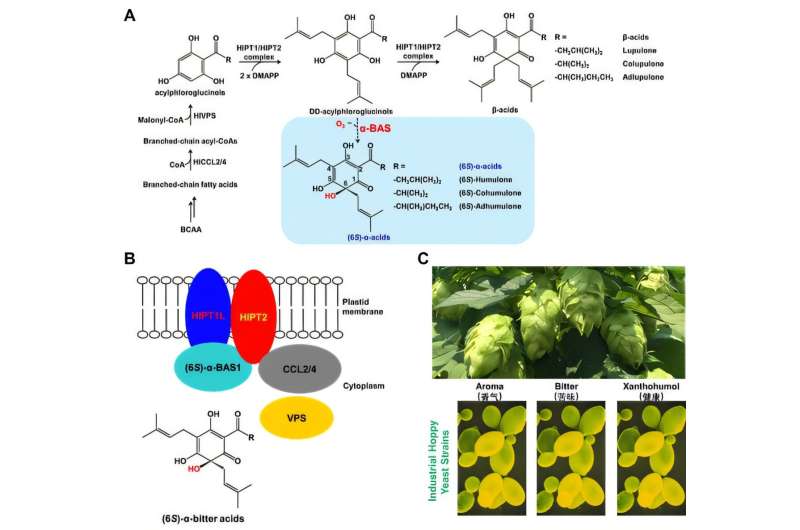
Hops play a critical role in beer production, providing its signature flavor and aroma. A recent study led by Prof. Wang Guodong from the Institute of Genetics and Developmental Biology of the Chinese Academy of Sciences has revealed the enzyme responsible for synthesizing α-bitter acids—an essential component that contributes to beer’s characteristic bitterness. This breakthrough has significant implications for both the brewing industry and the understanding of plant biosynthesis.
While the upstream biosynthetic pathway for α-bitter acids has been well-documented, the final step remained elusive for over a decade. The enzyme known as α-bitter acid synthase (α-BAS) had not been functionally verified, despite the identification of several candidate genes. The research team utilized a highly sensitive liquid chromatography–mass spectrometry (LC–MS) detection method to differentiate between the two chiral forms of α-bitter acids—6S and 6R.
Their findings, published in Plant Communications, demonstrated that hop glandular trichomes primarily accumulate the 6S-type α-bitter acid. Further research revealed that the precursor, deoxy-α-bitter acid, oxidizes when exposed to air, forming a racemic mixture of the two types. This spontaneous reaction had complicated efforts to confirm the function of α-BAS.
To overcome this challenge, the researchers established a yeast heterologous expression system and systematically tested over ten candidate genes. The results identified HlMO18 as the enzyme that specifically catalyzes the conversion of deoxy-α-bitter acid into the predominantly produced 6S form. Key amino acid residues crucial for the enzyme’s activity were also identified.
Further mechanistic analyses showed that 6S-type α-bitter acid synthase forms a metabolic complex with upstream enzymes, explaining why only the 6S form accumulates in hop glandular trichomes. This research completes the biosynthetic map of α-bitter acids in hops, providing essential insights for the brewing industry.
The implications of this discovery extend beyond understanding hops. The researchers aim to leverage synthetic biology to engineer industrial yeast strains capable of producing “hoppy beer,” which retains authentic hop flavors without using actual hop plants. This innovative approach could potentially lower production costs and allow for a greater variety of customized, flavor-rich beers.
By elucidating the biosynthetic pathways of the three major flavor compounds in hops, this study paves the way for advancements in beer production. As the brewing industry continues to evolve, these findings represent a significant step towards enhancing flavor profiles and improving efficiency in beer manufacturing.
For further details, refer to the study by Chengyong Feng and colleagues, titled “A flavin-dependent monooxygenase favors the formation of (6S)-α-bitter acids in hop glandular trichomes,” published in Plant Communications in 2025.

Cosmic Mystery Deepens: Where Are the Universe’s Defects?

Lady Bulldogs Shine in Postseason Awards Following Final Four Run

CALV Hosts Essential Class for Local Real Estate Professionals

Urgent Alert: “Spaving” Surges as Shoppers Overspend Online

Jefferies Initiates Coverage on Insmed with “Buy” Rating

Three Dog Night to Perform with Ambrosia at Mayo Civic Center

Urgent Announcement: Charles M. Payment Passes Away at 78

Houston Education Foundation Donates $4,592 for Student Programs

Beeks Financial Cloud Shares Drop 7% Amid Increased Trading Volume

Foreign Inflows into Japan Stocks Surge to ¥1.34 Trillion

University of Hawaiʻi Joins $25.6M AI Project to Monitor Disasters

Sydney Sweeney Embraces Body Positivity Amid Hollywood Challenges

Hudson Williams Gains Popularity as Breakout Star on Heated Rivalry

Urgent Farewell: Joleen Chaney Leaves Legacy at KFOR

Boeing’s Merger with McDonnell Douglas: A Strategic Move Explained

$1.25M Grant Advances Hawaiʻi’s Real-Time Hazard Monitoring

Derrick Dove and ABAC Band Set for Free Americana Concert

Bodybuilder Eugene Teo Transitions to Mindful Movement for Health
-
Business9 months ago
Foreign Inflows into Japan Stocks Surge to ¥1.34 Trillion
-
Science9 months ago
University of Hawaiʻi Joins $25.6M AI Project to Monitor Disasters
-
 Entertainment9 months ago
Sydney Sweeney Embraces Body Positivity Amid Hollywood Challenges
-
 Entertainment8 months ago
Hudson Williams Gains Popularity as Breakout Star on Heated Rivalry
-
 Top Stories9 months ago
Urgent Farewell: Joleen Chaney Leaves Legacy at KFOR
-
 World9 months ago
Boeing’s Merger with McDonnell Douglas: A Strategic Move Explained
-
 Science8 months ago
$1.25M Grant Advances Hawaiʻi’s Real-Time Hazard Monitoring
-
 Entertainment8 months ago
Derrick Dove and ABAC Band Set for Free Americana Concert
-
 Health6 months ago
Bodybuilder Eugene Teo Transitions to Mindful Movement for Health
-

 Top Stories9 months ago
BOYNEXTDOOR’s Jaehyun Faces Backlash Amid BTS-TWICE Controversy
-

 World7 months ago
San Francisco Airport to Host 16 Nonstop Airlines to Europe in 2026
-

 Top Stories7 months ago
National Coast Guard Museum Set to Open in 2027 After Funding Secured