
Science
Researchers Develop Innovative Fluorinated Framework for Gas Separation

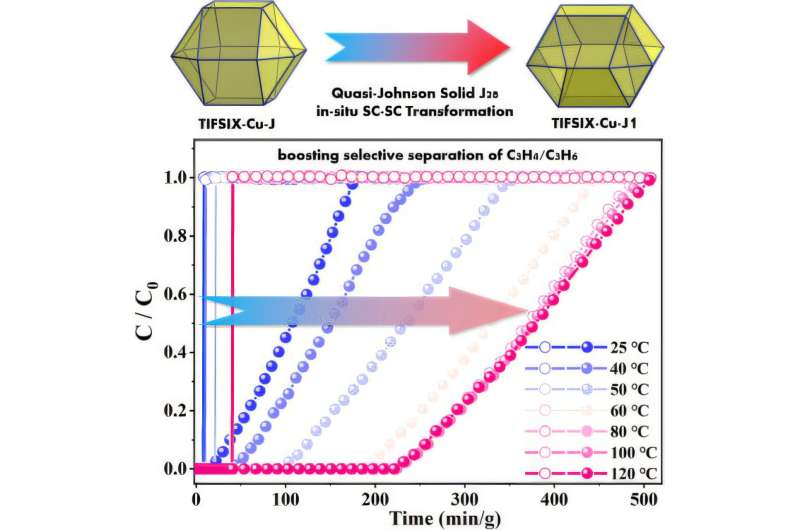
A research team from the Fujian Institute of Research on the Structure of Matter, part of the Chinese Academy of Sciences, has synthesized a groundbreaking pillar-cage fluorinated hybrid porous framework named TIFSIX-Cu-J. This novel material features a rare crystalline structure known as the quasi-Johnson solid J28. The study, led by Prof. Wu Mingyan, was published in the journal Chem on November 5, 2025, and highlights the potential of this framework in gas separation applications.
The synthesis of TIFSIX-Cu-J employed a bottom-up, self-assembly approach that utilized geometrical elements resembling quadrangles and isosceles triangles. Notably, TIFSIX-Cu-J demonstrated a heat-triggered structural transformation, converting the J28 cage into a distorted square orthobicupola structure. Researchers conducted thorough analyses, employing single-crystal-to-single-crystal (SC-SC) transformation methods and bulk crystalline powder X-ray diffraction to elucidate these structural changes.
This innovative self-assembly technique not only allows for the creation of TIFSIX-Cu-J but can also be applied to synthesize isomorphic crystals such as SIFSIX-Cu-J and ZrFSIX-Cu-J. The researchers found that TIFSIX-Cu-J1, a variant of TIFSIX-Cu-J, exhibited remarkable performance in adsorption tests, achieving a capacity of 140.5 cm³∙g-1 for C3H4 (propylene). The difference in adsorption amounts between C3H4 and C3H6 (propane) increased significantly, from 19.6 cm³∙g-1 to 34.8 cm³∙g-1.
The study also indicated that TIFSIX-Cu-J1 provided a higher selectivity for C3H4 over C3H6 compared to its predecessor TIFSIX-Cu-J. In breakthrough experiments, a column packed with TIFSIX-Cu-J1 achieved a C3H6 productivity approximately twenty times greater than that of TIFSIX-Cu-J. Theoretical calculations further confirmed that the pore surface characteristics of the quasi-Johnson solid J28 structure in TIFSIX-Cu-J1 favor the preferential capture of C3H4, thus enhancing the selective separation process for these gases.
This research not only offers new insights into the systematic design and synthesis of advanced pillar-cage fluorinated hybrid porous frameworks but also underscores the effectiveness of bottom-up, self-assembly methods for developing artificial cage-like three-dimensional architectures. Such innovations are poised to contribute significantly to energy-efficient gas purification technologies, which are increasingly vital in various industrial applications.
For more information, refer to the original study by Cheng Chen et al., titled “Pillar-cage fluorinated hybrid porous frameworks featuring quasi-Johnson solid J28,” published in Chem, DOI: 10.1016/j.chempr.2025.102696.

Cosmic Mystery Deepens: Where Are the Universe’s Defects?

Lady Bulldogs Shine in Postseason Awards Following Final Four Run

CALV Hosts Essential Class for Local Real Estate Professionals

Urgent Alert: “Spaving” Surges as Shoppers Overspend Online

Jefferies Initiates Coverage on Insmed with “Buy” Rating

Three Dog Night to Perform with Ambrosia at Mayo Civic Center

Urgent Announcement: Charles M. Payment Passes Away at 78

Houston Education Foundation Donates $4,592 for Student Programs

Beeks Financial Cloud Shares Drop 7% Amid Increased Trading Volume

Foreign Inflows into Japan Stocks Surge to ¥1.34 Trillion

University of Hawaiʻi Joins $25.6M AI Project to Monitor Disasters

Sydney Sweeney Embraces Body Positivity Amid Hollywood Challenges

Hudson Williams Gains Popularity as Breakout Star on Heated Rivalry

Urgent Farewell: Joleen Chaney Leaves Legacy at KFOR

Boeing’s Merger with McDonnell Douglas: A Strategic Move Explained

$1.25M Grant Advances Hawaiʻi’s Real-Time Hazard Monitoring

Derrick Dove and ABAC Band Set for Free Americana Concert

Bodybuilder Eugene Teo Transitions to Mindful Movement for Health
-
Business9 months ago
Foreign Inflows into Japan Stocks Surge to ¥1.34 Trillion
-
Science9 months ago
University of Hawaiʻi Joins $25.6M AI Project to Monitor Disasters
-
 Entertainment9 months ago
Sydney Sweeney Embraces Body Positivity Amid Hollywood Challenges
-
 Entertainment8 months ago
Hudson Williams Gains Popularity as Breakout Star on Heated Rivalry
-
 Top Stories9 months ago
Urgent Farewell: Joleen Chaney Leaves Legacy at KFOR
-
 World9 months ago
Boeing’s Merger with McDonnell Douglas: A Strategic Move Explained
-
 Science8 months ago
$1.25M Grant Advances Hawaiʻi’s Real-Time Hazard Monitoring
-
 Entertainment8 months ago
Derrick Dove and ABAC Band Set for Free Americana Concert
-
 Health6 months ago
Bodybuilder Eugene Teo Transitions to Mindful Movement for Health
-

 Top Stories9 months ago
BOYNEXTDOOR’s Jaehyun Faces Backlash Amid BTS-TWICE Controversy
-

 World7 months ago
San Francisco Airport to Host 16 Nonstop Airlines to Europe in 2026
-

 Top Stories7 months ago
National Coast Guard Museum Set to Open in 2027 After Funding Secured