
Science
New Antibody Therapy 77A Enhances Immune Response Against Cancers

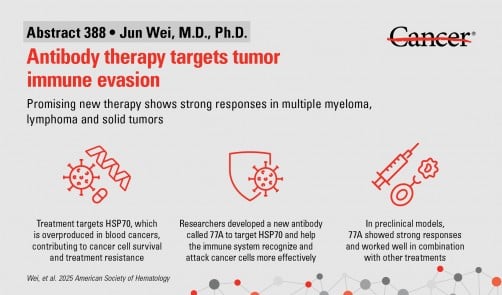
A new investigational therapy, known as 77A, developed by researchers at The University of Texas MD Anderson Cancer Center, has shown significant promise in enhancing the immune response against various blood cancers, including myeloma and lymphoma, as well as solid tumors. This breakthrough was presented on December 6, 2025, during the 67th Annual Meeting and Exposition of the American Society of Hematology (ASH) by Jun Wei, M.D., Ph.D., an assistant professor of Lymphoma & Myeloma.
The therapy utilizes an antibody that targets a cancer survival protein known as HSP70. By converting HSP70 into an immune system trigger, 77A activates T cells and natural killer (NK) cells. This activation is crucial in reshaping the tumor environment and fostering long-lasting immune responses. In preclinical laboratory models, 77A demonstrated its ability to amplify the effects of chemotherapy, radiation, and other immunotherapies across multiple tumor types.
Mechanism of Action and Early Findings
The mechanism behind 77A’s effectiveness lies in its ability to target HSP70, which is often overproduced in certain cancers and plays a role in helping tumors evade immune detection. By suppressing immune responses and promoting cancer cell survival, HSP70 creates a challenging environment for treatment. In laboratory settings, 77A exhibited strong antitumor effects, significantly improving the detection and destruction of cancer cells by enhancing the activity of both innate and adaptive immune cells.
The therapy’s synergistic potential is particularly notable when combined with established treatments. It has proven effective alongside chemotherapy, radiation therapy, and immune checkpoint blockade. Furthermore, 77A shows promise in conjunction with adoptive T cell therapy, a modern approach where patients receive lab-grown immune cells designed to target their cancer.
Next Steps and Future Implications
The findings from this study open avenues for future clinical trials, particularly as early tests with human immune cells suggest that 77A could enhance immune responses even in healthy individuals. This positions 77A as a potentially versatile therapeutic option, warranting further investigation.
Robert Z. Orlowski, M.D., Ph.D., a professor of Lymphoma & Myeloma, expressed optimism about the therapy’s future: “These results give us confidence that 77A could become a versatile immunotherapy. Our next step is to advance a humanized version of this antibody into clinical trials to evaluate its potential in patients across multiple cancer types.”
The development of the humanized version of 77A is currently underway, with plans to initiate clinical trials in the near future. This represents a significant step forward in the fight against cancer, providing hope for patients battling various forms of the disease.
The study received support from Blood Cancer United, formerly known as the Leukemia & Lymphoma Society. A comprehensive list of collaborating authors and their disclosures is available with the abstract presented at the ASH meeting. As research progresses, 77A may very well pave the way for a new era in immunotherapy, offering renewed hope for those affected by blood and solid cancers.

Cosmic Mystery Deepens: Where Are the Universe’s Defects?

Lady Bulldogs Shine in Postseason Awards Following Final Four Run

CALV Hosts Essential Class for Local Real Estate Professionals

Urgent Alert: “Spaving” Surges as Shoppers Overspend Online

Jefferies Initiates Coverage on Insmed with “Buy” Rating

Three Dog Night to Perform with Ambrosia at Mayo Civic Center

Urgent Announcement: Charles M. Payment Passes Away at 78

Houston Education Foundation Donates $4,592 for Student Programs

Beeks Financial Cloud Shares Drop 7% Amid Increased Trading Volume

Foreign Inflows into Japan Stocks Surge to ¥1.34 Trillion

University of Hawaiʻi Joins $25.6M AI Project to Monitor Disasters

Sydney Sweeney Embraces Body Positivity Amid Hollywood Challenges

Hudson Williams Gains Popularity as Breakout Star on Heated Rivalry

Urgent Farewell: Joleen Chaney Leaves Legacy at KFOR

Boeing’s Merger with McDonnell Douglas: A Strategic Move Explained

$1.25M Grant Advances Hawaiʻi’s Real-Time Hazard Monitoring

Derrick Dove and ABAC Band Set for Free Americana Concert

BOYNEXTDOOR’s Jaehyun Faces Backlash Amid BTS-TWICE Controversy
-
Business9 months ago
Foreign Inflows into Japan Stocks Surge to ¥1.34 Trillion
-
Science8 months ago
University of Hawaiʻi Joins $25.6M AI Project to Monitor Disasters
-
 Entertainment9 months ago
Sydney Sweeney Embraces Body Positivity Amid Hollywood Challenges
-
 Entertainment7 months ago
Hudson Williams Gains Popularity as Breakout Star on Heated Rivalry
-
 Top Stories8 months ago
Urgent Farewell: Joleen Chaney Leaves Legacy at KFOR
-
 World9 months ago
Boeing’s Merger with McDonnell Douglas: A Strategic Move Explained
-
 Science7 months ago
$1.25M Grant Advances Hawaiʻi’s Real-Time Hazard Monitoring
-
 Entertainment8 months ago
Derrick Dove and ABAC Band Set for Free Americana Concert
-
 Top Stories9 months ago
BOYNEXTDOOR’s Jaehyun Faces Backlash Amid BTS-TWICE Controversy
-

 Health6 months ago
Bodybuilder Eugene Teo Transitions to Mindful Movement for Health
-

 World6 months ago
San Francisco Airport to Host 16 Nonstop Airlines to Europe in 2026
-

 Top Stories7 months ago
National Coast Guard Museum Set to Open in 2027 After Funding Secured