
Science
NASA’s Chandra Releases Timelapse of Kepler’s Supernova Remnant

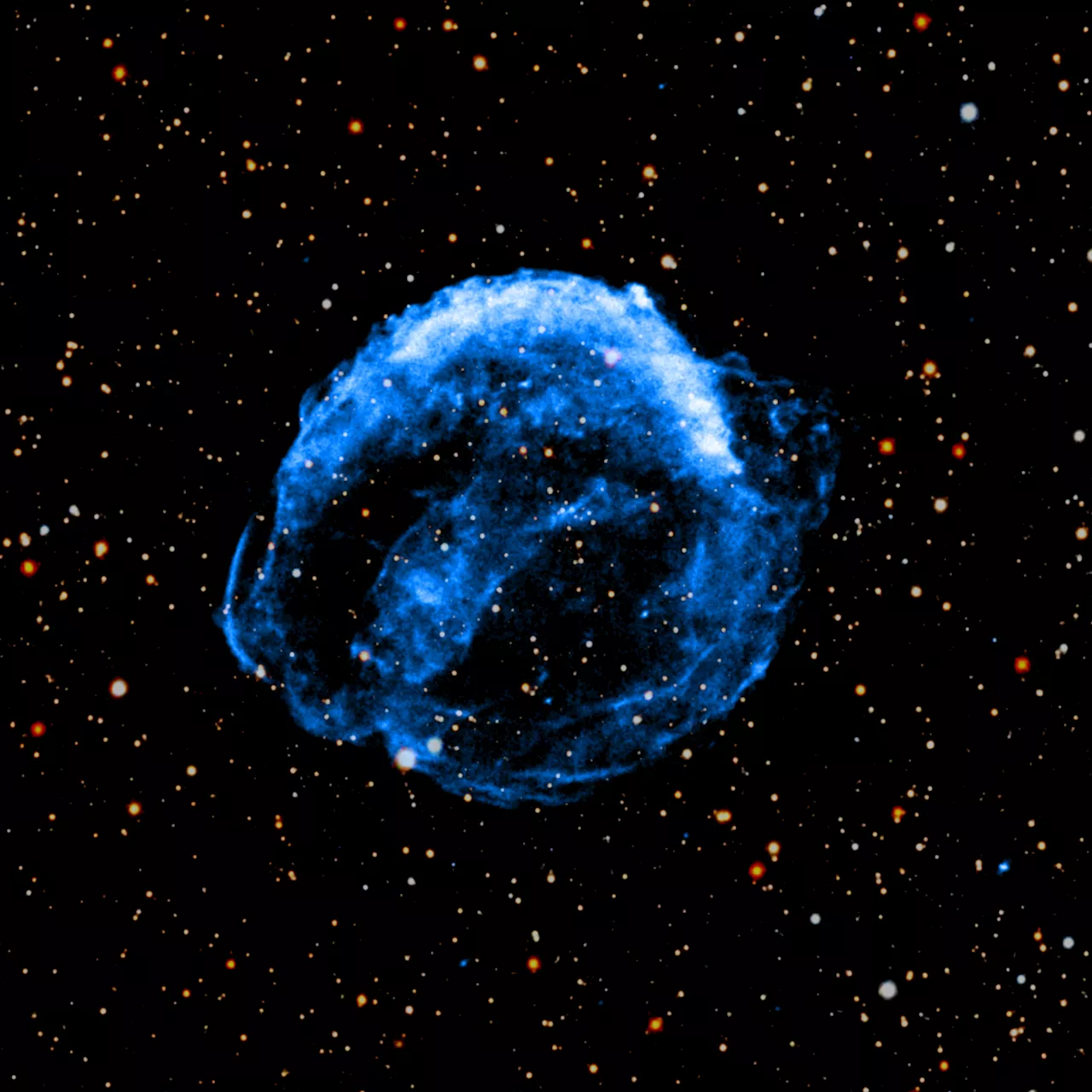
A new video showcasing the evolution of Kepler’s Supernova Remnant has been released by NASA, utilizing data from the Chandra X-ray Observatory gathered over more than two and a half decades. This video, the longest ever produced by Chandra, features X-ray observations taken in the years 2000, 2004, 2006, 2014, and 2025, combined with optical images from the Pan-STARRS telescope.
Kepler’s Supernova Remnant, named after the German astronomer Johannes Kepler, was first documented in the night sky in 1604. Astronomers have since determined that the remnant is the result of a white dwarf star explosion, triggered when it exceeded a critical mass, either by drawing material from a companion star or merging with another white dwarf. This type of supernova is classified as Type Ia, which scientists use to measure the universe’s expansion.
The remnant, located approximately 17,000 light-years from Earth, emits strong X-ray light due to the intense heating of materials left in the wake of the explosion. This enables Chandra to capture detailed images of the debris and its changes over time.
Insights from Decades of Data
The video highlights the dynamic nature of the supernova remnant, demonstrating the changes in size and structure over the years. According to Jessye Gassel, a graduate student at George Mason University and the lead researcher on this project, “The plot of Kepler’s story is just now beginning to unfold.” Gassel discussed the findings at the 247th meeting of the American Astronomical Society in Phoenix.
The analysis indicates that the fastest-moving parts of the remnant travel at about 13.8 million miles per hour, heading toward the lower section of the video frame. In contrast, the slower areas are moving at around 4 million miles per hour toward the upper section. This significant disparity in speed is attributed to the varying densities of gas encountered by the remnant. The denser gas at the top slows the expansion compared to the less dense gas at the bottom.
Understanding Cosmic Evolution
Understanding supernova explosions and the elements they release into space is crucial for grasping the formation of new stars and planets. Brian Williams, a principal investigator at NASA’s Goddard Space Flight Center, emphasized the importance of this research, stating, “Supernova explosions and the elements they hurl into space are the lifeblood of new stars and planets. Understanding exactly how they behave is crucial to knowing our cosmic history.”
In addition to analyzing the motion of the remnant, researchers also examined the characteristics of the blast wave—the leading edge of the explosion. By measuring its width and speed, scientists can gather more information about the stellar explosion and its surrounding environment.
NASA’s Marshall Space Flight Center in Huntsville, Alabama, manages the Chandra program, while the Smithsonian Astrophysical Observatory’s Chandra X-ray Center oversees the scientific operations from Cambridge, Massachusetts.
The ten-second silent video allows for a detailed visual experience of Kepler’s expanding Supernova Remnant. As viewers observe the sequence, they can see the remnant resemble a cloudy neon blue ring, subtly expanding over time, akin to a slowly inflating balloon. The animation cycles through the five datasets, with dates displayed in the lower right corner, providing context and allowing for better comprehension of the visual data.
Through decades of meticulous data collection and analysis, scientists are gaining deeper insights into the environment where this once-massive star exploded, enhancing our understanding of how stellar remnants evolve over time.

Cosmic Mystery Deepens: Where Are the Universe’s Defects?

Lady Bulldogs Shine in Postseason Awards Following Final Four Run

CALV Hosts Essential Class for Local Real Estate Professionals

Urgent Alert: “Spaving” Surges as Shoppers Overspend Online

Jefferies Initiates Coverage on Insmed with “Buy” Rating

Three Dog Night to Perform with Ambrosia at Mayo Civic Center

Urgent Announcement: Charles M. Payment Passes Away at 78

Houston Education Foundation Donates $4,592 for Student Programs

Beeks Financial Cloud Shares Drop 7% Amid Increased Trading Volume

Foreign Inflows into Japan Stocks Surge to ¥1.34 Trillion

University of Hawaiʻi Joins $25.6M AI Project to Monitor Disasters

Sydney Sweeney Embraces Body Positivity Amid Hollywood Challenges

Hudson Williams Gains Popularity as Breakout Star on Heated Rivalry

Urgent Farewell: Joleen Chaney Leaves Legacy at KFOR

Boeing’s Merger with McDonnell Douglas: A Strategic Move Explained

$1.25M Grant Advances Hawaiʻi’s Real-Time Hazard Monitoring

Derrick Dove and ABAC Band Set for Free Americana Concert

BOYNEXTDOOR’s Jaehyun Faces Backlash Amid BTS-TWICE Controversy
-
Business9 months ago
Foreign Inflows into Japan Stocks Surge to ¥1.34 Trillion
-
Science9 months ago
University of Hawaiʻi Joins $25.6M AI Project to Monitor Disasters
-
 Entertainment9 months ago
Sydney Sweeney Embraces Body Positivity Amid Hollywood Challenges
-
 Entertainment7 months ago
Hudson Williams Gains Popularity as Breakout Star on Heated Rivalry
-
 Top Stories8 months ago
Urgent Farewell: Joleen Chaney Leaves Legacy at KFOR
-
 World9 months ago
Boeing’s Merger with McDonnell Douglas: A Strategic Move Explained
-
 Science7 months ago
$1.25M Grant Advances Hawaiʻi’s Real-Time Hazard Monitoring
-
 Entertainment8 months ago
Derrick Dove and ABAC Band Set for Free Americana Concert
-
 Top Stories9 months ago
BOYNEXTDOOR’s Jaehyun Faces Backlash Amid BTS-TWICE Controversy
-

 Health6 months ago
Bodybuilder Eugene Teo Transitions to Mindful Movement for Health
-

 World6 months ago
San Francisco Airport to Host 16 Nonstop Airlines to Europe in 2026
-

 Top Stories7 months ago
National Coast Guard Museum Set to Open in 2027 After Funding Secured