
Science
Metal Detectorist Uncovers Enigmatic Viking Age Grave in Norway

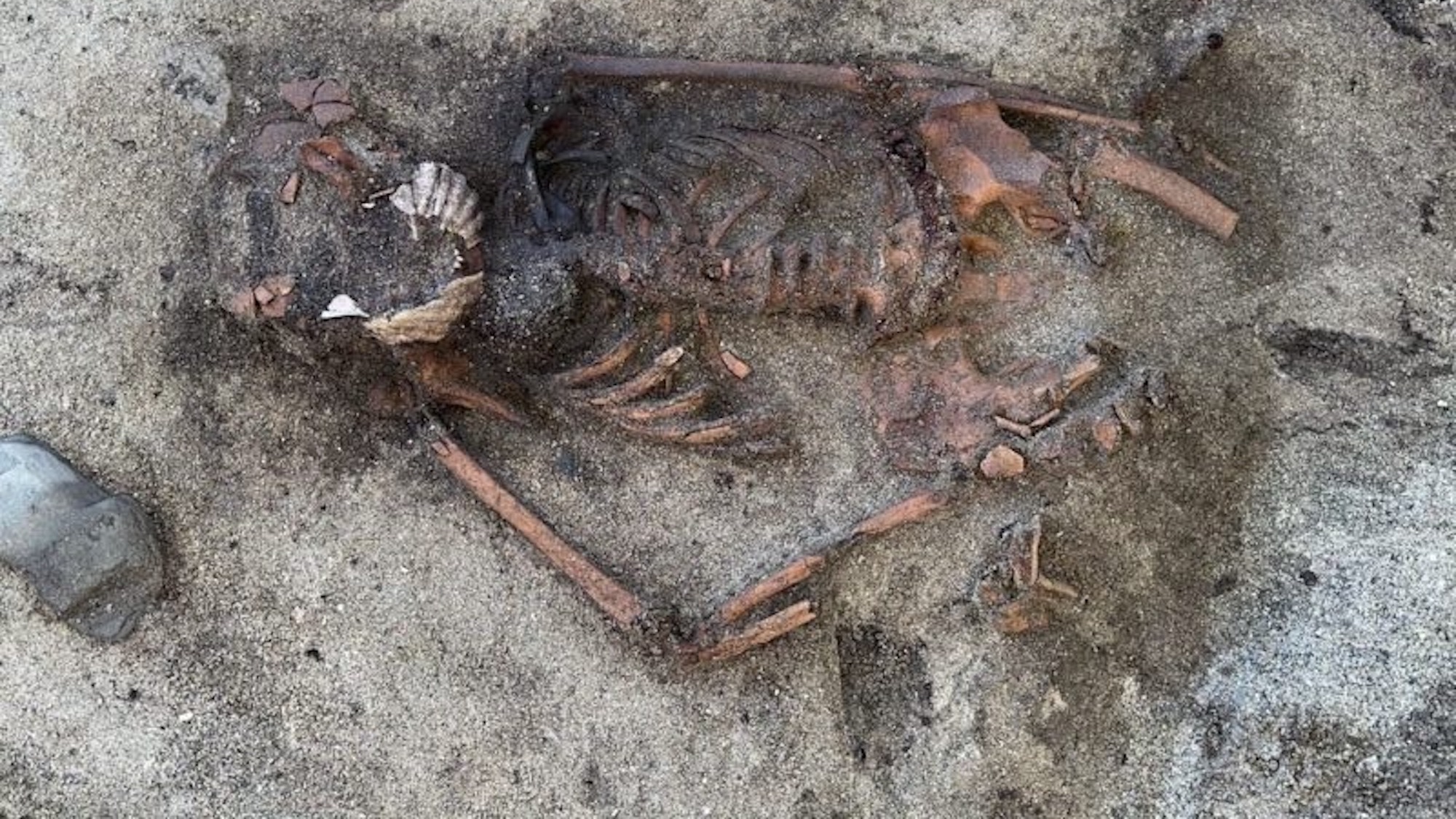
A remarkable discovery has emerged from Trøndelag County, Norway, where a metal detectorist has uncovered a Viking Age grave containing the remains of an individual adorned with elaborate costume and jewelry. This significant find was initiated by Roy Søreng, who, after locating an oval brooch, contacted researchers from the Norwegian University of Science and Technology (NTNU) for further investigation. The subsequent excavation has revealed a wealth of archaeological treasures that shed light on the customs of the Viking Age.
The excavation team, led by Raymond Sauvage, head engineer of the NTNU Museum’s Department of Archaeology and Cultural History, has been working discreetly to protect the site. “The Viking Age grave contains what we believe to be a woman, buried with a typical Viking Age costume and jewelry set from the 800s,” said Sauvage. This suggests that she was a free woman, possibly married, and may have held a significant role, perhaps as the mistress of a local farm.
Among the grave’s contents, archaeologists found two oval brooches, including the one discovered by Søreng, which were used to secure the straps of a suspender dress. Additionally, a ring buckle was uncovered, intended to fasten the neck opening of a petticoat. Notably, the grave also included two scallop shells that partially covered the deceased’s mouth. While scallop shells are known to have symbolized Christianity during the Middle Ages, their presence in a pre-Christian burial site raises intriguing questions regarding their significance.
“This practice is not previously known from pre-Christian graves in Norway,” Sauvage explained. “We don’t yet know what the symbolism means.” Alongside the scallop shells, the excavation revealed bird bones, likely wing bones, which may have also held symbolic importance during the burial ceremony.
The recent discovery follows another significant find at the same location earlier this year, where another well-preserved skeleton was unearthed. Hanne Bryn, field supervisor from the NTNU’s Department of Archaeology and Cultural History, noted that the new grave likely belongs to an individual one to three generations younger than the previously discovered skeleton. “During the inspection, we quickly realized that we were facing a new skeletal grave that was in acute danger of being damaged during the next ploughing,” Bryn added.
Thanks to the cooperation of the landowner, Arve Innstrand, the excavation could proceed, allowing researchers to study the grave in detail. The next phase of the project will involve comprehensive analysis of the skeleton, preservation of the artifacts, and collection of samples for dating and DNA analysis. “The goal is to learn more about the person and any possible kinship to the previous find from the same site,” Sauvage stated.
Researchers will investigate various aspects, including the individual’s height, gender-defining traits, and any signs of disease. As the analysis unfolds, the archaeological community anticipates further revelations that could deepen understanding of Viking Age burial practices and social structures.
This discovery not only highlights the ongoing contributions of amateur archaeologists like Søreng but also underscores the importance of collaboration between the public and academic institutions in uncovering and preserving history. The findings from Trøndelag County promise to enrich the narrative of the Viking Age and provide a clearer picture of life in that era.

Cosmic Mystery Deepens: Where Are the Universe’s Defects?

Lady Bulldogs Shine in Postseason Awards Following Final Four Run

CALV Hosts Essential Class for Local Real Estate Professionals

Urgent Alert: “Spaving” Surges as Shoppers Overspend Online

Jefferies Initiates Coverage on Insmed with “Buy” Rating

Three Dog Night to Perform with Ambrosia at Mayo Civic Center

Urgent Announcement: Charles M. Payment Passes Away at 78

Houston Education Foundation Donates $4,592 for Student Programs

Beeks Financial Cloud Shares Drop 7% Amid Increased Trading Volume

Foreign Inflows into Japan Stocks Surge to ¥1.34 Trillion

University of Hawaiʻi Joins $25.6M AI Project to Monitor Disasters

Sydney Sweeney Embraces Body Positivity Amid Hollywood Challenges

Hudson Williams Gains Popularity as Breakout Star on Heated Rivalry

Urgent Farewell: Joleen Chaney Leaves Legacy at KFOR

Boeing’s Merger with McDonnell Douglas: A Strategic Move Explained

$1.25M Grant Advances Hawaiʻi’s Real-Time Hazard Monitoring

Derrick Dove and ABAC Band Set for Free Americana Concert

Bodybuilder Eugene Teo Transitions to Mindful Movement for Health
-
Business9 months ago
Foreign Inflows into Japan Stocks Surge to ¥1.34 Trillion
-
Science9 months ago
University of Hawaiʻi Joins $25.6M AI Project to Monitor Disasters
-
 Entertainment9 months ago
Sydney Sweeney Embraces Body Positivity Amid Hollywood Challenges
-
 Entertainment8 months ago
Hudson Williams Gains Popularity as Breakout Star on Heated Rivalry
-
 Top Stories9 months ago
Urgent Farewell: Joleen Chaney Leaves Legacy at KFOR
-
 World9 months ago
Boeing’s Merger with McDonnell Douglas: A Strategic Move Explained
-
 Science8 months ago
$1.25M Grant Advances Hawaiʻi’s Real-Time Hazard Monitoring
-
 Entertainment8 months ago
Derrick Dove and ABAC Band Set for Free Americana Concert
-
 Health6 months ago
Bodybuilder Eugene Teo Transitions to Mindful Movement for Health
-

 Top Stories9 months ago
BOYNEXTDOOR’s Jaehyun Faces Backlash Amid BTS-TWICE Controversy
-

 World7 months ago
San Francisco Airport to Host 16 Nonstop Airlines to Europe in 2026
-

 Top Stories7 months ago
National Coast Guard Museum Set to Open in 2027 After Funding Secured