
Science
Interstellar Comet 3I/ATLAS Offers Unique Insights into Cosmic Origins

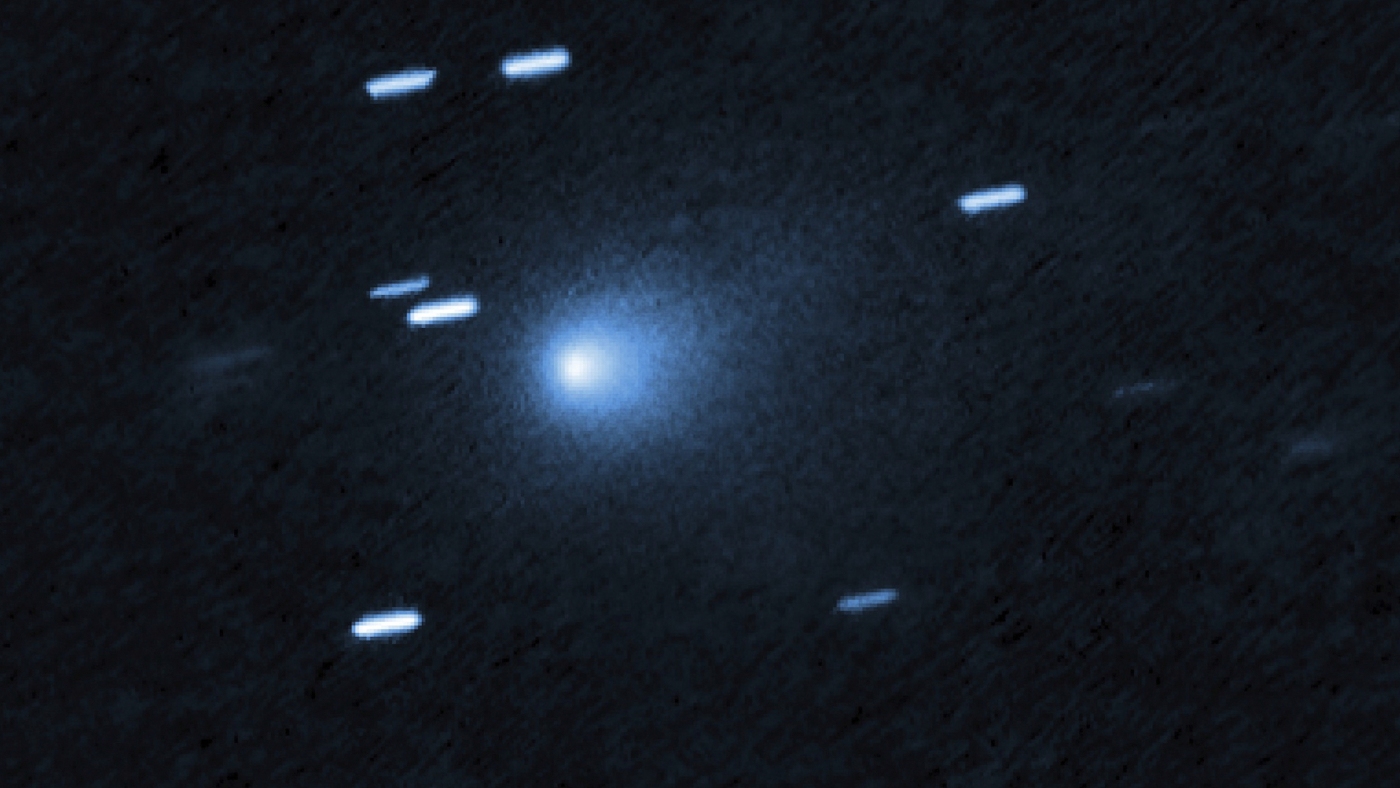
An ancient comet from beyond our solar system, designated 3I/ATLAS, has captured the attention of scientists following its arrival this summer. This celestial body provides a rare opportunity to study planetary systems far removed from our current technological reach, offering insights into the origins of materials that may date back billions of years.
The significance of 3I/ATLAS lies not only in its interstellar origin but also in the detection of nickel vapor in the gas surrounding it. This finding marks the first instance of such a metal being identified at a distance nearly four times that of Earth from the sun, where temperatures typically prevent metals from vaporizing. According to Darryl Z. Seligman, an assistant professor of physics and astronomy at Michigan State University, observing this rare comet is “extremely valuable” as it presents a unique chance to analyze an object before it exits our solar system.
The comet was first confirmed on July 1, 2023, through a sky survey conducted by the Asteroid Terrestrial-impact Last Alert System (ATLAS). Subsequent observations by research teams, including those from the Instituto de Astrofísca-Pontificia Universidad Católica de Chile, revealed the presence of nickel vapor. Rohan Rahatgaonkar, a Ph.D. student involved in the research, noted that the nickel levels increased during their observations using the Very Large Telescope in Chile, which was not initially aimed at detecting such materials.
Unlocking the Secrets of 3I/ATLAS
The research team, led by Thomas Puzia, emphasized the excitement surrounding the nickel detection, stating, “It was pretty clear that it was nickel. So it was super, super exciting.” Despite this breakthrough, Puzia cautions that further evidence collection and analysis are needed to understand the implications of these findings fully.
As 3I/ATLAS approaches the sun, it will experience thermodynamic changes that could trigger additional reactions, potentially offering further clues about its formation and evolution. The comet may even be older than our solar system, as indicated by the chemical signatures it emits. Rahatgaonkar explained that these signatures reflect the comet’s ancient origins and its extensive journey through interstellar space.
Seligman, Rahatgaonkar, and Puzia highlighted the importance of studying interstellar objects like 3I/ATLAS for understanding star systems that formed billions of years ago. These celestial bodies provide invaluable chemical and physical details about their origins, enriching our knowledge of the universe beyond our solar system.
The analysis of 3I/ATLAS continues as international teams collaborate, combining observations from various telescopes and instruments. This ongoing research underscores the potential for new discoveries about the cosmos and the ancient materials that populate it, making 3I/ATLAS a focal point for future investigations into interstellar phenomena.

Cosmic Mystery Deepens: Where Are the Universe’s Defects?

Lady Bulldogs Shine in Postseason Awards Following Final Four Run

CALV Hosts Essential Class for Local Real Estate Professionals

Urgent Alert: “Spaving” Surges as Shoppers Overspend Online

Jefferies Initiates Coverage on Insmed with “Buy” Rating

Three Dog Night to Perform with Ambrosia at Mayo Civic Center

Urgent Announcement: Charles M. Payment Passes Away at 78

Houston Education Foundation Donates $4,592 for Student Programs

Beeks Financial Cloud Shares Drop 7% Amid Increased Trading Volume

Foreign Inflows into Japan Stocks Surge to ¥1.34 Trillion

University of Hawaiʻi Joins $25.6M AI Project to Monitor Disasters

Sydney Sweeney Embraces Body Positivity Amid Hollywood Challenges

Hudson Williams Gains Popularity as Breakout Star on Heated Rivalry

Urgent Farewell: Joleen Chaney Leaves Legacy at KFOR

Boeing’s Merger with McDonnell Douglas: A Strategic Move Explained

$1.25M Grant Advances Hawaiʻi’s Real-Time Hazard Monitoring

Derrick Dove and ABAC Band Set for Free Americana Concert

BOYNEXTDOOR’s Jaehyun Faces Backlash Amid BTS-TWICE Controversy
-
Business9 months ago
Foreign Inflows into Japan Stocks Surge to ¥1.34 Trillion
-
Science9 months ago
University of Hawaiʻi Joins $25.6M AI Project to Monitor Disasters
-
 Entertainment9 months ago
Sydney Sweeney Embraces Body Positivity Amid Hollywood Challenges
-
 Entertainment7 months ago
Hudson Williams Gains Popularity as Breakout Star on Heated Rivalry
-
 Top Stories8 months ago
Urgent Farewell: Joleen Chaney Leaves Legacy at KFOR
-
 World9 months ago
Boeing’s Merger with McDonnell Douglas: A Strategic Move Explained
-
 Science7 months ago
$1.25M Grant Advances Hawaiʻi’s Real-Time Hazard Monitoring
-
 Entertainment8 months ago
Derrick Dove and ABAC Band Set for Free Americana Concert
-
 Top Stories9 months ago
BOYNEXTDOOR’s Jaehyun Faces Backlash Amid BTS-TWICE Controversy
-

 Health6 months ago
Bodybuilder Eugene Teo Transitions to Mindful Movement for Health
-

 Top Stories7 months ago
National Coast Guard Museum Set to Open in 2027 After Funding Secured
-

 World6 months ago
San Francisco Airport to Host 16 Nonstop Airlines to Europe in 2026