
Science
Innovator Builds Versatile Xenon Lamp for Spectroscopy

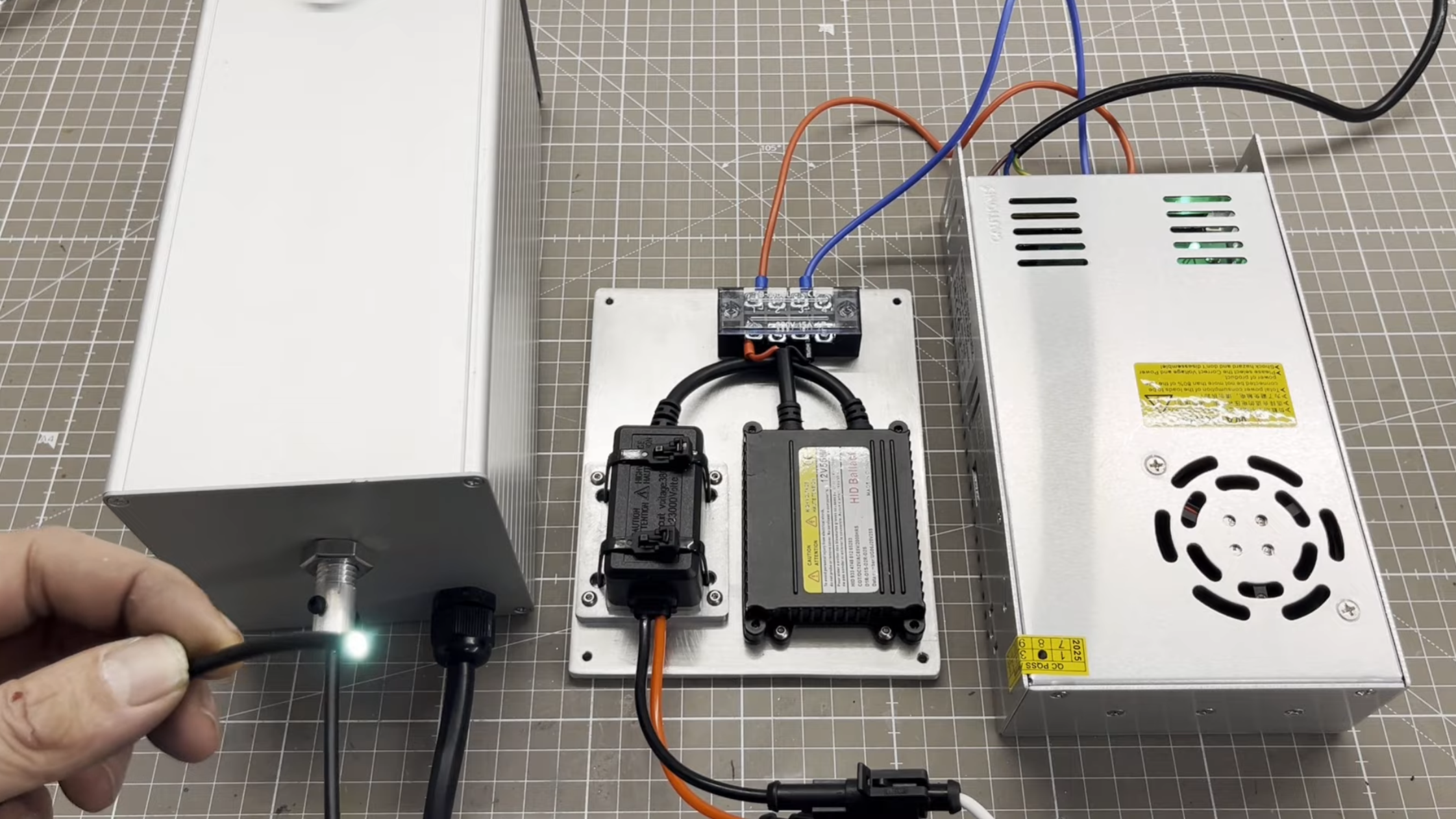
A new light source for spectroscopy has been developed by an innovator known as Markus Bindhammer. In his latest video, he demonstrates the construction of a xenon lamp that promises to enhance the accuracy and versatility of spectrometric measurements. This development highlights the potential for hobbyists and professionals alike to utilize a more effective calibration method for identifying wavelengths.
Before any spectrometer can effectively analyze light, it must undergo calibration. This process typically involves detecting distinctive peaks or troughs from a known light source to establish a reference for subsequent measurements. While many hobbyists rely on the peaks produced by a mercury-vapor fluorescent light, a xenon bulb offers a broader and more adaptable range of wavelengths. The xenon gas discharge not only covers a wide band of wavelengths but also emits several characteristic spikes in the infrared spectrum, making it particularly valuable for absorbance spectroscopy.
In his project, Markus Bindhammer employed an H7 xenon bulb, commonly used in vehicle headlights, as the core of his light source. The design features a concave mirror positioned behind the bulb, which helps to reflect and focus the emitted light. Two converging lenses are placed in front of the bulb to direct the light onto the end of an optical cable made of PMMA, enhancing the transmission of ultraviolet light. The entire assembly is secured with aluminum brackets, ensuring stability and alignment.
The concave mirror in the setup is crafted from a section of aluminum pipe that has been cut open, demonstrating both creativity and resourcefulness in the construction process. To protect the internal components from stray light, a light trap is fitted over the fan outlet, which also aids in cooling the system. The complete setup is housed within an aluminum case, emphasizing durability and portability.
While Markus Bindhammer has yet to test this new light source with his unique spectrometer, initial assessments suggest it should perform effectively. The project not only showcases innovative techniques for amateur scientists but also underscores the need to explore commercial scientific light sources for broader applications.
This development stands as a testament to the growing interest and capability within the amateur scientific community, encouraging further exploration and experimentation in the field of spectroscopy. As enthusiasts like Markus continue to push the boundaries of home-built scientific equipment, the potential for advancements in measurement accuracy and versatility increases significantly.

Cosmic Mystery Deepens: Where Are the Universe’s Defects?

Lady Bulldogs Shine in Postseason Awards Following Final Four Run

CALV Hosts Essential Class for Local Real Estate Professionals

Urgent Alert: “Spaving” Surges as Shoppers Overspend Online

Jefferies Initiates Coverage on Insmed with “Buy” Rating

Three Dog Night to Perform with Ambrosia at Mayo Civic Center

Urgent Announcement: Charles M. Payment Passes Away at 78

Houston Education Foundation Donates $4,592 for Student Programs

Beeks Financial Cloud Shares Drop 7% Amid Increased Trading Volume

Foreign Inflows into Japan Stocks Surge to ¥1.34 Trillion

University of Hawaiʻi Joins $25.6M AI Project to Monitor Disasters

Sydney Sweeney Embraces Body Positivity Amid Hollywood Challenges

Hudson Williams Gains Popularity as Breakout Star on Heated Rivalry

Urgent Farewell: Joleen Chaney Leaves Legacy at KFOR

Boeing’s Merger with McDonnell Douglas: A Strategic Move Explained

$1.25M Grant Advances Hawaiʻi’s Real-Time Hazard Monitoring

Derrick Dove and ABAC Band Set for Free Americana Concert

BOYNEXTDOOR’s Jaehyun Faces Backlash Amid BTS-TWICE Controversy
-
Business9 months ago
Foreign Inflows into Japan Stocks Surge to ¥1.34 Trillion
-
Science9 months ago
University of Hawaiʻi Joins $25.6M AI Project to Monitor Disasters
-
 Entertainment9 months ago
Sydney Sweeney Embraces Body Positivity Amid Hollywood Challenges
-
 Entertainment8 months ago
Hudson Williams Gains Popularity as Breakout Star on Heated Rivalry
-
 Top Stories9 months ago
Urgent Farewell: Joleen Chaney Leaves Legacy at KFOR
-
 World9 months ago
Boeing’s Merger with McDonnell Douglas: A Strategic Move Explained
-
 Science8 months ago
$1.25M Grant Advances Hawaiʻi’s Real-Time Hazard Monitoring
-
 Entertainment8 months ago
Derrick Dove and ABAC Band Set for Free Americana Concert
-
 Top Stories9 months ago
BOYNEXTDOOR’s Jaehyun Faces Backlash Amid BTS-TWICE Controversy
-

 Health6 months ago
Bodybuilder Eugene Teo Transitions to Mindful Movement for Health
-

 World6 months ago
San Francisco Airport to Host 16 Nonstop Airlines to Europe in 2026
-

 Top Stories7 months ago
National Coast Guard Museum Set to Open in 2027 After Funding Secured