
Science
How Hammerhead Sharks Evolved Their Unique Heads

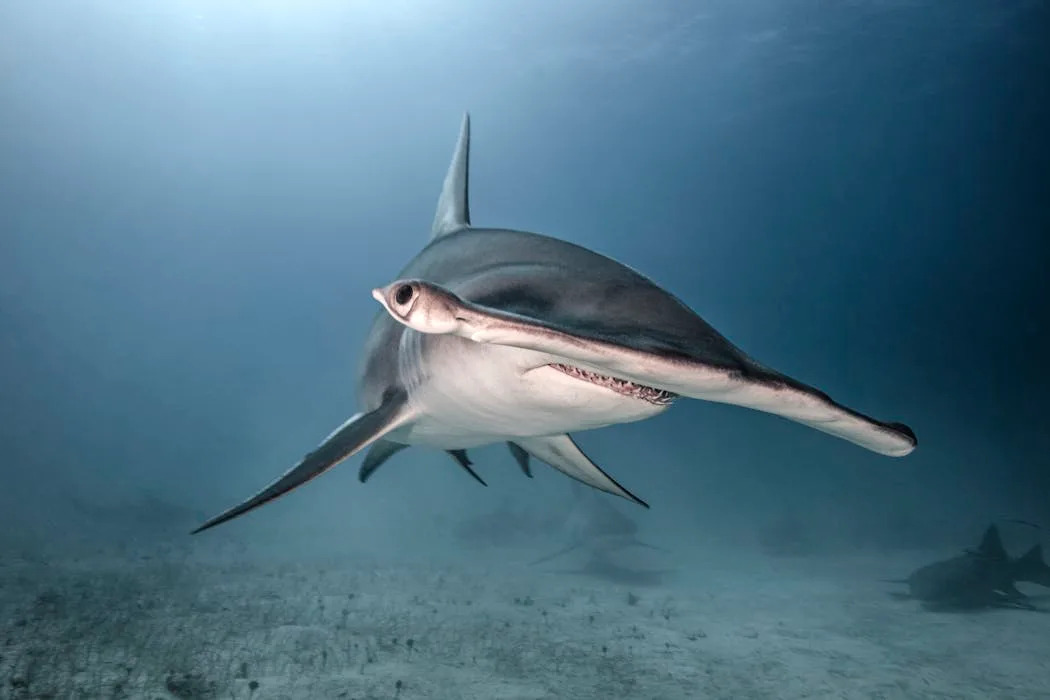
Hammerhead sharks are renowned for their distinctive hammer-shaped heads, a feature that has intrigued scientists and the public alike. According to research conducted by Gavin Naylor from the University of Florida, these unique head shapes offer several advantages that contribute to the sharks’ survival in their ocean habitats.
Advantages of the Hammer Shape
One of the primary benefits of the hammer-shaped head is enhanced vision. The placement of the eyes on either side of the head allows hammerhead sharks to have a wider field of view. This positioning enables them to see different parts of their surroundings simultaneously. To counterbalance the challenge of depth perception that comes with such a wide angle, hammerhead sharks possess specialized sensory organs known as ampullae of Lorenzini. These pore-like structures, located on the underside of their hammers, can detect electrical signals emitted by potential prey, allowing them to locate food buried in the sand.
Research indicates that hammerhead sharks also benefit from increased maneuverability. The enlarged surface area of their heads aids in making quick turns while swimming. This adaptation is crucial when chasing fast-moving prey, as a hammerhead can pivot more swiftly than other shark species, improving its chances of a successful catch.
Evolutionary Insights
The evolutionary history of hammerhead sharks is not fully understood, primarily due to the lack of fossil evidence beyond their teeth. Sharks are composed of cartilage, which decomposes rapidly and does not fossilize well, making it difficult for scientists to trace their development through time. Currently, there are nine species of hammerhead sharks, varying in size and head shape. Among these are the great hammerhead (S. mokarran), the smooth hammerhead (S. zygaena), and the bonnethead (S. tiburo).
Historically, scientists believed that the earliest hammerhead species had smaller hammer shapes that evolved into the larger forms seen today. However, DNA analysis conducted by Naylor and his team revealed unexpected findings. The research indicated that the older species possess relatively larger hammers compared to their younger counterparts. This revelation challenges prior assumptions about the evolutionary trajectory of these sharks.
Naylor’s study suggests that the evolution of hammerhead sharks illustrates a different model of adaptation. Typically, evolution is seen as a gradual process driven by natural selection, where organisms slowly adjust to their environments. However, in the case of hammerheads, certain species may have developed their distinctive head shapes as a result of genetic mutations that provided survival advantages.
The winghead shark (E. blochii), which has one of the widest heads, is believed to be one of the earliest branches of hammerhead evolution. Over time, the evolutionary pressures appear to have favored smaller hammers, leading to the modern bonnethead, which features the smallest hammer of all.
The findings from Naylor’s research offer new insights into the complexities of shark evolution and the role of genetic anomalies in shaping the characteristics of these remarkable marine creatures. As scientists continue to study these fascinating animals, they hope to uncover further mysteries surrounding their biology and evolution.

Cosmic Mystery Deepens: Where Are the Universe’s Defects?

Lady Bulldogs Shine in Postseason Awards Following Final Four Run

CALV Hosts Essential Class for Local Real Estate Professionals

Urgent Alert: “Spaving” Surges as Shoppers Overspend Online

Jefferies Initiates Coverage on Insmed with “Buy” Rating

Three Dog Night to Perform with Ambrosia at Mayo Civic Center

Urgent Announcement: Charles M. Payment Passes Away at 78

Houston Education Foundation Donates $4,592 for Student Programs

Beeks Financial Cloud Shares Drop 7% Amid Increased Trading Volume

Foreign Inflows into Japan Stocks Surge to ¥1.34 Trillion

University of Hawaiʻi Joins $25.6M AI Project to Monitor Disasters

Sydney Sweeney Embraces Body Positivity Amid Hollywood Challenges

Hudson Williams Gains Popularity as Breakout Star on Heated Rivalry

Urgent Farewell: Joleen Chaney Leaves Legacy at KFOR

Boeing’s Merger with McDonnell Douglas: A Strategic Move Explained

$1.25M Grant Advances Hawaiʻi’s Real-Time Hazard Monitoring

Derrick Dove and ABAC Band Set for Free Americana Concert

BOYNEXTDOOR’s Jaehyun Faces Backlash Amid BTS-TWICE Controversy
-
Business9 months ago
Foreign Inflows into Japan Stocks Surge to ¥1.34 Trillion
-
Science8 months ago
University of Hawaiʻi Joins $25.6M AI Project to Monitor Disasters
-
 Entertainment9 months ago
Sydney Sweeney Embraces Body Positivity Amid Hollywood Challenges
-
 Entertainment7 months ago
Hudson Williams Gains Popularity as Breakout Star on Heated Rivalry
-
 Top Stories8 months ago
Urgent Farewell: Joleen Chaney Leaves Legacy at KFOR
-
 World9 months ago
Boeing’s Merger with McDonnell Douglas: A Strategic Move Explained
-
 Science7 months ago
$1.25M Grant Advances Hawaiʻi’s Real-Time Hazard Monitoring
-
 Entertainment8 months ago
Derrick Dove and ABAC Band Set for Free Americana Concert
-
 Top Stories9 months ago
BOYNEXTDOOR’s Jaehyun Faces Backlash Amid BTS-TWICE Controversy
-

 Health6 months ago
Bodybuilder Eugene Teo Transitions to Mindful Movement for Health
-

 World6 months ago
San Francisco Airport to Host 16 Nonstop Airlines to Europe in 2026
-

 Top Stories7 months ago
National Coast Guard Museum Set to Open in 2027 After Funding Secured