
Science
Exploring Seven Cosmic Mysteries That Dark Matter Might Explain

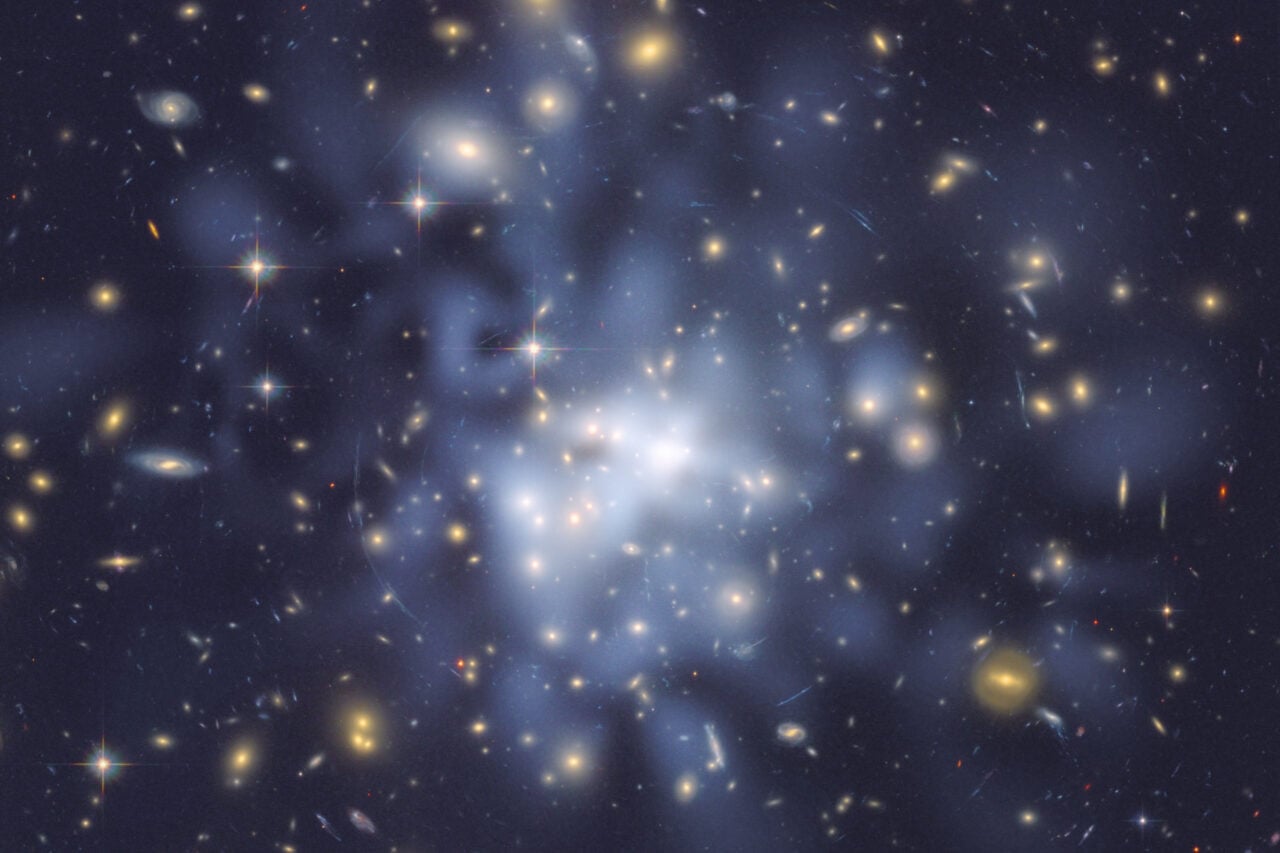
Understanding the universe has always posed significant challenges for astronomers, particularly when trying to account for the elusive substance known as dark matter. This mysterious component, which constitutes approximately 85% of the universe’s total mass, is invisible and does not interact with light, making it extremely difficult to observe directly. Despite its intangibility, dark matter plays a crucial role in explaining various cosmic phenomena, revealing its profound impact on our understanding of the universe.
Dark Matter: The Missing Mass
The very foundation of dark matter is rooted in the realization that ordinary matter—everything visible, from planets to stars—makes up only about 15% of the universe. This discrepancy raises essential questions about the remaining mass that influences the gravitational dynamics of galaxies and clusters. If dark matter indeed comprises 85% of the universe, it significantly affects the gravitational interactions that govern cosmic structures, making its study vital for astronomers.
Galactic Insights and Cosmic Phenomena
One of the earliest indications of dark matter’s existence came from the work of American astronomer Vera Rubin in the 1970s. Her observations of spiral galaxies, including our own Milky Way, revealed that stars at the outer edges of galaxies traveled at unexpectedly high speeds. According to established laws of physics, this should not be possible without an unseen mass providing additional gravitational pull. Rubin’s findings suggested that dark matter must be present to prevent these galaxies from tearing apart.
The gravitational influence of dark matter extends to the center of our galaxy as well. Research from Johns Hopkins University proposed that an excess of gamma rays detected at the Galactic Center could be attributed to dark matter particle collisions. Additionally, a recent study from Argentina’s Institute of Astrophysics La Plata explored the idea of a dark matter core influencing the local stellar dynamics, highlighting the potential for dark matter to help explain the Milky Way’s complex structure.
Another fascinating manifestation of dark matter is seen through gravitational lensing, a phenomenon where massive objects like galaxies bend spacetime, altering the path of light. This effect allows astronomers to observe distant celestial bodies that would otherwise remain hidden. Dark matter contributes to these lensing effects, creating intriguing optical illusions, such as the notable Einstein Cross.
The Bullet Cluster, a galaxy cluster formed from a significant collision, further demonstrates dark matter’s role in cosmic interactions. Data from NASA’s Chandra X-ray Observatory in 2006 revealed that most of the cluster’s mass appears to be concentrated around the galaxies rather than within the colliding gas. This observation has become one of the most compelling pieces of evidence supporting the existence of dark matter.
The relationship between dark matter and fundamental physics remains an area of intense investigation. Some physicists believe that dark matter may be linked to supersymmetry, a theoretical framework suggesting that every particle has a partner. CERN has explored this connection, although direct evidence for supersymmetry has yet to be found. The search for dark matter continues to be intertwined with the quest to understand the universe’s fundamental properties.
Finally, the cosmic microwave background (CMB), a remnant radiation from the Big Bang, provides further insights into the universe’s early development. Sensitive detectors have identified temperature fluctuations in the CMB, which are thought to be influenced by dark matter’s gravitational effects. Although dark matter does not interact with radiation directly, its presence has contributed to observable anisotropies in the CMB, aiding scientists in reconstructing the universe’s shape and evolution.
In summary, dark matter remains a fundamental concept in contemporary astrophysics, offering explanations for various cosmic phenomena. Its influence on galaxies, gravitational lensing, and the cosmic microwave background illustrates that while dark matter may be invisible, its effects are profoundly felt throughout the universe. As research continues, astronomers hope to uncover more about this enigmatic substance and its role in the cosmos.

Cosmic Mystery Deepens: Where Are the Universe’s Defects?

Lady Bulldogs Shine in Postseason Awards Following Final Four Run

CALV Hosts Essential Class for Local Real Estate Professionals

Urgent Alert: “Spaving” Surges as Shoppers Overspend Online

Jefferies Initiates Coverage on Insmed with “Buy” Rating

Three Dog Night to Perform with Ambrosia at Mayo Civic Center

Urgent Announcement: Charles M. Payment Passes Away at 78

Houston Education Foundation Donates $4,592 for Student Programs

Beeks Financial Cloud Shares Drop 7% Amid Increased Trading Volume

Foreign Inflows into Japan Stocks Surge to ¥1.34 Trillion

University of Hawaiʻi Joins $25.6M AI Project to Monitor Disasters

Sydney Sweeney Embraces Body Positivity Amid Hollywood Challenges

Hudson Williams Gains Popularity as Breakout Star on Heated Rivalry

Urgent Farewell: Joleen Chaney Leaves Legacy at KFOR

Boeing’s Merger with McDonnell Douglas: A Strategic Move Explained

$1.25M Grant Advances Hawaiʻi’s Real-Time Hazard Monitoring

Derrick Dove and ABAC Band Set for Free Americana Concert

BOYNEXTDOOR’s Jaehyun Faces Backlash Amid BTS-TWICE Controversy
-
Business9 months ago
Foreign Inflows into Japan Stocks Surge to ¥1.34 Trillion
-
Science8 months ago
University of Hawaiʻi Joins $25.6M AI Project to Monitor Disasters
-
 Entertainment9 months ago
Sydney Sweeney Embraces Body Positivity Amid Hollywood Challenges
-
 Entertainment7 months ago
Hudson Williams Gains Popularity as Breakout Star on Heated Rivalry
-
 Top Stories8 months ago
Urgent Farewell: Joleen Chaney Leaves Legacy at KFOR
-
 World9 months ago
Boeing’s Merger with McDonnell Douglas: A Strategic Move Explained
-
 Science7 months ago
$1.25M Grant Advances Hawaiʻi’s Real-Time Hazard Monitoring
-
 Entertainment8 months ago
Derrick Dove and ABAC Band Set for Free Americana Concert
-
 Top Stories9 months ago
BOYNEXTDOOR’s Jaehyun Faces Backlash Amid BTS-TWICE Controversy
-

 Health6 months ago
Bodybuilder Eugene Teo Transitions to Mindful Movement for Health
-

 World6 months ago
San Francisco Airport to Host 16 Nonstop Airlines to Europe in 2026
-

 Top Stories7 months ago
National Coast Guard Museum Set to Open in 2027 After Funding Secured