
Science
Discoveries on Asteroid Bennu Reveal Building Blocks of Life

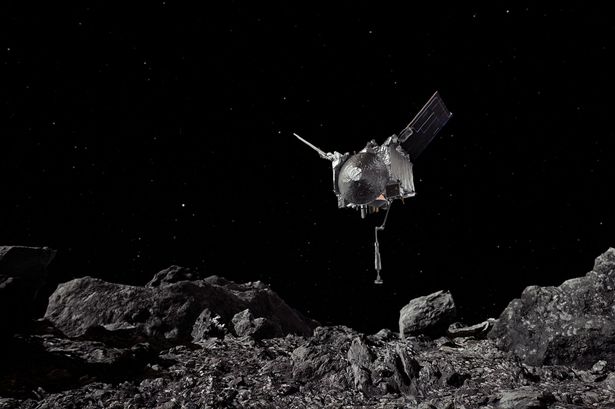
Scientists have made groundbreaking discoveries regarding the asteroid Bennu, revealing it may contain the essential building blocks of life. This information stems from samples collected by NASA’s spacecraft, which traveled approximately 63 million kilometers (about 39 million miles) to retrieve material from Bennu and successfully returned it to Earth.
The research indicates that Bennu may be rich in ancient water and a unique substance described as “space gum,” marking a significant advancement in our understanding of celestial bodies. The findings were highlighted by space communications expert Alexandra Doten on TikTok, where she elaborated on the potential implications for the origins of life in the cosmos.
Significant Discoveries from Bennu’s Samples
Researchers from Tohoku University in Japan detected sugars vital for life within the asteroid’s samples, a first for extraterrestrial materials. Among the key discoveries were 14 of the 20 amino acids used by life on Earth, along with all five nucleotide bases that constitute DNA and RNA. Notably, the presence of ribose and glucose in the samples suggests that essential components for forming RNA are present, a finding that could indicate RNA’s prevalence throughout the universe.
Doten emphasized the importance of these findings, stating, “This has huge implications – it could imply that RNA is more prevalent in the universe and could be the dominant form of early life.” The research suggests that Bennu could be a remnant of an ancient water world that has traversed space for billions of years.
Unusual Materials and Cosmic History
In addition to organic compounds, scientists were intrigued by the discovery of a pliable, gum-like material on Bennu, detailed in a study led by Scott Sandford from NASA’s Ames Research Center and Zack Gainsforth from the University of California. NASA described this substance as similar to soft plastic and noted that radiation exposure had made it brittle, akin to “a lawn chair left too many seasons in the sun.”
Furthermore, a study led by Ann Nguyen from NASA’s Johnson Space Center revealed a surprising quantity of dust in the samples, which originated from supernova explosions that occurred before the formation of our solar system. The implications of these findings not only enhance our understanding of Bennu but also contribute to the broader narrative of cosmic evolution.
The research findings from Bennu have the potential to reshape our comprehension of life’s origins and the conditions necessary for life beyond Earth. As scientists continue to analyze the samples, the discoveries may offer further insights into the building blocks of life and the universe’s history.

Cosmic Mystery Deepens: Where Are the Universe’s Defects?

Lady Bulldogs Shine in Postseason Awards Following Final Four Run

CALV Hosts Essential Class for Local Real Estate Professionals

Urgent Alert: “Spaving” Surges as Shoppers Overspend Online

Jefferies Initiates Coverage on Insmed with “Buy” Rating

Three Dog Night to Perform with Ambrosia at Mayo Civic Center

Urgent Announcement: Charles M. Payment Passes Away at 78

Houston Education Foundation Donates $4,592 for Student Programs

Beeks Financial Cloud Shares Drop 7% Amid Increased Trading Volume

Foreign Inflows into Japan Stocks Surge to ¥1.34 Trillion

University of Hawaiʻi Joins $25.6M AI Project to Monitor Disasters

Sydney Sweeney Embraces Body Positivity Amid Hollywood Challenges

Hudson Williams Gains Popularity as Breakout Star on Heated Rivalry

Urgent Farewell: Joleen Chaney Leaves Legacy at KFOR

Boeing’s Merger with McDonnell Douglas: A Strategic Move Explained

$1.25M Grant Advances Hawaiʻi’s Real-Time Hazard Monitoring

Derrick Dove and ABAC Band Set for Free Americana Concert

BOYNEXTDOOR’s Jaehyun Faces Backlash Amid BTS-TWICE Controversy
-
Business9 months ago
Foreign Inflows into Japan Stocks Surge to ¥1.34 Trillion
-
Science8 months ago
University of Hawaiʻi Joins $25.6M AI Project to Monitor Disasters
-
 Entertainment9 months ago
Sydney Sweeney Embraces Body Positivity Amid Hollywood Challenges
-
 Entertainment7 months ago
Hudson Williams Gains Popularity as Breakout Star on Heated Rivalry
-
 Top Stories8 months ago
Urgent Farewell: Joleen Chaney Leaves Legacy at KFOR
-
 World9 months ago
Boeing’s Merger with McDonnell Douglas: A Strategic Move Explained
-
 Science7 months ago
$1.25M Grant Advances Hawaiʻi’s Real-Time Hazard Monitoring
-
 Entertainment8 months ago
Derrick Dove and ABAC Band Set for Free Americana Concert
-
 Top Stories9 months ago
BOYNEXTDOOR’s Jaehyun Faces Backlash Amid BTS-TWICE Controversy
-

 Health6 months ago
Bodybuilder Eugene Teo Transitions to Mindful Movement for Health
-

 World6 months ago
San Francisco Airport to Host 16 Nonstop Airlines to Europe in 2026
-

 Top Stories7 months ago
National Coast Guard Museum Set to Open in 2027 After Funding Secured