
Science
Astronomers Discover Unique Exoplanet Orbiting Twin Stars

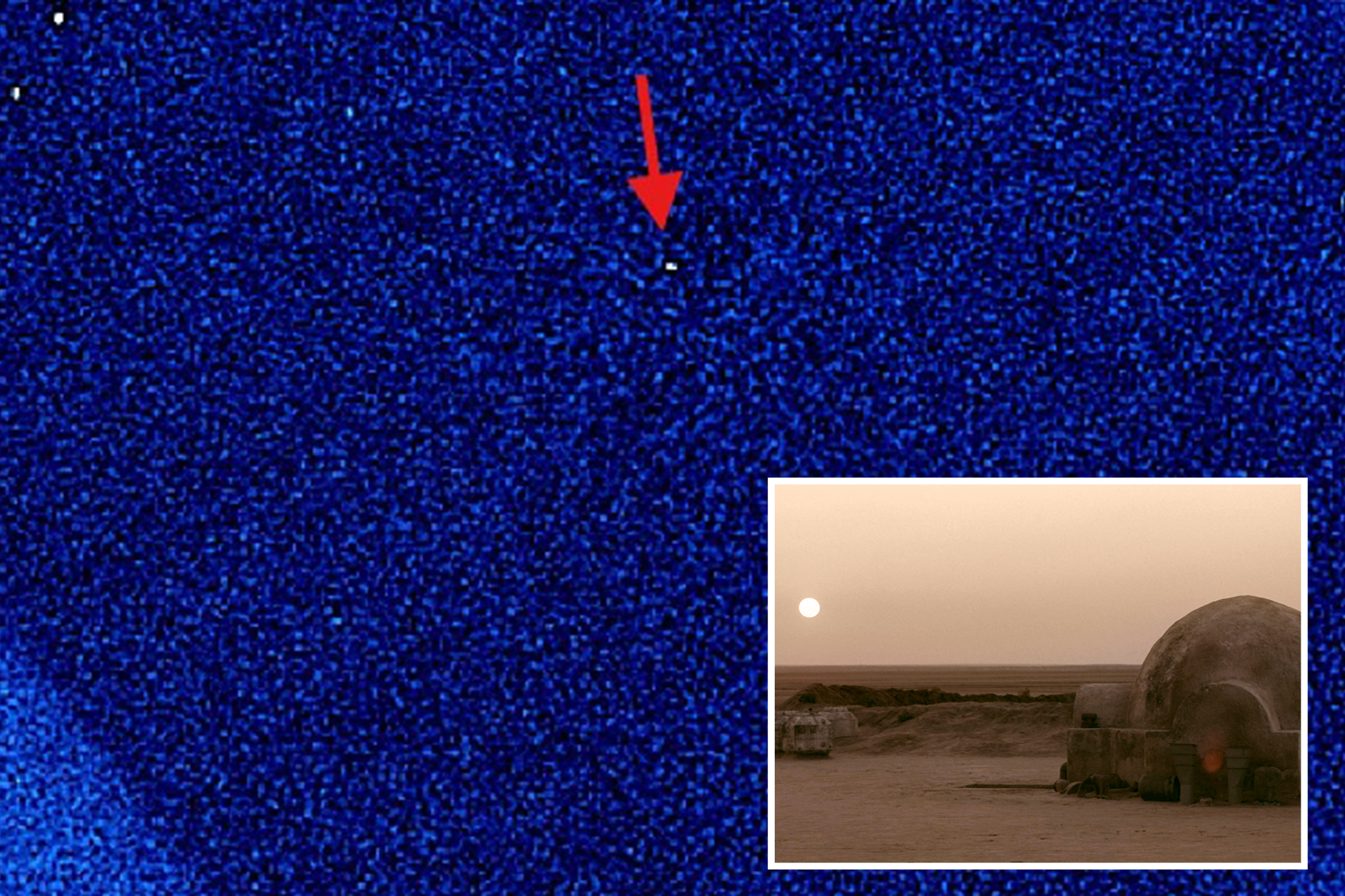
Astronomers have made a remarkable discovery, uncovering an exoplanet that orbits two stars, similar to the fictional planet Tatooine from the “Star Wars” franchise. This planet, named HD 143811 AB b, is located approximately 446 light-years from Earth in a binary star system. The findings were published in the journal Astronomy & Astrophysics and showcase a unique opportunity for researchers to study the dynamics of such systems.
Located closer to its twin stars than any previously observed exoplanet, HD 143811 AB b is a gas giant that orbits its binary suns at a distance significantly shorter than that of other known planets in similar systems. The planet’s proximity allows scientists to analyze both the stars and the planet’s trajectory simultaneously. According to Jason Wang, an exoplanet imaging expert at Northwestern University, “Of the 6,000 exoplanets that we know of, only a very small fraction of them orbit binaries. Of those, we only have a direct image of a handful of them.”
Researchers noted that HD 143811 AB b is about six times closer to its suns than any other exoplanet previously imaged in a binary system. Despite this relative closeness, it remains approximately 80 times farther from its stars than Earth is from the Sun. The planet takes about 300 years to complete a single orbit, while the binary stars revolve around each other every 18 days.
The discovery of HD 143811 AB b is not entirely new; the planet was identified in archival data from a decade ago. Wang and his team revisited data collected by the Gemini South telescope and its Gemini Planet Imager to confirm its existence. After analyzing data from 2016 and 2019 and cross-referencing it with observations from the W.M. Keck Observatory, the team detected a faint dot that was moving in tandem with a star, indicating it was indeed a planet.
Wang emphasized the importance of tracking the movement of celestial bodies, stating, “If a planet is bound to a star, then it will move with the star.” This method helped confirm HD 143811 AB b’s status as an orbiting planet, a conclusion supported independently by astronomers from the University of Exeter in the UK.
Scientists have also noted some intriguing characteristics about the exoplanet. With a surface temperature of approximately 1,416°F, HD 143811 AB b is nearly twice as hot as Venus. Additionally, it is thought to be around 13 million years old, which is relatively young in cosmic terms, especially when considering that Earth formed around 4.6 billion years ago.
Although the discovery raises questions about how such a planet could form around its twin suns, researchers are optimistic about continuing their investigation. Wang remarked, “Exactly how it works is still uncertain. Because we have only detected a few dozen planets like this, we don’t have enough data yet to put the picture together.” The team plans to track the orbits of HD 143811 AB b and its stars to gain further insights into the interactions within binary star systems.
This groundbreaking research not only enhances our understanding of planetary formation but also opens new avenues for studying the complex dynamics of celestial systems, providing a glimpse into the universe’s vast possibilities.

Cosmic Mystery Deepens: Where Are the Universe’s Defects?

Lady Bulldogs Shine in Postseason Awards Following Final Four Run

CALV Hosts Essential Class for Local Real Estate Professionals

Urgent Alert: “Spaving” Surges as Shoppers Overspend Online

Jefferies Initiates Coverage on Insmed with “Buy” Rating

Three Dog Night to Perform with Ambrosia at Mayo Civic Center

Urgent Announcement: Charles M. Payment Passes Away at 78

Houston Education Foundation Donates $4,592 for Student Programs

Beeks Financial Cloud Shares Drop 7% Amid Increased Trading Volume

Foreign Inflows into Japan Stocks Surge to ¥1.34 Trillion

University of Hawaiʻi Joins $25.6M AI Project to Monitor Disasters

Sydney Sweeney Embraces Body Positivity Amid Hollywood Challenges

Hudson Williams Gains Popularity as Breakout Star on Heated Rivalry

Urgent Farewell: Joleen Chaney Leaves Legacy at KFOR

Boeing’s Merger with McDonnell Douglas: A Strategic Move Explained

$1.25M Grant Advances Hawaiʻi’s Real-Time Hazard Monitoring

Derrick Dove and ABAC Band Set for Free Americana Concert

BOYNEXTDOOR’s Jaehyun Faces Backlash Amid BTS-TWICE Controversy
-
Business9 months ago
Foreign Inflows into Japan Stocks Surge to ¥1.34 Trillion
-
Science9 months ago
University of Hawaiʻi Joins $25.6M AI Project to Monitor Disasters
-
 Entertainment9 months ago
Sydney Sweeney Embraces Body Positivity Amid Hollywood Challenges
-
 Entertainment8 months ago
Hudson Williams Gains Popularity as Breakout Star on Heated Rivalry
-
 Top Stories9 months ago
Urgent Farewell: Joleen Chaney Leaves Legacy at KFOR
-
 World9 months ago
Boeing’s Merger with McDonnell Douglas: A Strategic Move Explained
-
 Science8 months ago
$1.25M Grant Advances Hawaiʻi’s Real-Time Hazard Monitoring
-
 Entertainment8 months ago
Derrick Dove and ABAC Band Set for Free Americana Concert
-
 Top Stories9 months ago
BOYNEXTDOOR’s Jaehyun Faces Backlash Amid BTS-TWICE Controversy
-

 Health6 months ago
Bodybuilder Eugene Teo Transitions to Mindful Movement for Health
-

 World6 months ago
San Francisco Airport to Host 16 Nonstop Airlines to Europe in 2026
-

 Top Stories7 months ago
National Coast Guard Museum Set to Open in 2027 After Funding Secured