
Science
Ariane 6 Rocket Launches Successfully, Expanding Europe’s Space Capabilities

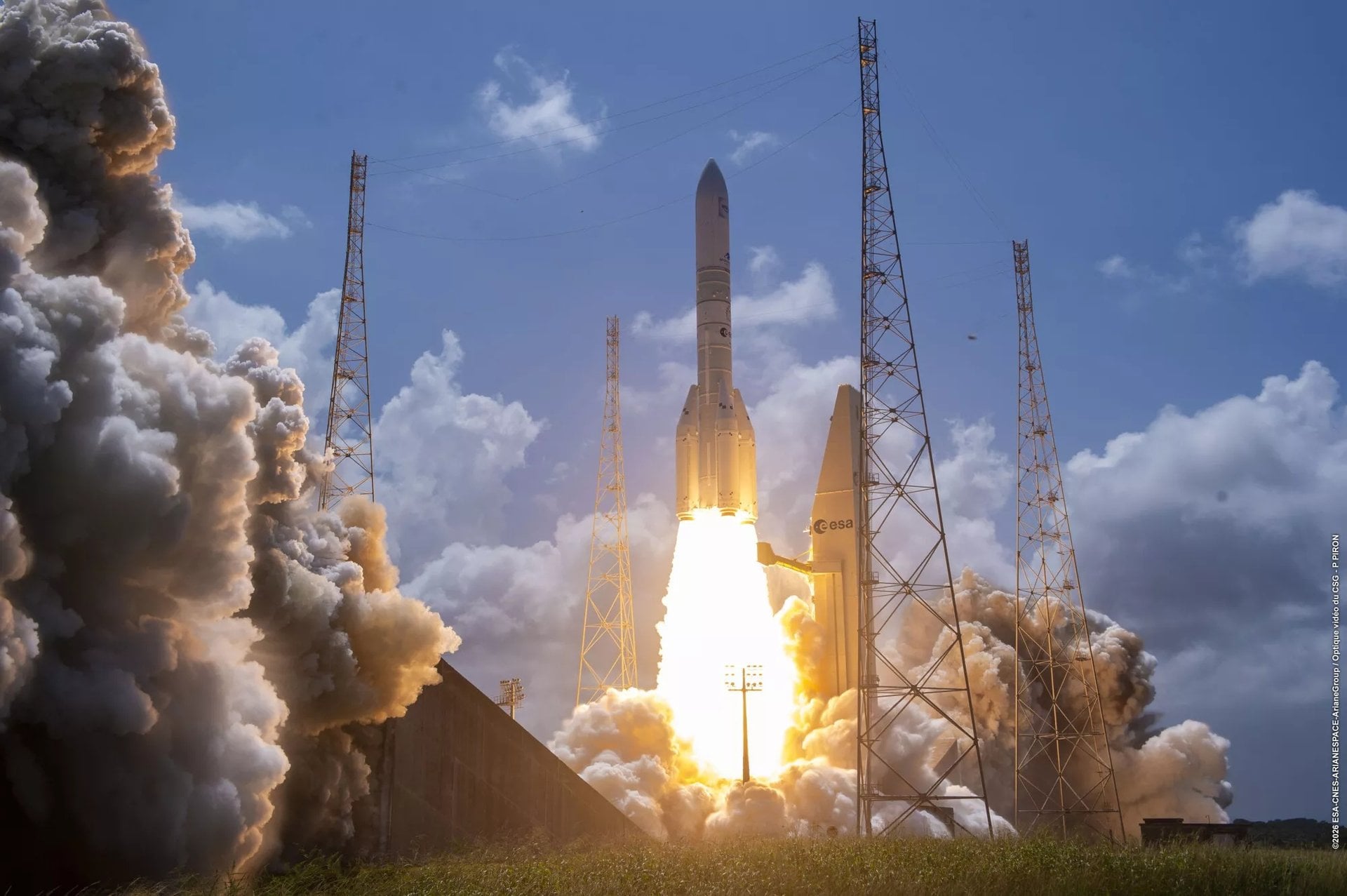
The Ariane 6 rocket successfully launched from the European Spaceport in Kourou, French Guiana, on February 12, 2024. This marked a significant milestone for the European Space Agency (ESA), Arianespace, and ArianeGroup, as it was the inaugural flight of the new rocket designed to enhance Europe’s capabilities in space exploration and commercial satellite launches.
The Ariane 6 rocket, specifically the Ariane 64 configuration, features four strap-on boosters, allowing it to deliver a heavy-lift payload capacity of 21,650 kg (47,730 lb) to Low Earth Orbit (LEO) and 11,500 kg (25,400 lb) to geostationary orbit (GSO). In contrast, the earlier model, the Ariane 62, could carry a medium payload of 10,350 kg (22,820 lb) to LEO. This enhanced capacity positions the Ariane 6 as a versatile alternative to its predecessor, the Ariane 5.
The maiden flight, designated VA267, launched at 1:45 p.m. local time (8:45 a.m. PST; 11:45 a.m. EST), successfully deploying a payload of 32 satellites for Amazon’s Leo constellation. This mission is particularly notable as it represents the first time a European launcher has serviced a satellite constellation, marking the beginning of 18 planned launches in support of this initiative.
New Opportunities for European Space Missions
The successful launch signals a new chapter for the ESA, enabling Europe to pursue ambitious space projects that span scientific research and commercial ventures. With the improved payload capacity of the Ariane 64, the ESA can now offer launch services to commercial partners, expanding its operational scope beyond governmental and scientific missions.
According to David Cavaillolès, CEO of Arianespace, the solid rocket booster known as P120C is among the largest and most powerful currently operational. Constructed with a carbon-fiber design and containing approximately 143.6 metric tons (158.3 U.S. tons) of propellant, each booster generates an average thrust of about 4.5 meganewtons (1,000,000 lbf) and boasts a specific impulse of 279 seconds (2.74 km/s).
The ESA has highlighted the Ariane 6’s capabilities through a video presentation, showcasing upcoming missions that will leverage the rocket’s enhanced performance. Among these is the PLAnetary Transits and Oscillations of stars (PLATO) satellite, scheduled for launch in January 2027. PLATO aims to advance the current understanding of exoplanets by measuring their sizes, detecting exomoons, and characterizing host stars to evaluate their habitability.
Another significant mission on the horizon is the Argonaut lunar lander, which is crucial for the ESA’s future lunar exploration plans. The agency envisions deploying hundreds of these landers to facilitate robotic and crewed missions, including those associated with NASA’s Artemis program. The long-term goal includes establishing an international lunar outpost, enhancing accessibility to the Moon’s surface for both governmental and commercial partners.
Looking Ahead
With the successful launch of the Ariane 6, Europe is poised to enhance its position in the global space industry. As the ESA continues to innovate and expand its capabilities, this rocket is expected to play a pivotal role in a range of missions, from scientific exploration to commercial satellite deployment. The future of Europe’s space endeavors looks promising, with the Ariane 6 at the forefront of its ambitions.

Cosmic Mystery Deepens: Where Are the Universe’s Defects?

Lady Bulldogs Shine in Postseason Awards Following Final Four Run

CALV Hosts Essential Class for Local Real Estate Professionals

Urgent Alert: “Spaving” Surges as Shoppers Overspend Online

Jefferies Initiates Coverage on Insmed with “Buy” Rating

Three Dog Night to Perform with Ambrosia at Mayo Civic Center

Urgent Announcement: Charles M. Payment Passes Away at 78

Houston Education Foundation Donates $4,592 for Student Programs

Beeks Financial Cloud Shares Drop 7% Amid Increased Trading Volume

Foreign Inflows into Japan Stocks Surge to ¥1.34 Trillion

University of Hawaiʻi Joins $25.6M AI Project to Monitor Disasters

Sydney Sweeney Embraces Body Positivity Amid Hollywood Challenges

Hudson Williams Gains Popularity as Breakout Star on Heated Rivalry

Urgent Farewell: Joleen Chaney Leaves Legacy at KFOR

Boeing’s Merger with McDonnell Douglas: A Strategic Move Explained

$1.25M Grant Advances Hawaiʻi’s Real-Time Hazard Monitoring

Derrick Dove and ABAC Band Set for Free Americana Concert

BOYNEXTDOOR’s Jaehyun Faces Backlash Amid BTS-TWICE Controversy
-
Business9 months ago
Foreign Inflows into Japan Stocks Surge to ¥1.34 Trillion
-
Science8 months ago
University of Hawaiʻi Joins $25.6M AI Project to Monitor Disasters
-
 Entertainment9 months ago
Sydney Sweeney Embraces Body Positivity Amid Hollywood Challenges
-
 Entertainment7 months ago
Hudson Williams Gains Popularity as Breakout Star on Heated Rivalry
-
 Top Stories8 months ago
Urgent Farewell: Joleen Chaney Leaves Legacy at KFOR
-
 World9 months ago
Boeing’s Merger with McDonnell Douglas: A Strategic Move Explained
-
 Science7 months ago
$1.25M Grant Advances Hawaiʻi’s Real-Time Hazard Monitoring
-
 Entertainment8 months ago
Derrick Dove and ABAC Band Set for Free Americana Concert
-
 Top Stories9 months ago
BOYNEXTDOOR’s Jaehyun Faces Backlash Amid BTS-TWICE Controversy
-

 Health6 months ago
Bodybuilder Eugene Teo Transitions to Mindful Movement for Health
-

 World6 months ago
San Francisco Airport to Host 16 Nonstop Airlines to Europe in 2026
-

 Top Stories7 months ago
National Coast Guard Museum Set to Open in 2027 After Funding Secured