
Politics
Trump’s Middle East Peace Plan Faces Skepticism Amid Ongoing Conflict

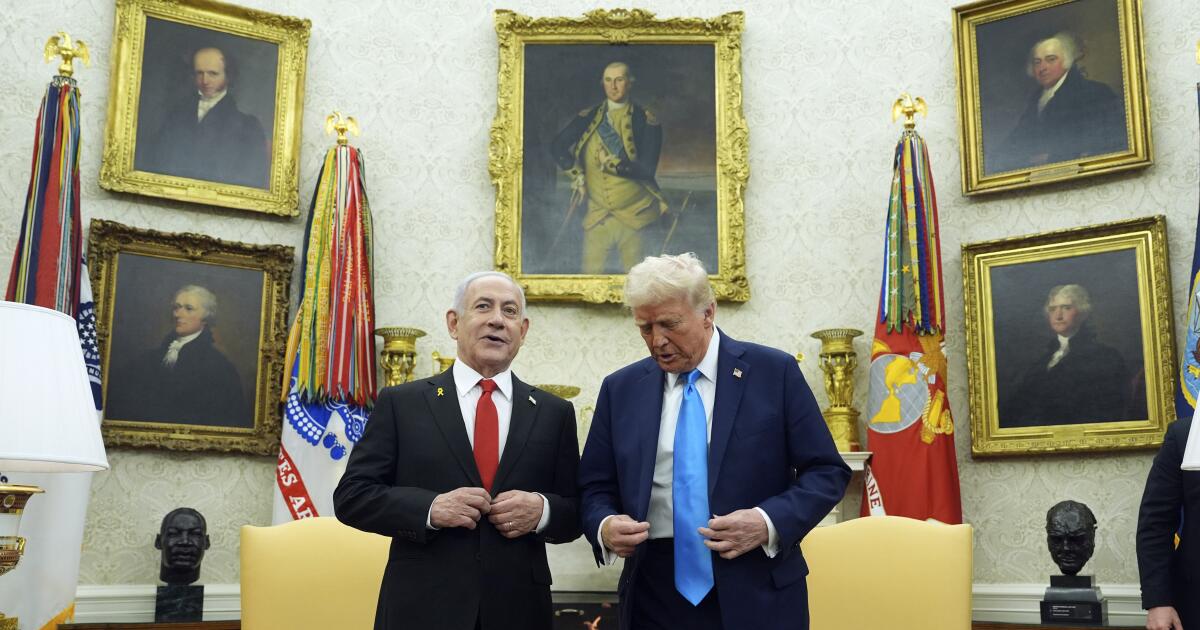
The recent unveiling of Donald Trump‘s 20-point peace plan for the Middle East has sparked a debate filled with skepticism and concern. The plan, which aims to address the long-standing conflict, has drawn mixed reactions from the public and experts alike, raising questions about its potential effectiveness in achieving lasting peace.
Public Reactions Highlight Concerns
In a letter addressed to the editor, June Maguire from Mission Viejo expressed doubt about the plan’s viability, questioning the United States’ longstanding support for Israel. Maguire noted that this support often intertwines with Prime Minister Benjamin Netanyahu‘s domestic interests, potentially undermining American priorities. She highlighted the rising international accusations of genocide against Israel, suggesting that the U.S. risks being seen as complicit in the violence.
Another letter from Saif M. Hussain in Woodland Hills echoed these sentiments, emphasizing the destruction in Gaza and arguing that Israel should bear the financial burden for the devastation it caused. Hussain argued that expecting other nations to contribute to rebuilding efforts is unjust, advocating for Israel to be held accountable for its actions.
Mixed Perspectives on Progress and Accountability
The reactions continue to vary significantly. Steve Watson from San Clemente viewed Trump’s actions as a step towards reducing violence, noting that under his leadership, there have been significant casualties, including approximately 64,000 Gazan deaths. Watson remarked on the hope that this plan could lead to a reduction in hostilities, particularly with Netanyahu seemingly acquiescing to pressure regarding military and financial support.
Conversely, Richard Ellison from Pasadena acknowledged Trump’s role in facilitating a ceasefire and the return of 20 Israeli hostages. Despite this, he criticized both Trump and previous president Joe Biden for their contributions to what he described as an ongoing cycle of violence, stating that their administrations have fueled the Israeli military efforts.
The complexities of the situation are further highlighted by Leonard Zivitz from Fullerton, who raised concerns about Hamas and its ability to govern Gaza. Zivitz described Hamas as untrustworthy, pointing out that the group has been implicated in violence against its own people while failing to acknowledge Israel as a legitimate state.
The discourse surrounding Trump’s peace plan reflects deep divisions in perspectives on accountability, the role of the United States in the Middle East, and the path to future peace. As the plan is set to unfold, the world watches closely, hoping for a resolution that could finally bring an end to decades of conflict.

Cosmic Mystery Deepens: Where Are the Universe’s Defects?

Lady Bulldogs Shine in Postseason Awards Following Final Four Run

CALV Hosts Essential Class for Local Real Estate Professionals

Urgent Alert: “Spaving” Surges as Shoppers Overspend Online

Jefferies Initiates Coverage on Insmed with “Buy” Rating

Three Dog Night to Perform with Ambrosia at Mayo Civic Center

Urgent Announcement: Charles M. Payment Passes Away at 78

Houston Education Foundation Donates $4,592 for Student Programs

Beeks Financial Cloud Shares Drop 7% Amid Increased Trading Volume

Foreign Inflows into Japan Stocks Surge to ¥1.34 Trillion

University of Hawaiʻi Joins $25.6M AI Project to Monitor Disasters

Sydney Sweeney Embraces Body Positivity Amid Hollywood Challenges

Hudson Williams Gains Popularity as Breakout Star on Heated Rivalry

Urgent Farewell: Joleen Chaney Leaves Legacy at KFOR

Boeing’s Merger with McDonnell Douglas: A Strategic Move Explained

$1.25M Grant Advances Hawaiʻi’s Real-Time Hazard Monitoring

Derrick Dove and ABAC Band Set for Free Americana Concert

BOYNEXTDOOR’s Jaehyun Faces Backlash Amid BTS-TWICE Controversy
-
Business9 months ago
Foreign Inflows into Japan Stocks Surge to ¥1.34 Trillion
-
Science8 months ago
University of Hawaiʻi Joins $25.6M AI Project to Monitor Disasters
-
 Entertainment9 months ago
Sydney Sweeney Embraces Body Positivity Amid Hollywood Challenges
-
 Entertainment7 months ago
Hudson Williams Gains Popularity as Breakout Star on Heated Rivalry
-
 Top Stories8 months ago
Urgent Farewell: Joleen Chaney Leaves Legacy at KFOR
-
 World9 months ago
Boeing’s Merger with McDonnell Douglas: A Strategic Move Explained
-
 Science7 months ago
$1.25M Grant Advances Hawaiʻi’s Real-Time Hazard Monitoring
-
 Entertainment8 months ago
Derrick Dove and ABAC Band Set for Free Americana Concert
-
 Top Stories9 months ago
BOYNEXTDOOR’s Jaehyun Faces Backlash Amid BTS-TWICE Controversy
-

 Health6 months ago
Bodybuilder Eugene Teo Transitions to Mindful Movement for Health
-

 World6 months ago
San Francisco Airport to Host 16 Nonstop Airlines to Europe in 2026
-

 Top Stories7 months ago
National Coast Guard Museum Set to Open in 2027 After Funding Secured