
Politics
Jasmine Crockett’s Senate Bid Transforms Texas Political Landscape

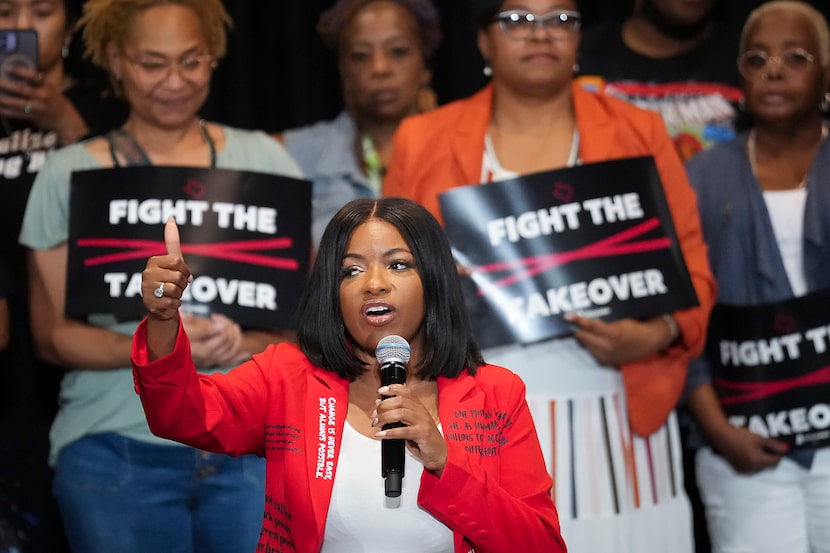
U.S. Representative Jasmine Crockett is poised to enter the Texas Democratic Senate primary, a move that significantly alters the dynamics of the upcoming 2026 midterm elections. As a prominent Dallas Democrat and successor to the late Eddie Bernice Johnson, Crockett’s anticipated candidacy could make this race the most expensive in Texas history, drawing parallels to the highly publicized 2018 contest in which Beto O’Rourke challenged Ted Cruz.
Crockett is expected to announce her decision on Monday, just 90 minutes before the filing deadline for the March 3 primary. Earlier this week, she hinted to reporters about her inclination to run and informed her potential Democratic rivals, Colin Allred and James Talarico, about her plans. Prior to her announcement, the primary was shaping up as a two-candidate race between Allred and Talarico.
Colin Allred declared his candidacy on July 1 and has already campaigned extensively throughout Texas. Having previously lost a Senate race to Cruz, he aims to reassure Democratic voters of his capability to contend against the likely Republican nominee, which may include Texas Attorney General Ken Paxton or U.S. Representative Wesley Hunt. Allred’s support base mainly consists of Black voters, suburban women, and moderates.
On the other hand, James Talarico entered the race in September and has branded himself as a principled advocate against the policies of former President Donald Trump. His campaign has generated enthusiasm among Democrats seeking a candidate capable of energizing the party’s base. However, Talarico faces a significant challenge in Crockett’s name recognition and popularity, which could divert some of his support.
Should Crockett formally enter the race, she may position herself as the frontrunner. Her presence might cause Allred and Talarico to reconsider their endorsements, particularly in North Texas, where Crockett’s appeal is strong. Nevertheless, both candidates have the advantage of established campaign structures, having started their efforts well before Crockett’s potential entry.
Should Crockett opt not to run for re-election in the House, U.S. Representative Marc Veasey, representing Fort Worth, is expected to pursue her current seat in District 30. During the recent congressional redistricting, the Texas Legislature, controlled by Republicans, altered Veasey’s district, removing his Tarrant County base and placing him in a newly configured District 30, which now includes a significant number of voters from Dallas County.
A Crockett Senate run would also influence the prospects of U.S. Representative Julie Johnson, who may seek re-election in District 33, where she is favored to win. Johnson’s current district was redrawn to reduce her base in Dallas County while extending into more Republican-leaning regions of East Texas. Former state Representative Domingo Garcia is also expected to contend for District 33.
Complicating this political landscape is the impending Supreme Court decision regarding the congressional map for the 2026 elections. If the Court decides to revert to the original district map from 2021, it could allow for further Democratic candidates to emerge in the race for Crockett’s House seat.
Crockett’s potential Senate campaign offers an opportunity to broaden the Democratic voter base, particularly among infrequent voters, as political consultants begin strategizing outreach efforts. However, her candidacy also presents risks, as she could alienate moderate Republicans disenchanted with the current political climate, potentially providing support for the Republican nominee.
The prevailing theory within the Democratic Party suggests that Paxton will secure the GOP nomination, and his perceived political vulnerabilities, including a recent impeachment and a public divorce, may provide a strategic advantage for the Democratic candidate. Conversely, some Republicans perceive Crockett as a unifying figure who might mitigate any divisions within the party, especially considering the unpopularity of Trump.
Crockett’s calculations may hinge on mobilizing a higher turnout from Democrats and new voters, which would be essential in counterbalancing any potential losses from conservative voter segments. As the political landscape evolves, all eyes will be on Texas as it prepares for a pivotal electoral season.

Cosmic Mystery Deepens: Where Are the Universe’s Defects?

Lady Bulldogs Shine in Postseason Awards Following Final Four Run

CALV Hosts Essential Class for Local Real Estate Professionals

Urgent Alert: “Spaving” Surges as Shoppers Overspend Online

Jefferies Initiates Coverage on Insmed with “Buy” Rating

Three Dog Night to Perform with Ambrosia at Mayo Civic Center

Urgent Announcement: Charles M. Payment Passes Away at 78

Houston Education Foundation Donates $4,592 for Student Programs

Beeks Financial Cloud Shares Drop 7% Amid Increased Trading Volume

Foreign Inflows into Japan Stocks Surge to ¥1.34 Trillion

University of Hawaiʻi Joins $25.6M AI Project to Monitor Disasters

Sydney Sweeney Embraces Body Positivity Amid Hollywood Challenges

Hudson Williams Gains Popularity as Breakout Star on Heated Rivalry

Urgent Farewell: Joleen Chaney Leaves Legacy at KFOR

Boeing’s Merger with McDonnell Douglas: A Strategic Move Explained

$1.25M Grant Advances Hawaiʻi’s Real-Time Hazard Monitoring

Derrick Dove and ABAC Band Set for Free Americana Concert

BOYNEXTDOOR’s Jaehyun Faces Backlash Amid BTS-TWICE Controversy
-
Business9 months ago
Foreign Inflows into Japan Stocks Surge to ¥1.34 Trillion
-
Science9 months ago
University of Hawaiʻi Joins $25.6M AI Project to Monitor Disasters
-
 Entertainment9 months ago
Sydney Sweeney Embraces Body Positivity Amid Hollywood Challenges
-
 Entertainment7 months ago
Hudson Williams Gains Popularity as Breakout Star on Heated Rivalry
-
 Top Stories8 months ago
Urgent Farewell: Joleen Chaney Leaves Legacy at KFOR
-
 World9 months ago
Boeing’s Merger with McDonnell Douglas: A Strategic Move Explained
-
 Science7 months ago
$1.25M Grant Advances Hawaiʻi’s Real-Time Hazard Monitoring
-
 Entertainment8 months ago
Derrick Dove and ABAC Band Set for Free Americana Concert
-
 Top Stories9 months ago
BOYNEXTDOOR’s Jaehyun Faces Backlash Amid BTS-TWICE Controversy
-

 Health6 months ago
Bodybuilder Eugene Teo Transitions to Mindful Movement for Health
-

 World6 months ago
San Francisco Airport to Host 16 Nonstop Airlines to Europe in 2026
-

 Top Stories7 months ago
National Coast Guard Museum Set to Open in 2027 After Funding Secured