
Health
New Cooling-Triggered Device Offers Targeted Pain Relief

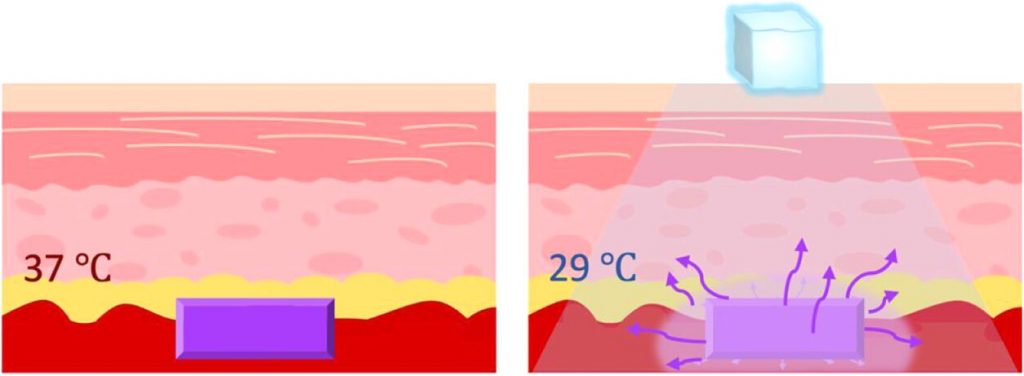
Researchers at Vanderbilt University have developed an innovative drug delivery mechanism that utilizes cooling to trigger the release of medication for pain relief. The device, detailed in a recent study published in ACS Biomaterials Science & Engineering, offers a potential alternative to traditional pain management methods, particularly in light of the opioid crisis affecting many countries.
This novel approach, led by Leon Bellan, an associate professor of mechanical and biomedical engineering, focuses on the localized delivery of nonsteroidal anti-inflammatory drugs (NSAIDs), such as Celecoxib. Currently, opioid-based medications dominate on-demand pain treatment, yet they come with severe addiction risks, resulting in approximately five deaths per hour due to opioid abuse in the United States. As a safer alternative, NSAIDs manage pain effectively without the same addictive properties.
To facilitate on-demand release of NSAIDs, the Bellan research team has designed a device that can be implanted in the body and activated by a simple drop in temperature. This cooling effect can be achieved by placing an ice pack over the area where the device, roughly the size of a watch battery, is located. Once the cooling stimulus is applied, a hydrogel within the implant liquefies, releasing the medication directly to the targeted area.
Bellan emphasized the advantages of this method, stating, “Going forward, we envision cooling being used more broadly as an external stimulus for targeted, patient-controlled delivery of drugs for pain relief or to treat other conditions.” Unlike previous techniques that utilize external stimuli like heat or ultrasound—methods requiring complex equipment—this cooling-triggered system is straightforward and energy-efficient.
The Bellan Lab for Advanced Materials at Vanderbilt employs a combination of traditional and advanced fabrication techniques alongside smart materials and biomaterials to tackle pressing biomedical challenges. The implications of this research extend beyond pain management, potentially revolutionizing how various conditions are treated through localized drug delivery.
With the ongoing need for effective pain relief solutions that minimize risks associated with addiction, this cooling-triggered drug delivery system represents a significant step forward. As the field of biomedical engineering continues to evolve, the integration of such innovative technologies may pave the way for safer, more efficient patient care.
For inquiries, please contact Lucas Johnson at [email protected].

Cosmic Mystery Deepens: Where Are the Universe’s Defects?

Lady Bulldogs Shine in Postseason Awards Following Final Four Run

CALV Hosts Essential Class for Local Real Estate Professionals

Urgent Alert: “Spaving” Surges as Shoppers Overspend Online

Jefferies Initiates Coverage on Insmed with “Buy” Rating

Three Dog Night to Perform with Ambrosia at Mayo Civic Center

Urgent Announcement: Charles M. Payment Passes Away at 78

Houston Education Foundation Donates $4,592 for Student Programs

Beeks Financial Cloud Shares Drop 7% Amid Increased Trading Volume

Foreign Inflows into Japan Stocks Surge to ¥1.34 Trillion

University of Hawaiʻi Joins $25.6M AI Project to Monitor Disasters

Sydney Sweeney Embraces Body Positivity Amid Hollywood Challenges

Hudson Williams Gains Popularity as Breakout Star on Heated Rivalry

Urgent Farewell: Joleen Chaney Leaves Legacy at KFOR

Boeing’s Merger with McDonnell Douglas: A Strategic Move Explained

$1.25M Grant Advances Hawaiʻi’s Real-Time Hazard Monitoring

Derrick Dove and ABAC Band Set for Free Americana Concert

BOYNEXTDOOR’s Jaehyun Faces Backlash Amid BTS-TWICE Controversy
-
Business9 months ago
Foreign Inflows into Japan Stocks Surge to ¥1.34 Trillion
-
Science8 months ago
University of Hawaiʻi Joins $25.6M AI Project to Monitor Disasters
-
 Entertainment9 months ago
Sydney Sweeney Embraces Body Positivity Amid Hollywood Challenges
-
 Entertainment7 months ago
Hudson Williams Gains Popularity as Breakout Star on Heated Rivalry
-
 Top Stories8 months ago
Urgent Farewell: Joleen Chaney Leaves Legacy at KFOR
-
 World9 months ago
Boeing’s Merger with McDonnell Douglas: A Strategic Move Explained
-
 Science7 months ago
$1.25M Grant Advances Hawaiʻi’s Real-Time Hazard Monitoring
-
 Entertainment8 months ago
Derrick Dove and ABAC Band Set for Free Americana Concert
-
 Top Stories9 months ago
BOYNEXTDOOR’s Jaehyun Faces Backlash Amid BTS-TWICE Controversy
-

 Health6 months ago
Bodybuilder Eugene Teo Transitions to Mindful Movement for Health
-

 World6 months ago
San Francisco Airport to Host 16 Nonstop Airlines to Europe in 2026
-

 Top Stories7 months ago
National Coast Guard Museum Set to Open in 2027 After Funding Secured