
Business
Fluor Inc. Shares Drop Despite Monthly Gains, P/E Ratio Raises Questions

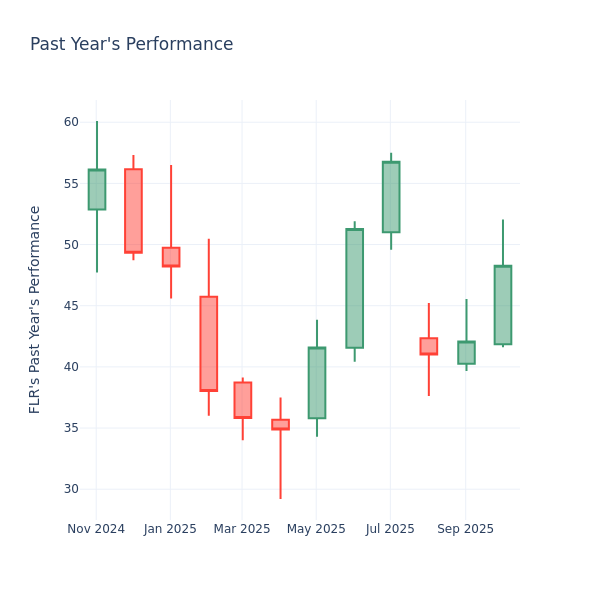
Fluor Inc. (NYSE: FLR) experienced a decline in its share price, currently at $48.22 following a 1.17% drop in the latest market session. Despite a monthly increase of 11.92%, the stock has seen an overall decrease of 8.60% over the past year. This mixed performance prompts long-term investors to closely examine the company’s price-to-earnings (P/E) ratio, a critical metric for assessing market valuation.
Understanding Fluor’s P/E Ratio
The P/E ratio serves as a benchmark for investors, allowing them to compare a company’s market performance against broader market data, historical earnings, and industry standards. Currently, Fluor’s P/E ratio stands at 2.02, which is significantly lower than the average P/E ratio of 43.63 in the Construction & Engineering sector. A lower P/E could suggest that shareholders expect the stock to underperform compared to its peers. Alternatively, it may indicate that the company is undervalued.
While a low P/E ratio can be an attractive signal for potential investors, it also raises questions about Fluor’s growth prospects and financial stability. Evaluating this ratio in isolation may lead to misguided investment decisions, as it is only one aspect of a company’s overall financial health.
Investors are encouraged to adopt a comprehensive approach when assessing Fluor’s market position. This includes analyzing other financial metrics, industry trends, and qualitative factors. A well-rounded evaluation can provide a clearer picture of the company’s potential and guide investors toward more informed decisions.
Implications for Investors
As Fluor Inc. navigates its recent challenges, long-term shareholders should consider the implications of the current P/E ratio alongside other factors. The recent drop in share price, despite positive short-term performance, suggests volatility that investors cannot ignore.
The market’s perception of Fluor may change as the company addresses its performance issues and aligns with industry trends. Investors should remain vigilant and informed, using various analytical tools to navigate the complexities of the market.
In conclusion, while a low P/E ratio can indicate potential undervaluation, it is essential not to overlook other financial indicators that contribute to a company’s overall health. By keeping a holistic view, investors can enhance their decision-making processes and increase the likelihood of favorable outcomes in their investment journey.
© 2025 Benzinga.com. Benzinga does not provide investment advice. All rights reserved.

Cosmic Mystery Deepens: Where Are the Universe’s Defects?

Lady Bulldogs Shine in Postseason Awards Following Final Four Run

CALV Hosts Essential Class for Local Real Estate Professionals

Urgent Alert: “Spaving” Surges as Shoppers Overspend Online

Jefferies Initiates Coverage on Insmed with “Buy” Rating

Three Dog Night to Perform with Ambrosia at Mayo Civic Center

Urgent Announcement: Charles M. Payment Passes Away at 78

Houston Education Foundation Donates $4,592 for Student Programs

Beeks Financial Cloud Shares Drop 7% Amid Increased Trading Volume

Foreign Inflows into Japan Stocks Surge to ¥1.34 Trillion

University of Hawaiʻi Joins $25.6M AI Project to Monitor Disasters

Sydney Sweeney Embraces Body Positivity Amid Hollywood Challenges

Hudson Williams Gains Popularity as Breakout Star on Heated Rivalry

Urgent Farewell: Joleen Chaney Leaves Legacy at KFOR

Boeing’s Merger with McDonnell Douglas: A Strategic Move Explained

$1.25M Grant Advances Hawaiʻi’s Real-Time Hazard Monitoring

Derrick Dove and ABAC Band Set for Free Americana Concert

BOYNEXTDOOR’s Jaehyun Faces Backlash Amid BTS-TWICE Controversy
-
Business9 months ago
Foreign Inflows into Japan Stocks Surge to ¥1.34 Trillion
-
Science9 months ago
University of Hawaiʻi Joins $25.6M AI Project to Monitor Disasters
-
 Entertainment9 months ago
Sydney Sweeney Embraces Body Positivity Amid Hollywood Challenges
-
 Entertainment8 months ago
Hudson Williams Gains Popularity as Breakout Star on Heated Rivalry
-
 Top Stories9 months ago
Urgent Farewell: Joleen Chaney Leaves Legacy at KFOR
-
 World9 months ago
Boeing’s Merger with McDonnell Douglas: A Strategic Move Explained
-
 Science8 months ago
$1.25M Grant Advances Hawaiʻi’s Real-Time Hazard Monitoring
-
 Entertainment8 months ago
Derrick Dove and ABAC Band Set for Free Americana Concert
-
 Top Stories9 months ago
BOYNEXTDOOR’s Jaehyun Faces Backlash Amid BTS-TWICE Controversy
-

 Health6 months ago
Bodybuilder Eugene Teo Transitions to Mindful Movement for Health
-

 World6 months ago
San Francisco Airport to Host 16 Nonstop Airlines to Europe in 2026
-

 Top Stories7 months ago
National Coast Guard Museum Set to Open in 2027 After Funding Secured