
Science
Innovative Biofilms Use Solar Energy to Clean Polluted Soils

Recent research has unveiled a groundbreaking approach to environmental cleanup, leveraging the interaction between solar energy, iron minerals, and bacteria to degrade pollutants in soil and groundwater. A study published on September 15, 2025, in the journal Environmental and Biogeochemical Processes by researchers from Kunming University of Science and Technology and the University of Massachusetts, explores how these mineral-bacterial biofilms can significantly enhance the degradation of common antibiotics such as tetracycline hydrochloride (TCH) and chloramphenicol (CPL).
The research highlights an innovative method that taps into the natural ability of non-phototrophic microorganisms to harvest solar energy. Traditionally, sunlight is understood primarily as a driver of photosynthesis in plants. However, recent findings indicate that microorganisms present in soils and sediments can also utilize solar radiation through interactions with minerals. This discovery opens up new avenues in bioremediation techniques, suggesting that solar energy can play a crucial role even in dark environments, such as saturated soils.
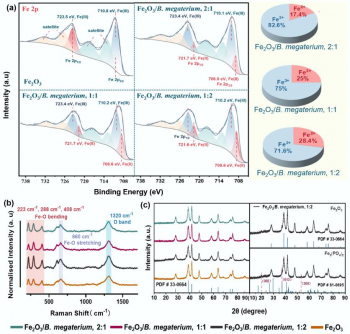
In this study, the team investigated the interactions between iron minerals, specifically Fe2O3 and FeOOH, and the bacterium Bacillus megaterium. They focused on how these interactions facilitate the accumulation and release of electrons during light-dark cycles. The co-culturing system demonstrated a continuous charge-discharge function, showcasing what the researchers describe as a “photovoltaic memory” effect.
The results revealed that the electron storage capacity, measured as the total accumulated charge (∑σ), increased with higher densities of bacterial biofilms. This indicates that denser biofilms are more efficient in capturing and storing energy. Notably, the research showed that charge accumulation was significantly higher during light exposure, with accumulated charges rising from 2.87 μC·cm−2 to 4.08 μC·cm−2 after several cycles.
One of the most compelling findings from the study is the enhanced degradation efficiency of pollutants following exposure to light. After just 60 minutes of light exposure, the degradation efficiency for TCH improved by 66.7%, while CPL saw a 46.7% improvement. This enhanced degradation is attributed to the synergistic interaction between the iron minerals and bacteria, which enables efficient electron transfer and storage, effectively allowing the system to act as a “biological capacitor.”
The structural and electrochemical analyses conducted as part of the study support the conclusion that these bacteria-mineral biofilms can significantly improve pollutant degradation. The research team suggests that this Fe2O3/B. megaterium biofilm system presents a sustainable and scalable solution for addressing environmental pollution, particularly in soil and groundwater.
This innovative approach does not require constant illumination, making it a practical solution for bioremediation in various ecosystems. The capacity of these biofilms to store and release energy in dark environments could transform current bioremediation practices, offering a cost-effective and energy-efficient option for cleaning up antibiotic-contaminated sites.
The study was supported by several funding sources, including the National Natural Science Foundation of China and the National Key Research and Development Program of China, among others.
As researchers continue to explore the potential of solar-powered biofilms, this work stands out as a significant advancement in the field of environmental science, paving the way for new strategies to combat soil and water pollution.
For more details, the complete study can be accessed at DOI 10.48130/ebp-0025-0006.

Cosmic Mystery Deepens: Where Are the Universe’s Defects?

Lady Bulldogs Shine in Postseason Awards Following Final Four Run

CALV Hosts Essential Class for Local Real Estate Professionals

Urgent Alert: “Spaving” Surges as Shoppers Overspend Online

Jefferies Initiates Coverage on Insmed with “Buy” Rating

Three Dog Night to Perform with Ambrosia at Mayo Civic Center

Urgent Announcement: Charles M. Payment Passes Away at 78

Houston Education Foundation Donates $4,592 for Student Programs

Beeks Financial Cloud Shares Drop 7% Amid Increased Trading Volume

Foreign Inflows into Japan Stocks Surge to ¥1.34 Trillion

University of Hawaiʻi Joins $25.6M AI Project to Monitor Disasters

Sydney Sweeney Embraces Body Positivity Amid Hollywood Challenges

Hudson Williams Gains Popularity as Breakout Star on Heated Rivalry

Urgent Farewell: Joleen Chaney Leaves Legacy at KFOR

Boeing’s Merger with McDonnell Douglas: A Strategic Move Explained

$1.25M Grant Advances Hawaiʻi’s Real-Time Hazard Monitoring

Derrick Dove and ABAC Band Set for Free Americana Concert

BOYNEXTDOOR’s Jaehyun Faces Backlash Amid BTS-TWICE Controversy
-
Business9 months ago
Foreign Inflows into Japan Stocks Surge to ¥1.34 Trillion
-
Science9 months ago
University of Hawaiʻi Joins $25.6M AI Project to Monitor Disasters
-
 Entertainment9 months ago
Sydney Sweeney Embraces Body Positivity Amid Hollywood Challenges
-
 Entertainment7 months ago
Hudson Williams Gains Popularity as Breakout Star on Heated Rivalry
-
 Top Stories8 months ago
Urgent Farewell: Joleen Chaney Leaves Legacy at KFOR
-
 World9 months ago
Boeing’s Merger with McDonnell Douglas: A Strategic Move Explained
-
 Science7 months ago
$1.25M Grant Advances Hawaiʻi’s Real-Time Hazard Monitoring
-
 Entertainment8 months ago
Derrick Dove and ABAC Band Set for Free Americana Concert
-
 Top Stories9 months ago
BOYNEXTDOOR’s Jaehyun Faces Backlash Amid BTS-TWICE Controversy
-

 Health6 months ago
Bodybuilder Eugene Teo Transitions to Mindful Movement for Health
-

 World6 months ago
San Francisco Airport to Host 16 Nonstop Airlines to Europe in 2026
-

 Top Stories7 months ago
National Coast Guard Museum Set to Open in 2027 After Funding Secured