
World
U.S. Military Prepares for Potentially Extended Operations Against Iran

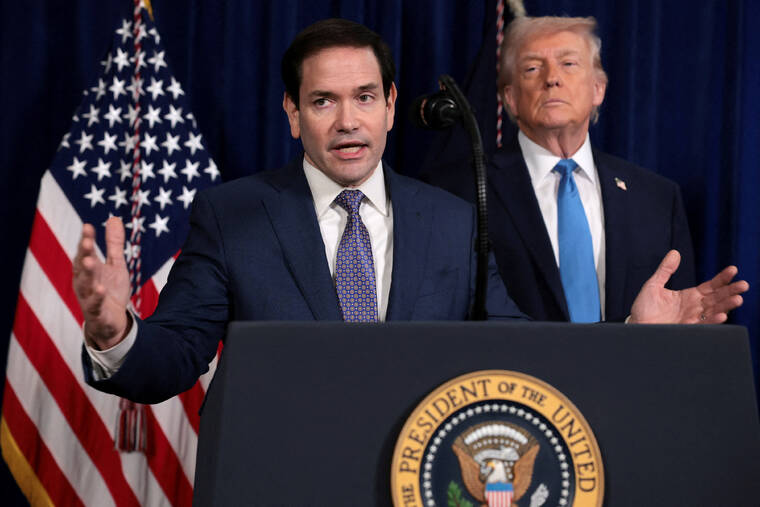
The U.S. military is gearing up for the possibility of extended operations against Iran, should President Donald Trump authorize an attack. According to two U.S. officials who spoke on condition of anonymity, the planning could lead to a conflict far more serious than previous encounters between the two nations. The heightened military readiness coincides with ongoing diplomatic discussions, as U.S. envoys Steve Witkoff and Jared Kushner are set to meet with Iranian representatives in Geneva, with mediation from Oman.
Secretary of State Marco Rubio emphasized that while Trump aims to achieve a diplomatic resolution with Tehran, the process is fraught with challenges. Recent military deployments in the region have raised concerns about escalating tensions. The Pentagon announced on Friday that it will send an additional aircraft carrier to the Middle East, bolstering its presence with thousands of troops, fighter aircraft, and guided-missile destroyers.
During a military event at Fort Bragg, North Carolina, Trump suggested that changing the Iranian government could be beneficial, although he did not specify who he would favor as a replacement. He remarked, “For 47 years, they’ve been talking and talking and talking.” Despite previous skepticism towards deploying ground troops in Iran, the current military buildup indicates a preference for air and naval strikes.
The White House spokesperson Anna Kelly affirmed that “President Trump has all options on the table with regard to Iran.” She noted that he considers various perspectives before making decisions that prioritize national security. The Pentagon has not commented on the specifics of the military planning.
Last year, the United States dispatched two aircraft carriers to the region, executing strikes on Iranian nuclear sites. The operation known as “Midnight Hammer” involved stealth bombers targeting these facilities, resulting in a limited Iranian response. However, the current military strategy appears to be more comprehensive, with potential strikes on Iranian state and security facilities, beyond just nuclear infrastructure.
Experts caution that a prolonged military engagement with Iran could pose significant risks to U.S. forces, given Iran’s substantial missile capabilities. The same officials indicated that retaliation from Iran is anticipated, leading to a cycle of strikes and counterstrikes. The White House and Pentagon have not publicly addressed the implications of such retaliatory actions.
Trump has consistently threatened military action against Iran due to its nuclear and missile programs and its suppression of internal dissent. He warned that failing to reach a diplomatic solution could lead to “very traumatic” consequences. The Iranian Revolutionary Guard has stated that any strikes on Iranian territory would result in retaliation against U.S. military bases, which are located throughout the Middle East, including in Jordan, Kuwait, Saudi Arabia, Qatar, Bahrain, the United Arab Emirates, and Turkey.
In a related development, Israeli Prime Minister Benjamin Netanyahu met with Trump to discuss the necessity of including key elements vital to Israel in any potential agreement with Iran. Iran has expressed a willingness to negotiate limits on its nuclear program in exchange for the lifting of sanctions but has firmly rejected linking these discussions to its missile capabilities.
Meanwhile, Iranian opposition figure Reza Pahlavi urged the United States to consider military intervention in Iran as a means to save lives and expedite the regime’s collapse. In an interview, he stated that the Iranian government appears to be on the verge of falling and that military action could accelerate this process. Pahlavi, living in exile in the United States since before the 1979 Islamic Revolution, expressed hope that such an attack would empower the Iranian people to rise against the current regime.
As diplomatic negotiations continue, the situation remains fluid, with the potential for significant changes in both military and political landscapes in the region.

Cosmic Mystery Deepens: Where Are the Universe’s Defects?

Lady Bulldogs Shine in Postseason Awards Following Final Four Run

CALV Hosts Essential Class for Local Real Estate Professionals

Urgent Alert: “Spaving” Surges as Shoppers Overspend Online

Jefferies Initiates Coverage on Insmed with “Buy” Rating

Three Dog Night to Perform with Ambrosia at Mayo Civic Center

Urgent Announcement: Charles M. Payment Passes Away at 78

Houston Education Foundation Donates $4,592 for Student Programs

Beeks Financial Cloud Shares Drop 7% Amid Increased Trading Volume

Foreign Inflows into Japan Stocks Surge to ¥1.34 Trillion

University of Hawaiʻi Joins $25.6M AI Project to Monitor Disasters

Sydney Sweeney Embraces Body Positivity Amid Hollywood Challenges

Hudson Williams Gains Popularity as Breakout Star on Heated Rivalry

Urgent Farewell: Joleen Chaney Leaves Legacy at KFOR

Boeing’s Merger with McDonnell Douglas: A Strategic Move Explained

$1.25M Grant Advances Hawaiʻi’s Real-Time Hazard Monitoring

Derrick Dove and ABAC Band Set for Free Americana Concert

BOYNEXTDOOR’s Jaehyun Faces Backlash Amid BTS-TWICE Controversy
-
Business9 months ago
Foreign Inflows into Japan Stocks Surge to ¥1.34 Trillion
-
Science9 months ago
University of Hawaiʻi Joins $25.6M AI Project to Monitor Disasters
-
 Entertainment9 months ago
Sydney Sweeney Embraces Body Positivity Amid Hollywood Challenges
-
 Entertainment7 months ago
Hudson Williams Gains Popularity as Breakout Star on Heated Rivalry
-
 Top Stories8 months ago
Urgent Farewell: Joleen Chaney Leaves Legacy at KFOR
-
 World9 months ago
Boeing’s Merger with McDonnell Douglas: A Strategic Move Explained
-
 Science7 months ago
$1.25M Grant Advances Hawaiʻi’s Real-Time Hazard Monitoring
-
 Entertainment8 months ago
Derrick Dove and ABAC Band Set for Free Americana Concert
-
 Top Stories9 months ago
BOYNEXTDOOR’s Jaehyun Faces Backlash Amid BTS-TWICE Controversy
-

 Health6 months ago
Bodybuilder Eugene Teo Transitions to Mindful Movement for Health
-

 World6 months ago
San Francisco Airport to Host 16 Nonstop Airlines to Europe in 2026
-

 Top Stories7 months ago
National Coast Guard Museum Set to Open in 2027 After Funding Secured