
World
Buddhist Monks Complete 2,300-Mile Peace Walk to Washington, D.C.

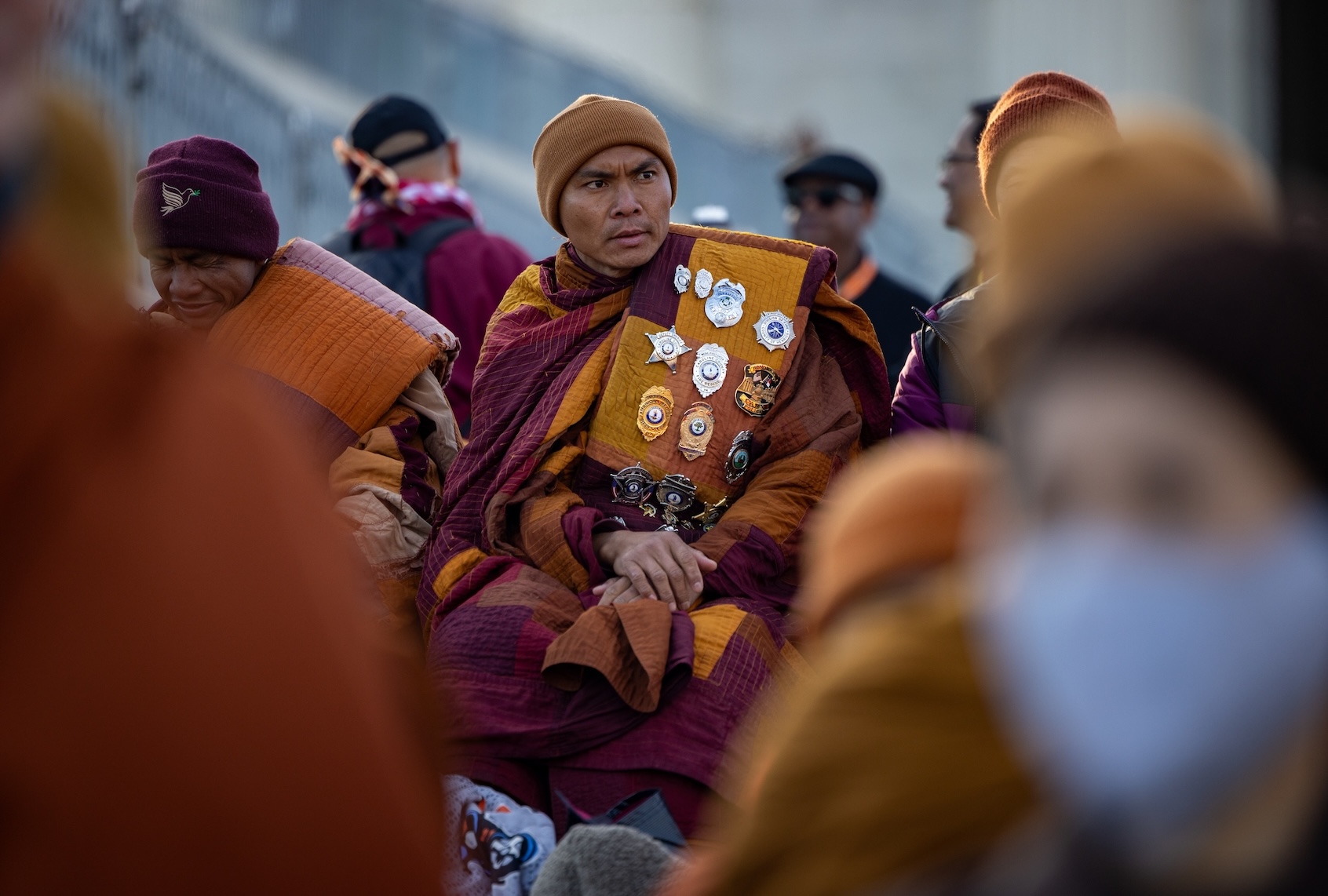
A group of 19 Buddhist monks has successfully completed a 2,300-mile pilgrimage across seven states, culminating in Washington, D.C. The journey, which lasted 108 days, aimed to raise awareness for peace. Led by the Venerable Bhikkhu Paññākāra, a Vietnamese-American monk, the group began their trek in Fort Worth, Texas, and attracted significant attention online, including the adoption of a dog named Aloka.
The monks traveled primarily in single file, many barefoot, carrying flowers and offering bracelets as symbols of peace. Along the way, they encountered thousands of admirers who often greeted them with silent reverence. Tragically, two monks were struck by a car during the journey, resulting in the amputation of one monk’s leg. Despite these challenges, the monks completed their pilgrimage, arriving in Washington, D.C., this week with images of worn shoes and battered feet.
Upon their arrival on Tuesday, the monks were greeted by a media presence and approximately 3,500 supporters at an arena. “My hope is, when this walk ends, the people we met will continue practicing mindfulness and find peace,” Paññākāra stated while passing through North Carolina. He emphasized that their mission was not to deliver peace but to raise awareness, saying, “to unlock that box and free it.”
The monks’ journey highlights a stark contrast to current global tensions. The ongoing conflict in the Middle East, particularly the violence between Israel and Hamas, has created a climate where the concept of peace is more critical than ever. Many observers note that the situation has escalated, with organizations such as Amnesty International and Genocide Watch labeling Israel’s military actions as disproportionate and even genocidal.
This backdrop of unrest raises questions about the efficacy of initiatives like former President Donald Trump‘s recently announced “Board of Peace.” Established during negotiations for a Gaza peace plan, this initiative has garnered criticism for its perceived hypocrisy and lack of genuine commitment to peace. Notably, the Israeli government recently joined this board, while many Western democracies have declined the invitation.
Critics argue that Trump’s approach to peace is deeply flawed, focusing more on propaganda than on genuine reconciliation. The notion of a “Board of Peace” appears to serve as a façade for a redefined concept of peace that aligns with Trump’s interests rather than the needs of those affected by conflict.
For instance, the board’s membership requires nations to contribute $1 billion in dues, leading some to view it as a potential bribery scheme. Furthermore, Trump’s past claims of having ended multiple wars have been called into question. The ongoing violence in the Middle East, with over 73,000 Palestinians and more than 2,000 Israelis reported dead since the conflict reignited, casts doubt on the validity of these assertions.
The monks’ peaceful demonstration stands in stark contrast to these political machinations. Their message, focused on intrinsic peace and mindfulness, resonates with many who are disillusioned by the current state of global affairs. As Paññākāra noted, the journey was not just about raising awareness but also about inspiring individuals to cultivate peace within themselves.
The monks’ pilgrimage serves as a poignant reminder of the need for genuine efforts towards peace in a time when it seems increasingly elusive. Their commitment to this cause, alongside the disturbing realities of global conflict, underscores the importance of grassroots movements in advocating for true peace.
As the world grapples with the complexities of conflict and governance, the message from the monks is clear: peace begins within each individual. Their journey represents a call to action for all to seek mindfulness and harmony in a fractured world.

Cosmic Mystery Deepens: Where Are the Universe’s Defects?

Lady Bulldogs Shine in Postseason Awards Following Final Four Run

CALV Hosts Essential Class for Local Real Estate Professionals

Urgent Alert: “Spaving” Surges as Shoppers Overspend Online

Jefferies Initiates Coverage on Insmed with “Buy” Rating

Three Dog Night to Perform with Ambrosia at Mayo Civic Center

Urgent Announcement: Charles M. Payment Passes Away at 78

Houston Education Foundation Donates $4,592 for Student Programs

Beeks Financial Cloud Shares Drop 7% Amid Increased Trading Volume

Foreign Inflows into Japan Stocks Surge to ¥1.34 Trillion

University of Hawaiʻi Joins $25.6M AI Project to Monitor Disasters

Sydney Sweeney Embraces Body Positivity Amid Hollywood Challenges

Hudson Williams Gains Popularity as Breakout Star on Heated Rivalry

Urgent Farewell: Joleen Chaney Leaves Legacy at KFOR

Boeing’s Merger with McDonnell Douglas: A Strategic Move Explained

$1.25M Grant Advances Hawaiʻi’s Real-Time Hazard Monitoring

Derrick Dove and ABAC Band Set for Free Americana Concert

BOYNEXTDOOR’s Jaehyun Faces Backlash Amid BTS-TWICE Controversy
-
Business9 months ago
Foreign Inflows into Japan Stocks Surge to ¥1.34 Trillion
-
Science9 months ago
University of Hawaiʻi Joins $25.6M AI Project to Monitor Disasters
-
 Entertainment9 months ago
Sydney Sweeney Embraces Body Positivity Amid Hollywood Challenges
-
 Entertainment7 months ago
Hudson Williams Gains Popularity as Breakout Star on Heated Rivalry
-
 Top Stories8 months ago
Urgent Farewell: Joleen Chaney Leaves Legacy at KFOR
-
 World9 months ago
Boeing’s Merger with McDonnell Douglas: A Strategic Move Explained
-
 Science7 months ago
$1.25M Grant Advances Hawaiʻi’s Real-Time Hazard Monitoring
-
 Entertainment8 months ago
Derrick Dove and ABAC Band Set for Free Americana Concert
-
 Top Stories9 months ago
BOYNEXTDOOR’s Jaehyun Faces Backlash Amid BTS-TWICE Controversy
-

 Health6 months ago
Bodybuilder Eugene Teo Transitions to Mindful Movement for Health
-

 World6 months ago
San Francisco Airport to Host 16 Nonstop Airlines to Europe in 2026
-

 Top Stories7 months ago
National Coast Guard Museum Set to Open in 2027 After Funding Secured