
Science
Clemson Exhibit Showcases Mass Spectrometry’s Historic Instruments

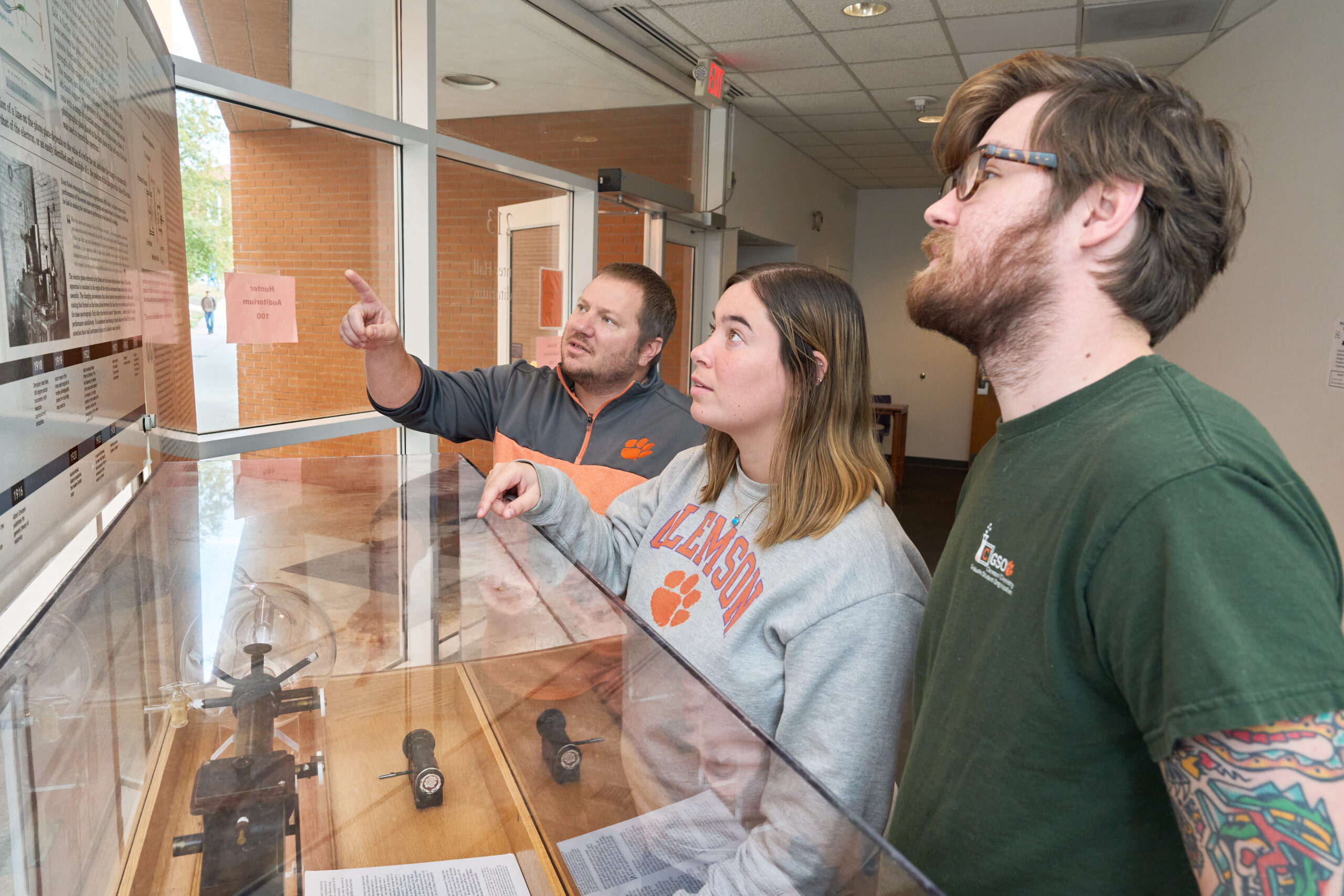
A new exhibit at Clemson University highlights the evolution of mass spectrometry, an analytical tool crucial for various fields including forensics, pharmaceutical analysis, and space exploration. Commissioned by the American Society for Mass Spectrometry, the exhibit features replica instruments that have played significant roles in scientific discoveries, and it will remain on display until next summer.
Located outside Hunter Auditorium, the exhibit is accessible to anyone with building access during normal business hours. It opens with a replica of J.J. Thomson‘s discharge tube, which was instrumental in the discovery of the electron. This is followed by Francis Aston‘s first mass spectrograph and James Chadwick‘s neutron chamber, both of which contributed to foundational advancements in mass spectrometry. These breakthroughs have enabled scientists to explore atomic structures and the complex molecules they form over the past century.
Clemson’s Department of Chemistry is home to two prominent mass spectrometrists: Ken Marcus, the Robert Adger Bowen Professor of Chemistry, and Christopher Chouinard, an assistant professor. Their research spans a range of applications from environmental analysis to drug detection. According to Chouinard, “Clemson is well-positioned nationally in mass spectrometry.”
Innovative Research and Applications
Chouinard’s lab is actively involved in drug forensics, focusing on substances such as fentanyl analogs and synthetic cannabinoids. The lab also investigates performance-enhancing drugs through funding from the Partnership for Clean Competition, a U.S. anti-doping agency dedicated to research. Their efforts aim to develop new mass spectrometry methods for detecting anabolic steroids and other performance-enhancing substances.
Recently, the lab has begun collaborating with the Clemson University Eukaryotic Pathogens Innovation Center (EPIC). This partnership seeks to enhance understanding of pathogenic infections through advanced mass spectrometry techniques. Chouinard’s work, alongside James Morris, a professor in the Department of Biochemistry and Genetics, aims to pave the way for therapeutic solutions to combat infections caused by brain-eating amoebas.
Groundbreaking Innovations in Analytical Chemistry
Ken Marcus’s research in analytical chemistry has led to two innovative areas of study. He is developing the Liquid Sampling-Atmospheric Pressure Glow Discharge (LS-APGD), a revolutionary method for analyzing the chemical composition of liquids using light and ions. Additionally, Marcus is exploring a separation method for proteins and exosomes, which he describes as “the next big little thing.” This method employs polymer fibers in high-performance liquid chromatography (HPLC) to separate and analyze complex mixtures.
Marcus has also designed instruments capable of assessing nutrients in bioreactors, which are crucial for producing antibody-based drugs. The integration of these technologies into modern analytical chemistry represents a significant step forward in scientific research.
The mass spectrometry exhibit at Clemson University not only showcases historic instruments that have shaped the field but also highlights ongoing research that continues to drive innovation. As the exhibit remains open to the public, it serves as a reminder of the profound impact that scientific advancements have on our understanding of the world.

Cosmic Mystery Deepens: Where Are the Universe’s Defects?

Lady Bulldogs Shine in Postseason Awards Following Final Four Run

CALV Hosts Essential Class for Local Real Estate Professionals

Urgent Alert: “Spaving” Surges as Shoppers Overspend Online

Jefferies Initiates Coverage on Insmed with “Buy” Rating

Three Dog Night to Perform with Ambrosia at Mayo Civic Center

Urgent Announcement: Charles M. Payment Passes Away at 78

Houston Education Foundation Donates $4,592 for Student Programs

Beeks Financial Cloud Shares Drop 7% Amid Increased Trading Volume

Foreign Inflows into Japan Stocks Surge to ¥1.34 Trillion

University of Hawaiʻi Joins $25.6M AI Project to Monitor Disasters

Sydney Sweeney Embraces Body Positivity Amid Hollywood Challenges

Hudson Williams Gains Popularity as Breakout Star on Heated Rivalry

Urgent Farewell: Joleen Chaney Leaves Legacy at KFOR

Boeing’s Merger with McDonnell Douglas: A Strategic Move Explained

$1.25M Grant Advances Hawaiʻi’s Real-Time Hazard Monitoring

Derrick Dove and ABAC Band Set for Free Americana Concert

BOYNEXTDOOR’s Jaehyun Faces Backlash Amid BTS-TWICE Controversy
-
Business9 months ago
Foreign Inflows into Japan Stocks Surge to ¥1.34 Trillion
-
Science8 months ago
University of Hawaiʻi Joins $25.6M AI Project to Monitor Disasters
-
 Entertainment9 months ago
Sydney Sweeney Embraces Body Positivity Amid Hollywood Challenges
-
 Entertainment7 months ago
Hudson Williams Gains Popularity as Breakout Star on Heated Rivalry
-
 Top Stories8 months ago
Urgent Farewell: Joleen Chaney Leaves Legacy at KFOR
-
 World9 months ago
Boeing’s Merger with McDonnell Douglas: A Strategic Move Explained
-
 Science7 months ago
$1.25M Grant Advances Hawaiʻi’s Real-Time Hazard Monitoring
-
 Entertainment8 months ago
Derrick Dove and ABAC Band Set for Free Americana Concert
-
 Top Stories9 months ago
BOYNEXTDOOR’s Jaehyun Faces Backlash Amid BTS-TWICE Controversy
-

 Health6 months ago
Bodybuilder Eugene Teo Transitions to Mindful Movement for Health
-

 World6 months ago
San Francisco Airport to Host 16 Nonstop Airlines to Europe in 2026
-

 Top Stories7 months ago
National Coast Guard Museum Set to Open in 2027 After Funding Secured