
World
Marine Pilot Jefferson DeBlanc Becomes Ace in Pacific Combat

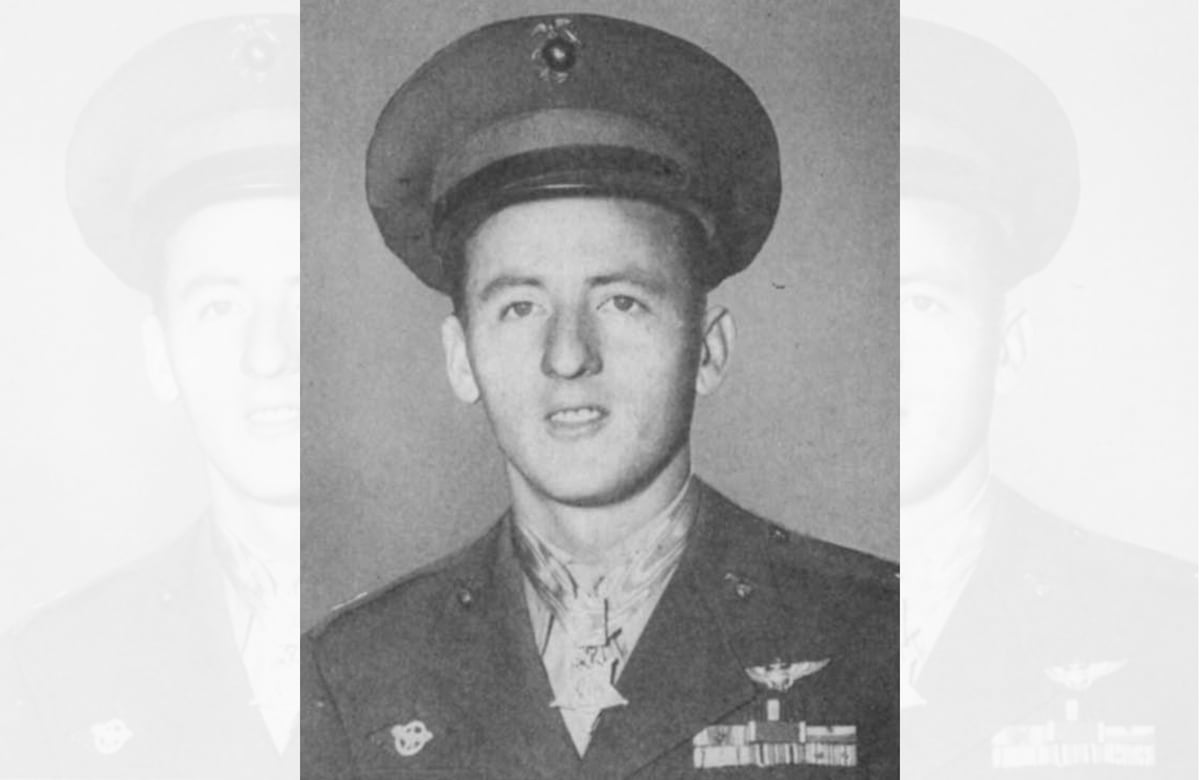
Jefferson Joseph DeBlanc, a Marine pilot who earned his ace status during World War II, made significant contributions to the Pacific theater of operations. Born on February 15, 1921, in Lockport, Louisiana, DeBlanc’s early life combined the spirit of a Cajun with the intellect of an academic. After graduating high school in 1938, he chose military aviation over college, enlisting in the U.S. Marines to avoid joining “the Yankee army.”
He began his training in U.S. Navy flight school in July 1941 before officially commissioning as a second lieutenant on April 3, 1942. Shortly thereafter, he joined Marine fighter squadron VMF-112 and received training on the Grumman F4F-4 Wildcat, just before deploying to the South Pacific.
Arriving at Henderson Field on Guadalcanal, DeBlanc engaged in his first combat mission on November 12, 1942. Alongside pilots from VMF-112 and VMF-121, he confronted a swarm of Mitsubishi G4M1 bombers attacking American shipping. DeBlanc later described this encounter as “a fighter pilot’s dream,” though he faced intense antiaircraft fire from the ships below. During this mission, he successfully downed a bomber while avoiding the flak that had claimed two Wildcats, both of whose pilots survived.
His next major engagement occurred on December 18, 1942, when he intercepted a Douglas SBD-3 Dauntless dive bomber chased by a Mitsubishi F1M2 biplane. In this encounter, DeBlanc succeeded in destroying the floatplane, marking another victory in his growing list of accomplishments.
DeBlanc’s career took a precarious turn on January 29, 1943, when his Wildcat suffered mechanical failure, forcing him to parachute into the ocean. He was quickly rescued by the destroyer Jenkins (DD-447), but the day was far from over. On January 31, 1943, while leading a squadron of eight Wildcats, he encountered enemy fighters while coordinating an attack on 12 Grumman TBF-1 Avengers and SBDs targeting enemy shipping near Kolombangara.
As DeBlanc engaged enemy fighters, he shot down two pursuing aircraft but sustained injuries during the confrontation. After successfully downing five enemy planes that day, he and Staff Sgt. James A. Feliton were forced to bail out into Vella Gulf. They swam to Kolombangara, where native coastwatchers rescued them and facilitated their return to Guadalcanal on February 12, 1943.
Unbeknownst to DeBlanc, the aircraft he fought were Nakajima Ki.43 army fighters, newly assigned to Rabaul. His actions that day led to a recommendation for both the Navy Cross and an Air Medal from his squadron commander, Major Paul J. Fontana. The Navy Cross was later upgraded to the Medal of Honor, which DeBlanc received from President Harry Truman on December 6, 1946.
Following the war, DeBlanc continued to serve his country, earning a promotion to captain on May 31, 1943. He returned to the United States in June 1943 as a tactics instructor and later served with VMF-422 in the Marshall Islands in 1944. His final aerial victory occurred five miles south of Yokoate, Okinawa, during the spring of 1945.
Throughout his life, DeBlanc maintained a commitment to education, earning four degrees, including a Doctorate of Education from McNeese State University. He taught mathematics and physics in schools across the United States and Europe while holding a reserve commission until his retirement as a colonel from the New Orleans Marine Air Group in 1972.
Jefferson DeBlanc passed away on November 7, 2007, in Saint Martinville, Louisiana. His legacy extends beyond military accolades, as he authored two works: a booklet titled “Once They Lived by the Sword” in 1988 and his memoir “The Guadalcanal Air War,” published in 2008. His life story reflects a remarkable blend of military prowess and dedication to education, marking him as a significant figure in both realms.

Cosmic Mystery Deepens: Where Are the Universe’s Defects?

Lady Bulldogs Shine in Postseason Awards Following Final Four Run

CALV Hosts Essential Class for Local Real Estate Professionals

Urgent Alert: “Spaving” Surges as Shoppers Overspend Online

Jefferies Initiates Coverage on Insmed with “Buy” Rating

Three Dog Night to Perform with Ambrosia at Mayo Civic Center

Urgent Announcement: Charles M. Payment Passes Away at 78

Houston Education Foundation Donates $4,592 for Student Programs

Beeks Financial Cloud Shares Drop 7% Amid Increased Trading Volume

Foreign Inflows into Japan Stocks Surge to ¥1.34 Trillion

University of Hawaiʻi Joins $25.6M AI Project to Monitor Disasters

Sydney Sweeney Embraces Body Positivity Amid Hollywood Challenges

Hudson Williams Gains Popularity as Breakout Star on Heated Rivalry

Urgent Farewell: Joleen Chaney Leaves Legacy at KFOR

Boeing’s Merger with McDonnell Douglas: A Strategic Move Explained

$1.25M Grant Advances Hawaiʻi’s Real-Time Hazard Monitoring

Derrick Dove and ABAC Band Set for Free Americana Concert

BOYNEXTDOOR’s Jaehyun Faces Backlash Amid BTS-TWICE Controversy
-
Business9 months ago
Foreign Inflows into Japan Stocks Surge to ¥1.34 Trillion
-
Science8 months ago
University of Hawaiʻi Joins $25.6M AI Project to Monitor Disasters
-
 Entertainment9 months ago
Sydney Sweeney Embraces Body Positivity Amid Hollywood Challenges
-
 Entertainment7 months ago
Hudson Williams Gains Popularity as Breakout Star on Heated Rivalry
-
 Top Stories8 months ago
Urgent Farewell: Joleen Chaney Leaves Legacy at KFOR
-
 World9 months ago
Boeing’s Merger with McDonnell Douglas: A Strategic Move Explained
-
 Science7 months ago
$1.25M Grant Advances Hawaiʻi’s Real-Time Hazard Monitoring
-
 Entertainment8 months ago
Derrick Dove and ABAC Band Set for Free Americana Concert
-
 Top Stories9 months ago
BOYNEXTDOOR’s Jaehyun Faces Backlash Amid BTS-TWICE Controversy
-

 Health6 months ago
Bodybuilder Eugene Teo Transitions to Mindful Movement for Health
-

 World6 months ago
San Francisco Airport to Host 16 Nonstop Airlines to Europe in 2026
-

 Top Stories7 months ago
National Coast Guard Museum Set to Open in 2027 After Funding Secured