
Science
Blue Origin’s NS-37 Flight to Feature First Wheelchair User in Space

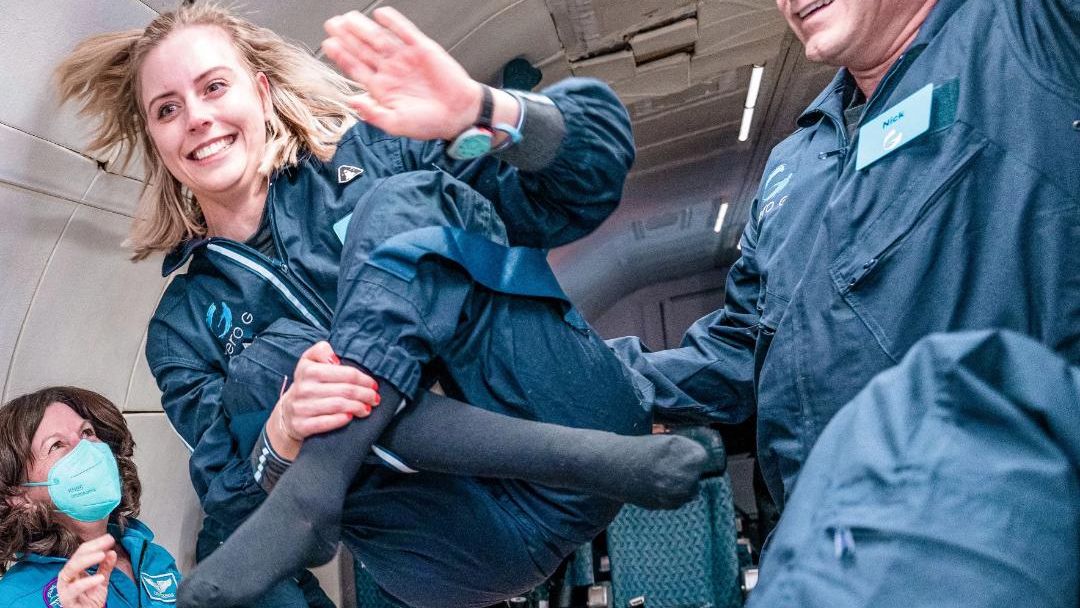
Blue Origin is set to launch its upcoming NS-37 space tourism flight, which will carry six passengers to suborbital space. Among them is Michaela “Michi” Benthaus, who is poised to make history as the first wheelchair user to travel to space. While the exact launch date has yet to be announced, her participation marks a significant milestone in the journey toward inclusivity in space exploration.
Benthaus became wheelchair-bound in 2018 following a mountain biking accident that resulted in a spinal cord injury. Her passion for space led her to participate in a parabolic flight in 2022 with AstroAccess, where she became one of the first wheelchair users to conduct accessibility experiments in a microgravity environment. During her journey, she completed 18 parabolas and contributed to pioneering experiments aimed at ensuring individuals with disabilities can effectively navigate and secure themselves in weightless conditions.
Advancing Accessibility in Space
Currently studying at the TUM School of Engineering and Design in Munich, Germany, Benthaus is also a young graduate trainee at the European Space Agency (ESA). AstroAccess, which is a project of SciAccess, Inc., aims to enhance disability inclusion in human space exploration. Founded in 2021, the initiative has conducted five microgravity missions, allowing disabled individuals—including scientists, veterans, and artists—to demonstrate the feasibility of flying in space.
AstroAccess emphasizes the message: “If we can make space accessible, we can make any space accessible.” Their work is paving the way for a broader range of individuals to experience space travel, breaking down barriers that have historically limited participation.
A Historical Perspective on Inclusivity
Alan Ladwig, a former NASA official, views Benthaus’s upcoming flight as a pivotal moment in space travel history. Ladwig, who has been involved with NASA since 1981, highlights the progress made since the early days of the space shuttle program. He recalls a crucial incident in June 1984 when the STS-41D mission faced an abort scenario, which raised concerns about safety for individuals with disabilities.
In 1985, a paraplegic individual was a finalist for the Journalist in Space Program, prompting discussions about the risks associated with selecting disabled astronauts. Ladwig notes that these concerns reflected a broader reluctance to include civilians in space travel, particularly those with disabilities.
The late Harriet Jenkins, who headed NASA’s Office of Equal Opportunity, conducted a study in the mid-1980s exploring the potential for individuals with disabilities to participate in shuttle missions. However, following the Challenger disaster in January 1986, the findings were sidelined, and the prospect of civilian space travel—especially for disabled individuals—remained stagnant.
Recent developments indicate a shift in this narrative. The ESA astronaut class selected in November 2022 included John McFall, a former Paralympic athlete, as part of the Parastronaut Feasibility Project. This initiative aims to assess whether people with disabilities can safely join missions to the International Space Station (ISS).
Ladwig asserts that the study, set to conclude in 2024, will affirm the feasibility of including disabled individuals in space missions. Although no specific plans have been established yet, the progress made by organizations like AstroAccess is commendable and essential for expanding opportunities in space travel.
Michaela Benthaus’s journey to space represents an important step toward inclusivity. As she prepares for her historic flight with Blue Origin, her experience holds the potential to inspire a new generation of diverse astronauts and advocates for accessibility in space exploration.

Cosmic Mystery Deepens: Where Are the Universe’s Defects?

Lady Bulldogs Shine in Postseason Awards Following Final Four Run

CALV Hosts Essential Class for Local Real Estate Professionals

Urgent Alert: “Spaving” Surges as Shoppers Overspend Online

Jefferies Initiates Coverage on Insmed with “Buy” Rating

Three Dog Night to Perform with Ambrosia at Mayo Civic Center

Urgent Announcement: Charles M. Payment Passes Away at 78

Houston Education Foundation Donates $4,592 for Student Programs

Beeks Financial Cloud Shares Drop 7% Amid Increased Trading Volume

Foreign Inflows into Japan Stocks Surge to ¥1.34 Trillion

University of Hawaiʻi Joins $25.6M AI Project to Monitor Disasters

Sydney Sweeney Embraces Body Positivity Amid Hollywood Challenges

Hudson Williams Gains Popularity as Breakout Star on Heated Rivalry

Urgent Farewell: Joleen Chaney Leaves Legacy at KFOR

Boeing’s Merger with McDonnell Douglas: A Strategic Move Explained

$1.25M Grant Advances Hawaiʻi’s Real-Time Hazard Monitoring

Derrick Dove and ABAC Band Set for Free Americana Concert

BOYNEXTDOOR’s Jaehyun Faces Backlash Amid BTS-TWICE Controversy
-
Business9 months ago
Foreign Inflows into Japan Stocks Surge to ¥1.34 Trillion
-
Science8 months ago
University of Hawaiʻi Joins $25.6M AI Project to Monitor Disasters
-
 Entertainment9 months ago
Sydney Sweeney Embraces Body Positivity Amid Hollywood Challenges
-
 Entertainment7 months ago
Hudson Williams Gains Popularity as Breakout Star on Heated Rivalry
-
 Top Stories8 months ago
Urgent Farewell: Joleen Chaney Leaves Legacy at KFOR
-
 World9 months ago
Boeing’s Merger with McDonnell Douglas: A Strategic Move Explained
-
 Science7 months ago
$1.25M Grant Advances Hawaiʻi’s Real-Time Hazard Monitoring
-
 Entertainment8 months ago
Derrick Dove and ABAC Band Set for Free Americana Concert
-
 Top Stories9 months ago
BOYNEXTDOOR’s Jaehyun Faces Backlash Amid BTS-TWICE Controversy
-

 Health6 months ago
Bodybuilder Eugene Teo Transitions to Mindful Movement for Health
-
 World6 months ago
San Francisco Airport to Host 16 Nonstop Airlines to Europe in 2026
-

 Top Stories7 months ago
National Coast Guard Museum Set to Open in 2027 After Funding Secured