
Science
$1.25M Grant Advances Hawaiʻi’s Real-Time Hazard Monitoring

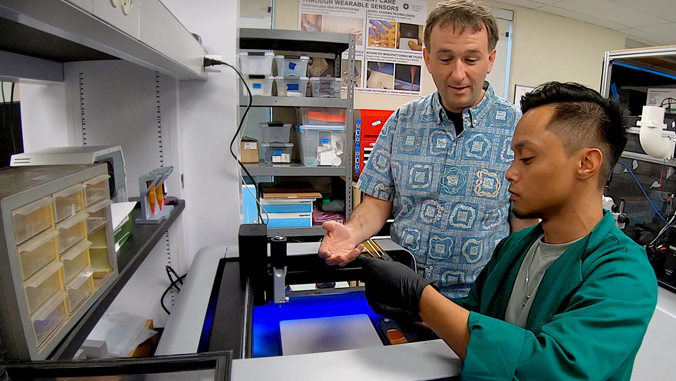
Researchers from the University of Hawaiʻi at Mānoa and Georgia Tech have been awarded a $1.25 million grant from the National Science Foundation to develop innovative hazard monitoring technology for Hawaiʻi. The project aims to create low-cost sensors that can provide real-time data to help protect communities from various threats, including wildfires, flooding, and water contamination.
The funding will facilitate the creation of sensors that can be printed quickly and deployed within hours. These devices will collect crucial data on environmental conditions, measuring factors such as water quality and soil contamination. The sensors will connect to a compact, AI-enabled handheld device, allowing users to access and interpret data through a publicly available dashboard.
Community-Centric Design Approach
To ensure the project meets local needs, the technology will be co-designed with community stakeholders who have a vested interest in land and water stewardship throughout Hawaiʻi. This includes partnerships with land stewardship organizations, Hawaiian-language immersion schools, and community colleges. Input from kūpuna (elders), residents, and kumu (teachers) will guide the project’s priorities and design.
Tyler Ray, the principal investigator and an associate professor at the University of Hawaiʻi at Mānoa College of Engineering, emphasized the initiative’s focus on local solutions. “We can shorten the path from idea to instrument and build sensors tuned to local priorities without relying on centralized, hard-to-access facilities,” he stated. “Our goal is a design-to-deployment pathway that works on-island: robust, affordable, and replicable.”
The sensors will be paired with a durable edge device capable of energy harvesting and data storage, even in areas with limited connectivity. An open library of circuits and firmware will allow partners to customize sensors for various measurements, including pH levels and heavy metal contamination.
Strengthening Community Connections
This initiative builds on existing relationships across Oʻahu, Maui, and Kauaʻi, fostering collaboration between residents, educators, and resource managers. The research team will conduct iterative design workshops and peer exchanges to refine their approach, culminating in a capstone gathering to share findings and open designs. Data governance practices will be established to ensure local control and protect sensitive information.
Co-principal investigator Aurora Kagawa-Viviani, an assistant professor in the Water Resources Research Center, highlighted the importance of co-design. “Our approach follows advances in community-centered co-design where we will design the sensing agenda together with community partners,” she explained. “Building strong and equitable relationships ensures the technology and the data it produces have lasting value long after the prototype.”
The grant will also support hands-on training initiatives that connect students from K–12 institutions, community colleges, and research universities with local partners. The project aims to create open hardware and software resources that could be adapted for use in various island, rural, and urban settings facing similar environmental challenges.
As this innovative project progresses, it promises to enhance Hawaiʻi’s capacity to monitor and respond to environmental hazards, ultimately improving safety and resilience for local communities.

Urgent: Arson Fire Causes $50,000 Damage in Mililani Business

KraneShares California Carbon ETF Sees Major Surge in Short Interest

NASA Scientists Uncover Mechanisms Behind Unique Aurora Phenomena

Short Interest in First Trust High Yield Opportunities Fund Soars

Smart Shoppers Choose Hisense Canvas Over Samsung Frame TVs

No. 13 Minnesota State Women Fall to Bemidji State 2-1 in Classic

Compagnie de Saint-Gobain Shares Drop 2.1% Following UBS Downgrade

Universal Robots Unveils Four Key AI Trends for 2026 and Beyond

Wisconsin Badgers Face Ohio State Buckeyes in Key Showdown

University of Hawaiʻi Joins $25.6M AI Project to Monitor Disasters

Foreign Inflows into Japan Stocks Surge to ¥1.34 Trillion

Hudson Williams Gains Popularity as Breakout Star on Heated Rivalry

Boeing’s Merger with McDonnell Douglas: A Strategic Move Explained

$1.25M Grant Advances Hawaiʻi’s Real-Time Hazard Monitoring

Sydney Sweeney Embraces Body Positivity Amid Hollywood Challenges

BOYNEXTDOOR’s Jaehyun Faces Backlash Amid BTS-TWICE Controversy

French Film Explores Group Therapy in ‘Group – The Schopenhauer Project’

Urgent Farewell: Joleen Chaney Leaves Legacy at KFOR
-
Science3 months ago
University of Hawaiʻi Joins $25.6M AI Project to Monitor Disasters
-
Business3 months ago
Foreign Inflows into Japan Stocks Surge to ¥1.34 Trillion
-
 Entertainment2 months ago
Hudson Williams Gains Popularity as Breakout Star on Heated Rivalry
-
 World3 months ago
Boeing’s Merger with McDonnell Douglas: A Strategic Move Explained
-
 Entertainment3 months ago
Sydney Sweeney Embraces Body Positivity Amid Hollywood Challenges
-
 Top Stories3 months ago
BOYNEXTDOOR’s Jaehyun Faces Backlash Amid BTS-TWICE Controversy
-
 World3 months ago
French Film Explores Group Therapy in ‘Group – The Schopenhauer Project’
-
 Top Stories3 months ago
Urgent Farewell: Joleen Chaney Leaves Legacy at KFOR
-
 Top Stories3 months ago
Marc Buoniconti’s Legacy: 40 Years Later, Lives Transformed
-

 Lifestyle4 months ago
Kelsea Ballerini Launches ‘Burn the Baggage’ Candle with Ranger Station
-

 Top Stories3 months ago
Carson Wentz Out for Season After Shoulder Surgery: Urgent Update
-
 World2 months ago
Nicolas Maduro’s Surprising Tenure: Defiance and Controversy