
World
New Theory Recasts Bayeux Tapestry’s Purpose and Origins

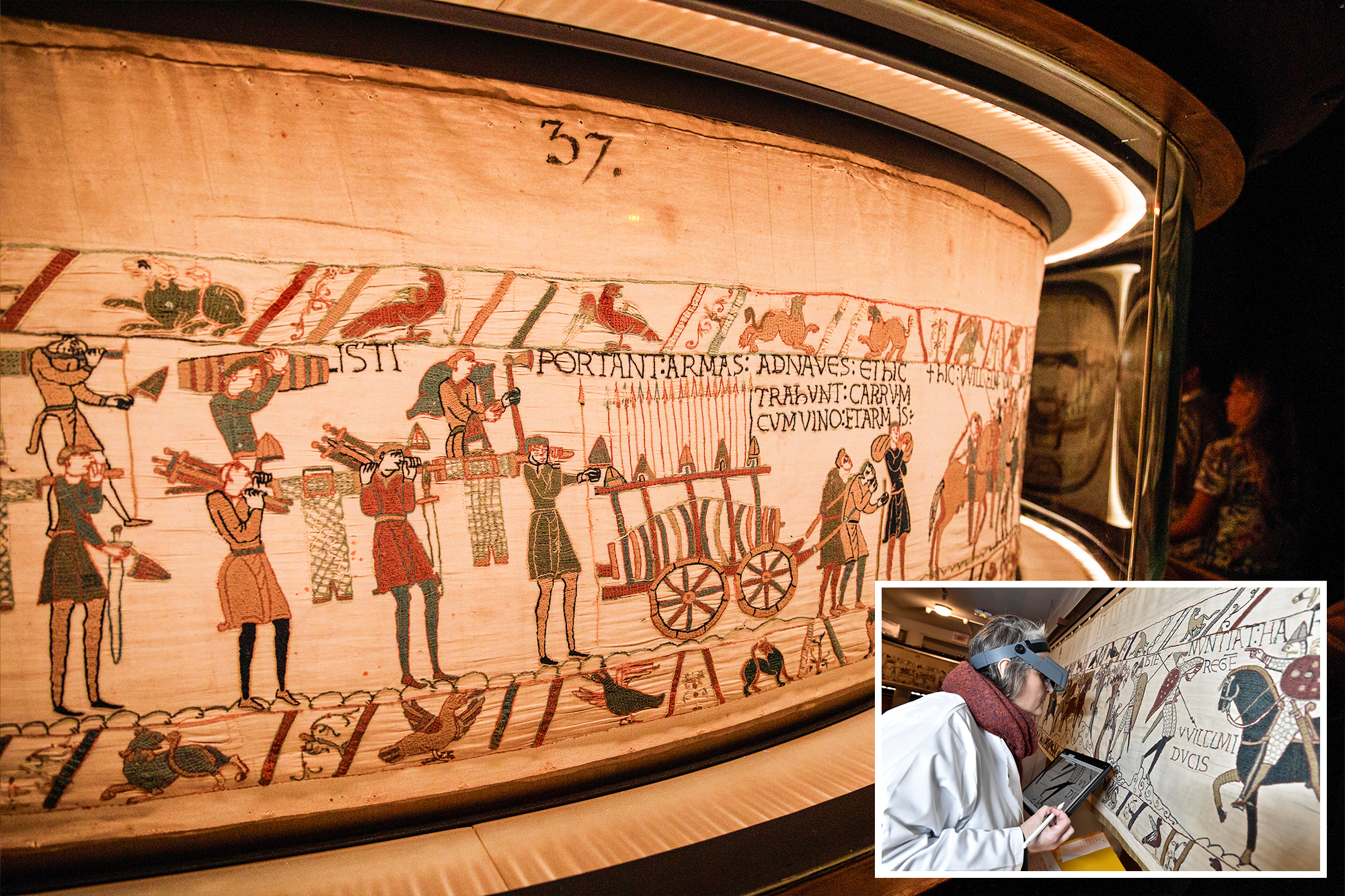
Recent research is challenging long-held beliefs about the Bayeux Tapestry, one of the most renowned artifacts of medieval art. Traditionally viewed as a decorative piece intended for display in Bayeux Cathedral, new findings suggest that it may have served a different purpose entirely. Scholar Benjamin Pohl, a professor of medieval history at the University of Bristol, argues that the tapestry was likely created for the monastic refectory of St. Augustine’s Abbey in Canterbury, rather than for the cathedral built in 1077.
Pohl’s research, published in the journal Historical Research on December 12, 2023, indicates that the tapestry, which vividly illustrates the events surrounding the Norman Conquest and the Battle of Hastings, was designed for a viewing experience that would have enhanced the monks’ mealtime reflections. He posits that it first arrived in Bayeux in the 15th century, a consequence of circumstances rather than deliberate planning.
“From a practical perspective,” Pohl explained, “a cathedral nave does not offer a particularly suitable space for hanging an embroidery of this length and weight in such a way that its contents can be seen and understood easily.” In contrast, he believes a monastic refectory would have provided an ideal environment, allowing the tapestry to be displayed at eye level. This would have made the images and texts more accessible to the monks.
The tapestry’s text is written in a specific form of Latin, which Pohl argues aligns with the varying literacy levels typical of a medieval monastery. He suggests that the narrative contained within the tapestry could have been interpreted as a moral lesson, resonating with the types of texts that monks would contemplate during their meals.
Pohl states, “The surviving evidence we have indicates that the refectory walls of St. Augustine’s would have been large enough to hang the Bayeux Tapestry in its entirety, probably covering most of its four internal walls.” However, the setting would not resemble a festive gathering. Instead, the viewing of the tapestry likely occurred in silence, with monks consuming simple fare such as bread, light beer, and occasional meat, in accordance with the rule of St. Benedict, which prescribed silence during meals.
If Pohl’s theory holds, it implies that the refectory was planned for construction in the 1080s, suggesting that the Bayeux Tapestry might have been stored away and forgotten until the completion of the refectory in 1120. “Nobody could have foreseen that it would take almost 50 years for the refectory to be completed,” he noted, highlighting the possibility that the tapestry remained in storage for nearly two generations.
This new perspective comes at a time when the Bayeux Tapestry is again capturing public attention. In July 2025, it was announced that the tapestry will be exhibited at the British Museum from September 2026 to July 2027—the first opportunity for it to be viewed in England in centuries. Earlier in 2025, Newcastle University revealed the discovery of Harold Godwinson’s residence in Bosham, a location featured in the tapestry, further enriching the historical narrative surrounding this iconic artwork.
Pohl’s findings contribute to a deeper understanding of the Bayeux Tapestry, inviting scholars and the public alike to reconsider its origins, purpose, and the context in which it was created. As discussions around the tapestry continue, the potential implications of Pohl’s theory may redefine how this monumental piece of history is perceived and appreciated in the future.

Beaufort Man Arrested in Hit-and-Run; Two Pedestrians Injured

KORU Medical Systems Sees 21.4% Drop in Short Interest in January

NASA’s WB-57: High-Altitude Research Aircraft Takes Flight

Chunghwa Telecom Sees 21.6% Drop in Short Interest for January

Claim Your $250 Bet Match NOW for Lakers vs. Knicks Showdown!

Court Ruling Affirms Panama Canal Independence from China

Waldencast PLC Sees 25.7% Drop in Short Interest in January

Selena Gomez Raps Kendrick Lamar’s “Not Like Us” in Viral Clip

Father and Son Reunited in Minnesota After ICE Detention

University of Hawaiʻi Joins $25.6M AI Project to Monitor Disasters

Foreign Inflows into Japan Stocks Surge to ¥1.34 Trillion

Hudson Williams Gains Popularity as Breakout Star on Heated Rivalry

Boeing’s Merger with McDonnell Douglas: A Strategic Move Explained

$1.25M Grant Advances Hawaiʻi’s Real-Time Hazard Monitoring

Sydney Sweeney Embraces Body Positivity Amid Hollywood Challenges

BOYNEXTDOOR’s Jaehyun Faces Backlash Amid BTS-TWICE Controversy

Urgent Farewell: Joleen Chaney Leaves Legacy at KFOR

French Film Explores Group Therapy in ‘Group – The Schopenhauer Project’
-
Science3 months ago
University of Hawaiʻi Joins $25.6M AI Project to Monitor Disasters
-
Business3 months ago
Foreign Inflows into Japan Stocks Surge to ¥1.34 Trillion
-
 Entertainment2 months ago
Hudson Williams Gains Popularity as Breakout Star on Heated Rivalry
-
 World3 months ago
Boeing’s Merger with McDonnell Douglas: A Strategic Move Explained
-
 Science2 months ago
$1.25M Grant Advances Hawaiʻi’s Real-Time Hazard Monitoring
-
 Entertainment3 months ago
Sydney Sweeney Embraces Body Positivity Amid Hollywood Challenges
-
 Top Stories3 months ago
BOYNEXTDOOR’s Jaehyun Faces Backlash Amid BTS-TWICE Controversy
-
 Top Stories3 months ago
Urgent Farewell: Joleen Chaney Leaves Legacy at KFOR
-
 World3 months ago
French Film Explores Group Therapy in ‘Group – The Schopenhauer Project’
-

 Top Stories3 months ago
Marc Buoniconti’s Legacy: 40 Years Later, Lives Transformed
-

 Lifestyle4 months ago
Kelsea Ballerini Launches ‘Burn the Baggage’ Candle with Ranger Station
-

 Top Stories3 months ago
Carson Wentz Out for Season After Shoulder Surgery: Urgent Update