
Science
Scientists Unlock New Mechanism in RNA Transcription Process

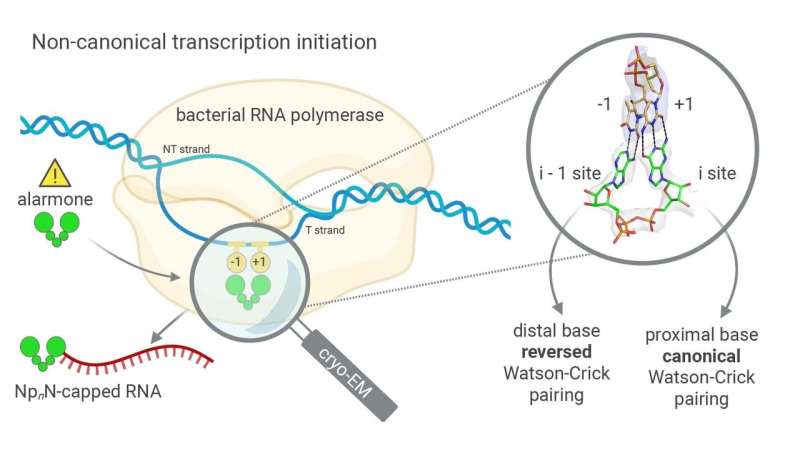
Researchers at the Institute of Organic Chemistry and Biochemistry of the CAS in Prague have uncovered a novel mechanism in the process of gene transcription. Their findings reveal how genetic information is transferred from deoxyribonucleic acid (DNA) to ribonucleic acid (RNA) through a previously unknown pathway. This groundbreaking study was published on January 29, 2026, in the journal Nature Chemical Biology.
Discovery of Alarmone Caps
The team focused on a specific class of molecules known as alarmones, which are prevalent in various organisms and often increase in concentration during cellular stress. These alarmones play a crucial role in protecting RNA during challenging conditions. The scientists explored how bacterial RNA polymerase can initiate transcription using dinucleoside polyphosphate molecules, known as NpNs, instead of traditional RNA building blocks.
Dr. Hana Cahová and her colleagues provided the first atomic-level description of how RNA with an alarmone cap can be generated directly at the onset of gene transcription. They discovered that NpNs bind through a different base pairing mechanism than what is typically observed in standard RNA processes.
Key Contributions and Technological Advances
The research was significantly influenced by contributions from team members, particularly Valentina Serianni, who demonstrated the capability of NpNs to initiate gene transcription, and Jana Škerlová, who conducted structural analyses of RNA polymerase. Utilizing cryogenic electron microscopy (cryo-EM), she illustrated how dinucleoside polyphosphate molecules interact within the active site of RNA polymerase, the enzyme responsible for transcribing genetic information.
“We’re describing something that truly occurs in cells and that we’re now able to observe directly at the level of individual molecules,” said Dr. Cahová. “This allows us to answer fundamental questions about cellular processes, such as how cells adapt to stress.”
Dr. Tomáš Kouba, another key author of the study, emphasized the importance of cryo-EM in their research. “Cryogenic electron microscopy allows us to freeze biological molecules in a state very close to their natural form and then determine their three-dimensional structure,” he explained. “This capability enables us to investigate enzyme functions down to the atomic level.”
The implications of this research extend beyond basic science; understanding how cells respond to stressors such as nutrient deprivation or temperature fluctuations could pave the way for advancements in medical and biotechnological applications. The detailed insights into RNA capping mechanisms reveal potential targets for therapeutic interventions in various diseases.
As the field of molecular biology continues to evolve, studies like this one highlight the intricate and dynamic processes that underlie gene expression. The findings from the Institute of Organic Chemistry and Biochemistry of the CAS not only enhance our understanding of fundamental biological mechanisms but also open doors for future research in cellular responses to environmental challenges.

Donaldson Capital Management Boosts Stake in UnitedHealth Group

Researchers Establish First Lab Colony of Invasive Beetle in Australia

Jersey City Schools Confirm Controversial Kindergarten Move

NeuroOne Medical Technologies Outperforms Cannlabs in Financial Metrics

Nevada Bankers Prepare for 2026 Challenges Amid Changing Landscape

Radian Group vs. Principal Financial: An In-Depth Stock Analysis

Clive Davis Gala Honors Ozzy Osbourne as Stars Shine Bright

Sun Valley Music Festival Reveals Star-Studded Lineup for 2026

February Insights for Cancer: Emotions Surge and Transform

University of Hawaiʻi Joins $25.6M AI Project to Monitor Disasters

Foreign Inflows into Japan Stocks Surge to ¥1.34 Trillion

Hudson Williams Gains Popularity as Breakout Star on Heated Rivalry

Boeing’s Merger with McDonnell Douglas: A Strategic Move Explained

$1.25M Grant Advances Hawaiʻi’s Real-Time Hazard Monitoring

Sydney Sweeney Embraces Body Positivity Amid Hollywood Challenges

BOYNEXTDOOR’s Jaehyun Faces Backlash Amid BTS-TWICE Controversy

French Film Explores Group Therapy in ‘Group – The Schopenhauer Project’

Urgent Farewell: Joleen Chaney Leaves Legacy at KFOR
-
Science3 months ago
University of Hawaiʻi Joins $25.6M AI Project to Monitor Disasters
-
Business3 months ago
Foreign Inflows into Japan Stocks Surge to ¥1.34 Trillion
-
 Entertainment2 months ago
Hudson Williams Gains Popularity as Breakout Star on Heated Rivalry
-
 World3 months ago
Boeing’s Merger with McDonnell Douglas: A Strategic Move Explained
-
 Science2 months ago
$1.25M Grant Advances Hawaiʻi’s Real-Time Hazard Monitoring
-
 Entertainment3 months ago
Sydney Sweeney Embraces Body Positivity Amid Hollywood Challenges
-
 Top Stories3 months ago
BOYNEXTDOOR’s Jaehyun Faces Backlash Amid BTS-TWICE Controversy
-
 World3 months ago
French Film Explores Group Therapy in ‘Group – The Schopenhauer Project’
-
 Top Stories3 months ago
Urgent Farewell: Joleen Chaney Leaves Legacy at KFOR
-

 Top Stories3 months ago
Marc Buoniconti’s Legacy: 40 Years Later, Lives Transformed
-

 Lifestyle4 months ago
Kelsea Ballerini Launches ‘Burn the Baggage’ Candle with Ranger Station
-

 Top Stories3 months ago
Carson Wentz Out for Season After Shoulder Surgery: Urgent Update