
Science
Scientists Scan Comet 3I/ATLAS for Alien Signals, Find None

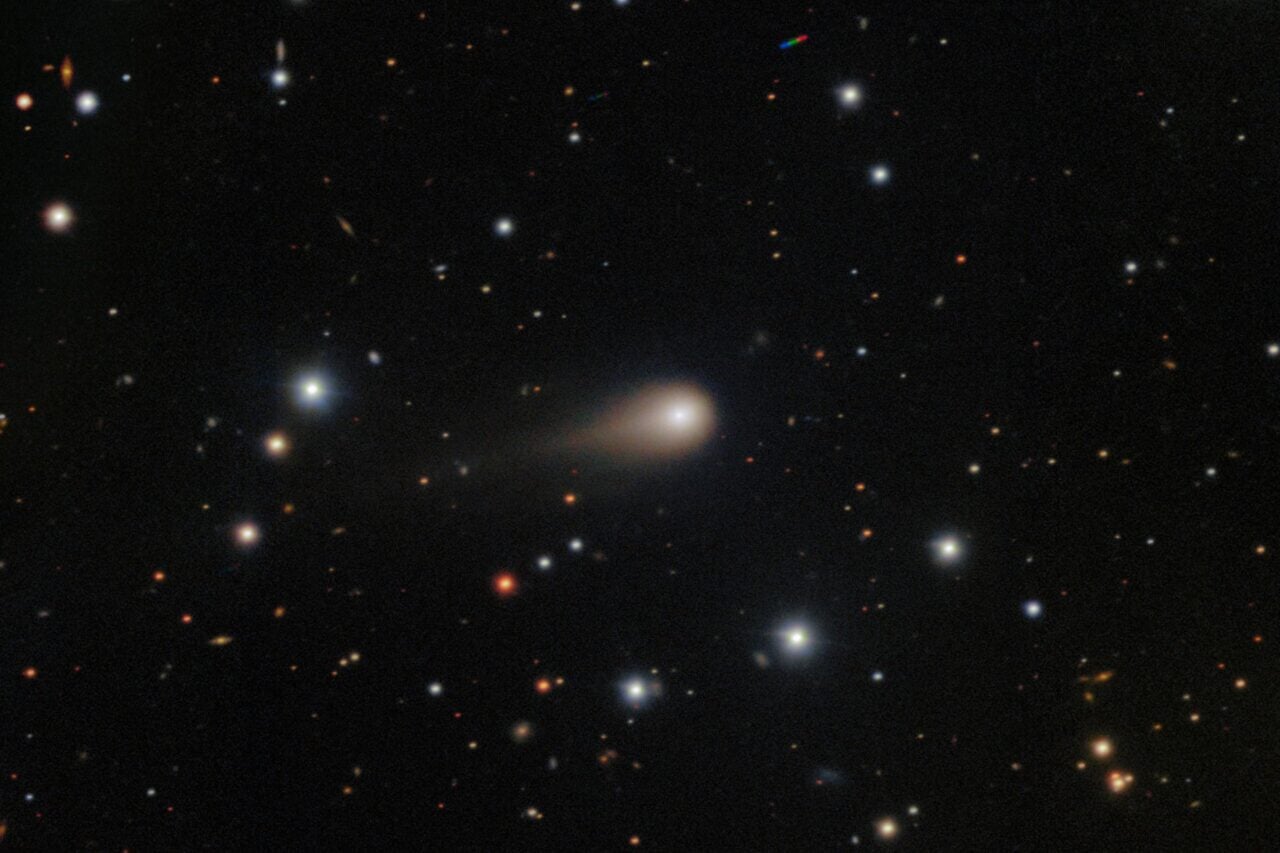
Astronomers have recently focused on interstellar object 3I/ATLAS, conducting a thorough search for potential alien signals. This investigation aimed to clarify its true nature amid ongoing speculation about its origins. While the scientific consensus suggests that 3I/ATLAS is a comet from outside our solar system, some researchers, notably Avi Loeb from Harvard University, have proposed that it might be an alien spacecraft.
To address these claims, the Breakthrough Listen program performed a “technosignature search” on December 18, 2023, as 3I/ATLAS approached its closest point to Earth. This initiative, described as the largest scientific effort to find evidence of extraterrestrial civilizations, utilized the Robert C. Byrd Green Bank Telescope in West Virginia, the largest moving structure on land.
The search aimed to detect artificial radio signals emanating from 3I/ATLAS. Despite promising initial results of about 470,000 potential signals, researchers eliminated all but nine candidates because those signals were also recorded when the telescope pointed away from the comet. Ultimately, these remaining signals were found to be human-made radio interference. The study concluded with the statement: “There is currently no evidence to suggest that [interstellar objects] are anything other than natural astrophysical objects.”
Understanding 3I/ATLAS
This research adds to a growing body of evidence that challenges the notion of 3I/ATLAS as a technological artifact. Other research groups have also conducted their own searches at various frequencies, all yielding similar results of no credible artificial signals.
Despite the lack of evidence for extraterrestrial technology, 3I/ATLAS is still a significant find in the realm of astronomy. It represents only the third interstellar object discovered, offering a unique opportunity to study a celestial body from another star system. Scientists have noted that this comet is notably different from its predecessors: it is older, larger, and faster, displaying unique chemical and physical properties.
As 3I/ATLAS heads back into interstellar space, astronomers will continue to analyze the extensive data collected during its flyby. These ongoing studies are anticipated to enhance our understanding of other star systems, even if they do not lead to the discovery of intelligent extraterrestrial life.
The findings from this technosignature search reaffirm the scientific community’s commitment to exploring the universe while emphasizing the need for careful consideration of extraordinary claims.

Beaufort Man Arrested in Hit-and-Run; Two Pedestrians Injured

KORU Medical Systems Sees 21.4% Drop in Short Interest in January

NASA’s WB-57: High-Altitude Research Aircraft Takes Flight

Chunghwa Telecom Sees 21.6% Drop in Short Interest for January

Claim Your $250 Bet Match NOW for Lakers vs. Knicks Showdown!

Court Ruling Affirms Panama Canal Independence from China

Waldencast PLC Sees 25.7% Drop in Short Interest in January

Selena Gomez Raps Kendrick Lamar’s “Not Like Us” in Viral Clip

Father and Son Reunited in Minnesota After ICE Detention

University of Hawaiʻi Joins $25.6M AI Project to Monitor Disasters

Foreign Inflows into Japan Stocks Surge to ¥1.34 Trillion

Hudson Williams Gains Popularity as Breakout Star on Heated Rivalry

Boeing’s Merger with McDonnell Douglas: A Strategic Move Explained

$1.25M Grant Advances Hawaiʻi’s Real-Time Hazard Monitoring

Sydney Sweeney Embraces Body Positivity Amid Hollywood Challenges

BOYNEXTDOOR’s Jaehyun Faces Backlash Amid BTS-TWICE Controversy

Urgent Farewell: Joleen Chaney Leaves Legacy at KFOR

French Film Explores Group Therapy in ‘Group – The Schopenhauer Project’
-
Science3 months ago
University of Hawaiʻi Joins $25.6M AI Project to Monitor Disasters
-
Business3 months ago
Foreign Inflows into Japan Stocks Surge to ¥1.34 Trillion
-
 Entertainment2 months ago
Hudson Williams Gains Popularity as Breakout Star on Heated Rivalry
-
 World3 months ago
Boeing’s Merger with McDonnell Douglas: A Strategic Move Explained
-
 Science2 months ago
$1.25M Grant Advances Hawaiʻi’s Real-Time Hazard Monitoring
-
 Entertainment3 months ago
Sydney Sweeney Embraces Body Positivity Amid Hollywood Challenges
-
 Top Stories3 months ago
BOYNEXTDOOR’s Jaehyun Faces Backlash Amid BTS-TWICE Controversy
-
 Top Stories3 months ago
Urgent Farewell: Joleen Chaney Leaves Legacy at KFOR
-
 World3 months ago
French Film Explores Group Therapy in ‘Group – The Schopenhauer Project’
-

 Top Stories3 months ago
Marc Buoniconti’s Legacy: 40 Years Later, Lives Transformed
-

 Lifestyle4 months ago
Kelsea Ballerini Launches ‘Burn the Baggage’ Candle with Ranger Station
-

 Top Stories3 months ago
Carson Wentz Out for Season After Shoulder Surgery: Urgent Update