
Science
Scientists Pinpoint Date of Historic Lahar Linked to Mount Rainier

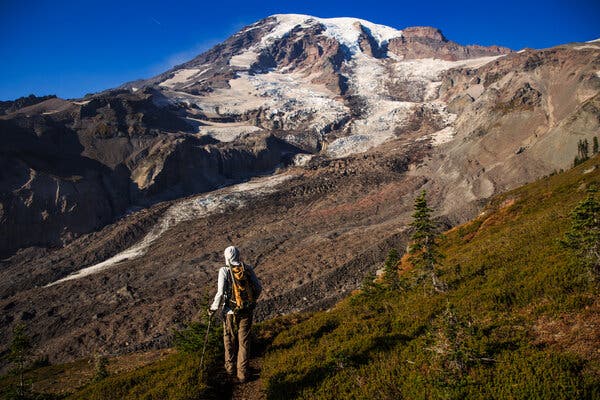
A recent study has shed light on a significant geological event linked to Mount Rainier, Washington. Researchers have determined the likely date of the catastrophic Electron Mudflow, a lahar that buried the surrounding landscape under nearly 20 feet of mud. This revelation is crucial for understanding the volcanic activity of the region and assessing future risks to communities situated downhill from the 14,410-foot volcano.
Over the past several millennia, lahars—mixtures of water, rock, and mud—have posed a substantial threat to areas surrounding Mount Rainier. While the volcano itself is an active geological feature, it is these dense mudflows, which can be as heavy as wet concrete, that present the greatest danger. Historically, lahars have surged down the mountain, reaching locations such as the Puget Sound, approximately 60 miles away.
The Electron Mudflow stands out as the most significant lahar in the past 1,000 years. It originated from Mount Rainier and flowed into what is today the small city of Orting. Prior estimates suggested that this event occurred around 500 years ago but lacked precision. The recent work published in the journal Geology offers a more exact timeframe based on advanced dendrochronology techniques.
Understanding Lahars and Their Impact
Dendrochronology, the study of tree rings, has proven to be a valuable tool in this research. Trees affected by the lahar often show clear signs of being uprooted or buried, which helps scientists like Bryan Black, a tree ring scientist at the University of Arizona, establish a timeline. As Black explains, “Trees don’t survive long,” allowing their outermost rings to provide precise indicators of events like lahars.
The Electron Mudflow, characterized by its rich clay content, is believed to have extended debris flows as far as 35 miles from the mountain. By analyzing tree rings in the affected areas, researchers were able to correlate the growth patterns of trees with the timing of the mudflow, offering a clearer picture of when this event occurred. This new understanding not only provides insight into past geological activity but also aids in predicting the potential for future lahars.
Scientists assert that having a more accurate date for the Electron Mudflow is essential for improving hazard assessments in the region. Knowing the specific year of past events can help create models that forecast future risks, ultimately supporting the safety of communities near Mount Rainier.
As research on Mount Rainier continues, the implications of this study underscore the importance of geological monitoring and preparedness in areas prone to volcanic activity and related hazards. Understanding the history of lahars like the Electron Mudflow is vital for mitigating the risks they pose to both residents and infrastructure in the vicinity of active volcanoes.

Shark Bites Surge Linked to Climate Change and Ecosystem Shifts

NASCAR Clash Delayed Due to Snow, Rescheduled for Monday

Boeing and Lockheed Martin Battle for Fighter Jet Dominance

Golden Link Chapter No. 204 Honors Kijahfha Mahoney with Service Award

Gigachad Price Falls to $0.0025 Amid Market Fluctuations

Exploring Bortus: The Complex Alien of ‘The Orville’

Harry Potter Quiz Links Personality Traits to Entrepreneurship

Colorado Voters React to Trump’s Immigration Actions Amid Midterms

Donaldson Capital Management Boosts Stake in UnitedHealth Group

University of Hawaiʻi Joins $25.6M AI Project to Monitor Disasters

Foreign Inflows into Japan Stocks Surge to ¥1.34 Trillion

Hudson Williams Gains Popularity as Breakout Star on Heated Rivalry

Boeing’s Merger with McDonnell Douglas: A Strategic Move Explained

$1.25M Grant Advances Hawaiʻi’s Real-Time Hazard Monitoring

Sydney Sweeney Embraces Body Positivity Amid Hollywood Challenges

BOYNEXTDOOR’s Jaehyun Faces Backlash Amid BTS-TWICE Controversy

French Film Explores Group Therapy in ‘Group – The Schopenhauer Project’

Urgent Farewell: Joleen Chaney Leaves Legacy at KFOR
-
Science3 months ago
University of Hawaiʻi Joins $25.6M AI Project to Monitor Disasters
-
Business3 months ago
Foreign Inflows into Japan Stocks Surge to ¥1.34 Trillion
-
 Entertainment2 months ago
Hudson Williams Gains Popularity as Breakout Star on Heated Rivalry
-
 World3 months ago
Boeing’s Merger with McDonnell Douglas: A Strategic Move Explained
-
 Science2 months ago
$1.25M Grant Advances Hawaiʻi’s Real-Time Hazard Monitoring
-
 Entertainment3 months ago
Sydney Sweeney Embraces Body Positivity Amid Hollywood Challenges
-
 Top Stories3 months ago
BOYNEXTDOOR’s Jaehyun Faces Backlash Amid BTS-TWICE Controversy
-
 World3 months ago
French Film Explores Group Therapy in ‘Group – The Schopenhauer Project’
-
 Top Stories3 months ago
Urgent Farewell: Joleen Chaney Leaves Legacy at KFOR
-

 Top Stories3 months ago
Marc Buoniconti’s Legacy: 40 Years Later, Lives Transformed
-

 Lifestyle4 months ago
Kelsea Ballerini Launches ‘Burn the Baggage’ Candle with Ranger Station
-

 Top Stories3 months ago
Carson Wentz Out for Season After Shoulder Surgery: Urgent Update