
Science
Robots Achieve Milestone by Learning 1,000 Tasks in One Day

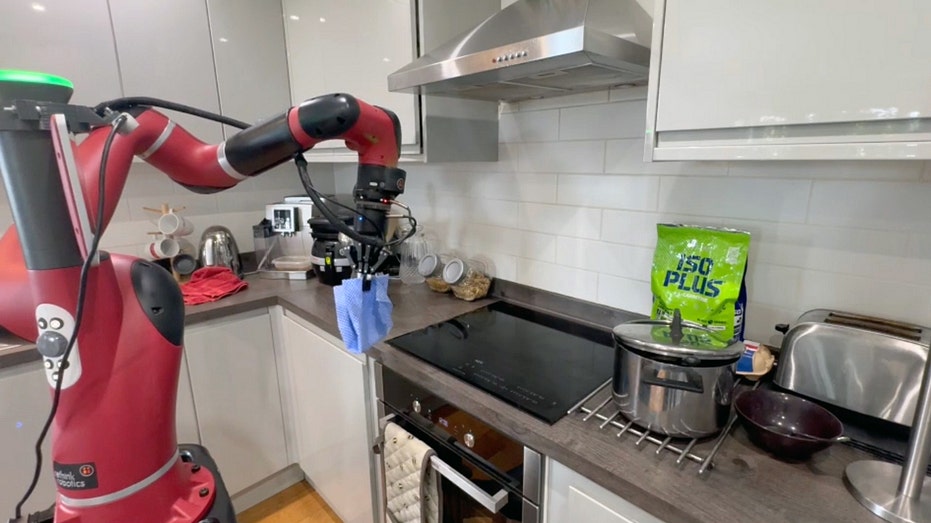
A groundbreaking study published in Science Robotics reveals that a robot has successfully learned 1,000 distinct physical tasks in just one day using only a single demonstration for each task. This achievement marks a significant advancement in the field of robotics and artificial intelligence, addressing a long-standing limitation in how robots learn and adapt to new challenges.
Historically, teaching robots to perform physical tasks has been a laborious process. Engineers typically require hundreds or even thousands of demonstrations for a robot to grasp basic movements. This inefficiency has often resulted in robots that can only perform repetitive tasks in controlled environments, failing when faced with variability in real-world settings. The gap between human learning—where individuals can often grasp new concepts after just a few demonstrations—and robotic learning has hindered progress in the field for decades.
The research team behind this recent study implemented a novel approach to teaching robots, focusing on breaking tasks into simpler phases. The system aligns with an object during one phase and manages the interaction in another. This method relies on a technique known as imitation learning, allowing robots to acquire physical skills from human demonstrations. By reusing knowledge from previously learned tasks, the robot can generalize its understanding rather than starting anew with each task.
Using a technique called Multi-Task Trajectory Transfer, the researchers trained a robotic arm on these 1,000 tasks in less than 24 hours of human demonstration time. Notably, this training occurred in real-world conditions, involving genuine objects and interactions, which is a critical factor in assessing the method’s effectiveness.
The implications of this research extend beyond mere numbers. Previous studies have often presented impressive results that falter outside of laboratory settings. In contrast, this research demonstrates that the robot can adapt to new object instances it had not encountered before, showcasing a significant leap in its ability to generalize and learn. Such adaptability is a crucial distinction between machines that merely repeat tasks and those that can adjust to new challenges.
This advancement addresses one of robotics’ biggest bottlenecks: the slow and inefficient learning process from demonstrations. By decomposing tasks and leveraging prior knowledge, this new system achieves unprecedented data efficiency compared to traditional methods. The potential for this technology could revolutionize various sectors, including healthcare, logistics, and manufacturing, where robots could learn to perform new tasks with minimal programming.
As robots become capable of learning more rapidly and flexibly, the future of robotics appears to be shifting. Rather than being confined to repetitive tasks, robots may soon be able to operate in diverse environments, adapting to new situations much like humans do. This could pave the way for home robots that learn from simple demonstrations, enhancing their usability and affordability.
While this milestone does not mean that humanoid robots will become household helpers overnight, it signifies significant progress in overcoming challenges that have limited the potential of robotics for years. As the conversation around robots evolves, it will increasingly focus on their ability to adapt rather than merely repeat actions. This shift will undoubtedly influence how society perceives and interacts with robotic technology in the near future.

Cosmic Mystery Deepens: Where Are the Universe’s Defects?

Lady Bulldogs Shine in Postseason Awards Following Final Four Run

CALV Hosts Essential Class for Local Real Estate Professionals

Urgent Alert: “Spaving” Surges as Shoppers Overspend Online

Jefferies Initiates Coverage on Insmed with “Buy” Rating

Three Dog Night to Perform with Ambrosia at Mayo Civic Center

Urgent Announcement: Charles M. Payment Passes Away at 78

Houston Education Foundation Donates $4,592 for Student Programs

Beeks Financial Cloud Shares Drop 7% Amid Increased Trading Volume

Foreign Inflows into Japan Stocks Surge to ¥1.34 Trillion

University of Hawaiʻi Joins $25.6M AI Project to Monitor Disasters

Hudson Williams Gains Popularity as Breakout Star on Heated Rivalry

Sydney Sweeney Embraces Body Positivity Amid Hollywood Challenges

Urgent Farewell: Joleen Chaney Leaves Legacy at KFOR

Boeing’s Merger with McDonnell Douglas: A Strategic Move Explained

$1.25M Grant Advances Hawaiʻi’s Real-Time Hazard Monitoring

BOYNEXTDOOR’s Jaehyun Faces Backlash Amid BTS-TWICE Controversy

Bodybuilder Eugene Teo Transitions to Mindful Movement for Health
-
Business5 months ago
Foreign Inflows into Japan Stocks Surge to ¥1.34 Trillion
-
Science5 months ago
University of Hawaiʻi Joins $25.6M AI Project to Monitor Disasters
-
 Entertainment4 months ago
Hudson Williams Gains Popularity as Breakout Star on Heated Rivalry
-
 Entertainment6 months ago
Sydney Sweeney Embraces Body Positivity Amid Hollywood Challenges
-
 Top Stories5 months ago
Urgent Farewell: Joleen Chaney Leaves Legacy at KFOR
-
 World6 months ago
Boeing’s Merger with McDonnell Douglas: A Strategic Move Explained
-
 Science4 months ago
$1.25M Grant Advances Hawaiʻi’s Real-Time Hazard Monitoring
-
 Top Stories6 months ago
BOYNEXTDOOR’s Jaehyun Faces Backlash Amid BTS-TWICE Controversy
-
 Health3 months ago
Bodybuilder Eugene Teo Transitions to Mindful Movement for Health
-

 Health3 months ago
Hartford’s Abandoned Tower Faces Growing Safety Concerns
-

 World6 months ago
French Film Explores Group Therapy in ‘Group – The Schopenhauer Project’
-

 World4 months ago
Nicolas Maduro’s Surprising Tenure: Defiance and Controversy