
Science
Innovator Constructs Acoustic Radiometer Using Sound Waves

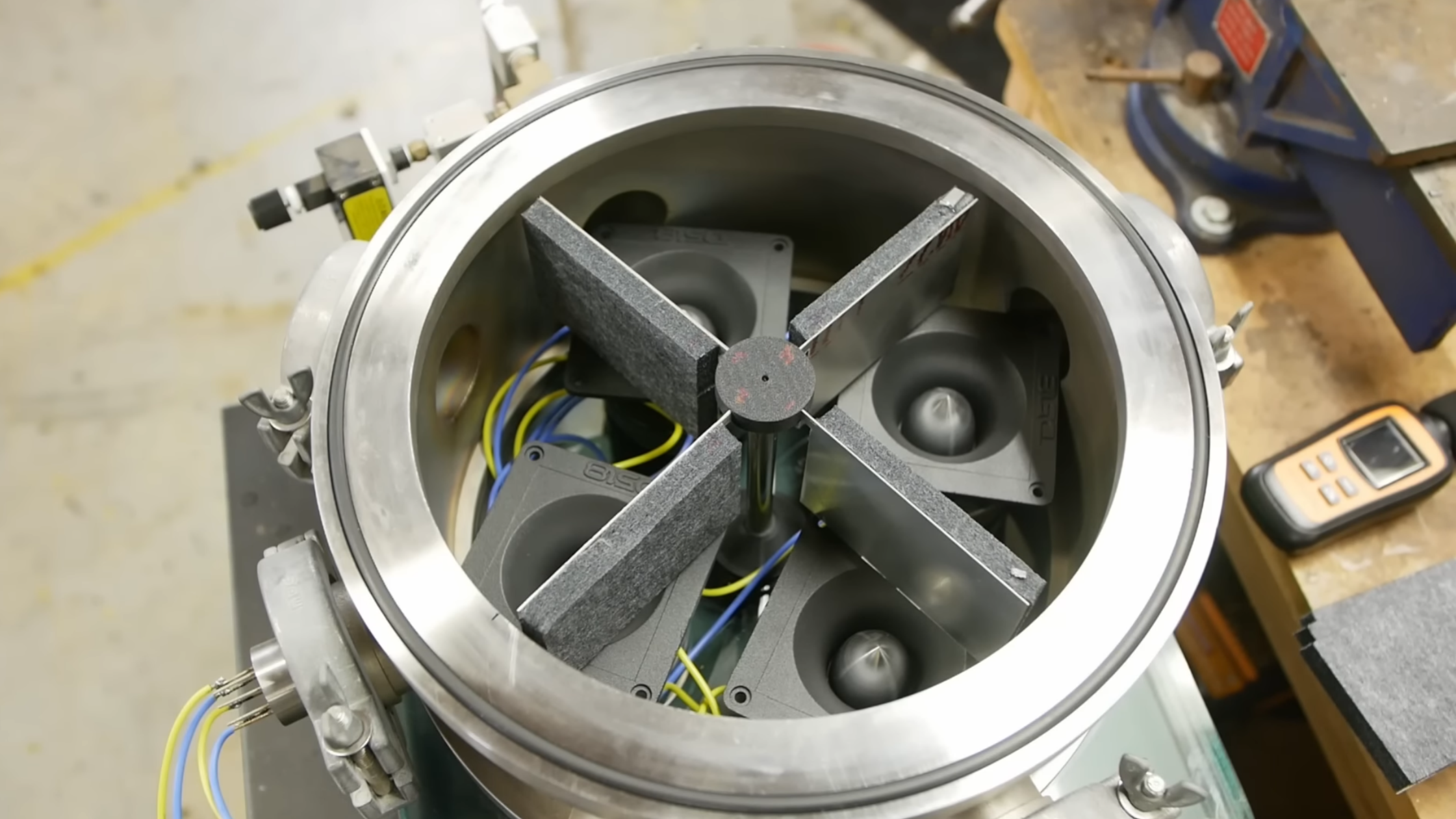
A new type of radiometer has been developed that operates using sound waves instead of light. Ben Krasnow, a notable innovator in experimental physics, built this acoustic radiometer to demonstrate how sound can create motion through pressure differences. While traditional Crookes radiometers are often misattributed to functioning solely on radiation pressure, Krasnow’s design showcases a more effective method involving acoustic energy.
Krasnow constructed two sets of vanes from laser-cut aluminum, attaching sound-absorbing foam to one side of each vane. These vanes were mounted around a jewel bearing sourced from an analog voltmeter. Positioned above four speakers within an acoustically sealed chamber, the setup utilized 130-decibel white noise to generate sound pressure. The vanes spun due to the pressure difference created by the sound waves impacting the reflective aluminum side more than the foam side.
Testing revealed that the vanes exhibited opposite spinning directions depending on the configuration of the foam. This observation confirmed that the rotation was indeed caused by the pressure differential rather than an acoustic streaming effect, further validating the effectiveness of Krasnow’s approach.
Krasnow faced challenges during his experiments, particularly with speaker durability. The high sound levels resulted in the burnout of several speakers. To mitigate this issue, he carefully monitored the temperature of the speaker coils at varying power levels. By observing the increasing resistance of the coils as they heated, he could determine the temperature and thus prevent overheating.
In his experiments, Krasnow also assessed the performance of the radiometer in various gas environments, including hydrogen, helium, carbon dioxide, and sulfur hexafluoride. Surprisingly, none of these gases surpassed the effectiveness of air. This outcome aligns with the understanding that speakers are optimized to transfer energy efficiently to air, highlighting the limitations of utilizing other gases in this context.
While Krasnow’s design is not the most efficient means of converting electrical energy into motion, it contributes to the growing body of knowledge regarding acoustic resonance applications. The work may pave the way for future innovations powered by sound, a concept that has garnered interest in various fields.
Krasnow has previously discussed the mechanics of traditional Crookes radiometers, providing a thorough understanding of their operation. His latest project underscores the potential for acoustic phenomena to drive new technologies and invites further exploration into this fascinating area of physics.

Japan’s PM Takaichi Vows to Prioritize Fiscal Management NOW

Long Island Faces Disruptive Winter Weather Tuesday Morning

Urgent: 18-Year-Old Killed in Triple Shooting in Bronzeville

Shark Teeth Reveal Urgent Insights to Prevent Extinction

Englewood Church Members Reunite After Thanksgiving Fire

Mayor Names Alan Wong as District 4 Supervisor Amid Controversy

Study Reveals Nitrous Oxide’s Potential in Treating Depression

Walmart Launches Massive Cyber Monday Sales Starting at $5

Rep. Don Bacon Criticizes White House for Lack of Clarity on Ukraine

University of Hawaiʻi Joins $25.6M AI Project to Monitor Disasters

Foreign Inflows into Japan Stocks Surge to ¥1.34 Trillion

BOYNEXTDOOR’s Jaehyun Faces Backlash Amid BTS-TWICE Controversy

Carson Wentz Out for Season After Shoulder Surgery: Urgent Update

Marc Buoniconti’s Legacy: 40 Years Later, Lives Transformed

Innovative Surgery Restores Confidence for Breast Cancer Patients

Kelsea Ballerini Launches ‘Burn the Baggage’ Candle with Ranger Station

Steve Kerr Supports Jonathan Kuminga After Ejection in Preseason Game

Chicago’s Viral ‘Rat Hole’ Likely Created by Squirrel, Study Reveals
-
Science4 weeks ago
University of Hawaiʻi Joins $25.6M AI Project to Monitor Disasters
-
Business1 month ago
Foreign Inflows into Japan Stocks Surge to ¥1.34 Trillion
-
 Top Stories1 month ago
BOYNEXTDOOR’s Jaehyun Faces Backlash Amid BTS-TWICE Controversy
-
 Top Stories1 month ago
Carson Wentz Out for Season After Shoulder Surgery: Urgent Update
-
 Top Stories1 month ago
Marc Buoniconti’s Legacy: 40 Years Later, Lives Transformed
-
 Health1 month ago
Innovative Surgery Restores Confidence for Breast Cancer Patients
-
 Lifestyle2 months ago
Kelsea Ballerini Launches ‘Burn the Baggage’ Candle with Ranger Station
-
 Sports2 months ago
Steve Kerr Supports Jonathan Kuminga After Ejection in Preseason Game
-
 Science2 months ago
Chicago’s Viral ‘Rat Hole’ Likely Created by Squirrel, Study Reveals
-

 Lifestyle2 months ago
Dua Lipa Celebrates Passing GCSE Spanish During World Tour
-

 Entertainment2 months ago
Zoe Saldana Advocates for James Cameron’s Avatar Documentary
-
 Politics2 months ago
Dallin H. Oaks Assumes Leadership of Latter-day Saints Church